TheClimateChanger
-
Posts
4,617 -
Joined
-
Last visited
Content Type
Profiles
Blogs
Forums
American Weather
Media Demo
Store
Gallery
Everything posted by TheClimateChanger
-
Occasional Thoughts on Climate Change
TheClimateChanger replied to donsutherland1's topic in Climate Change
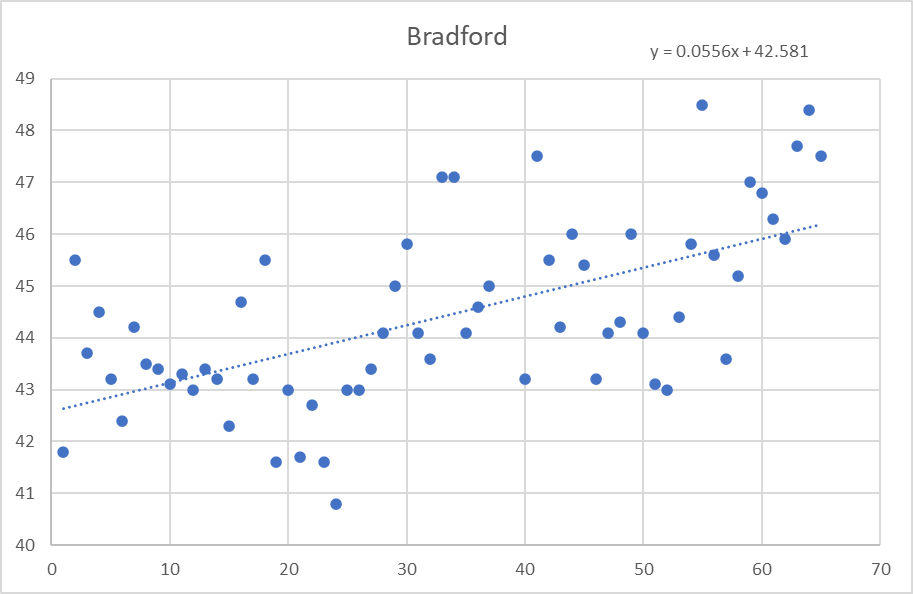
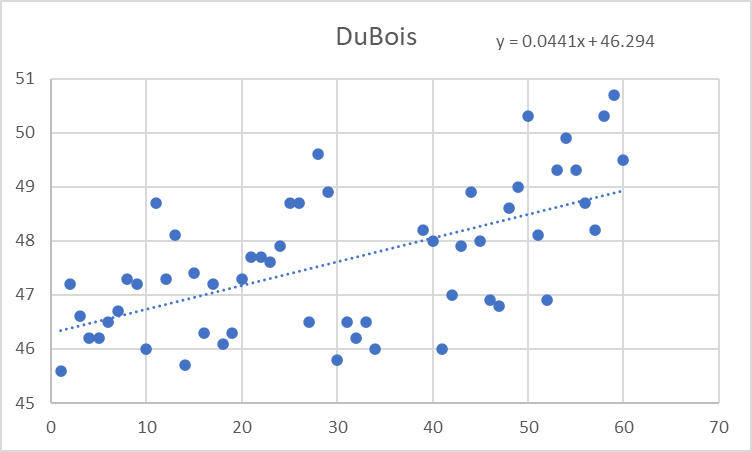
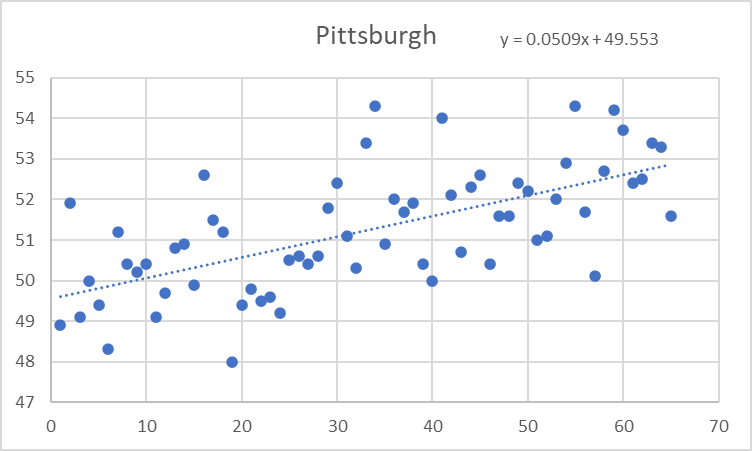
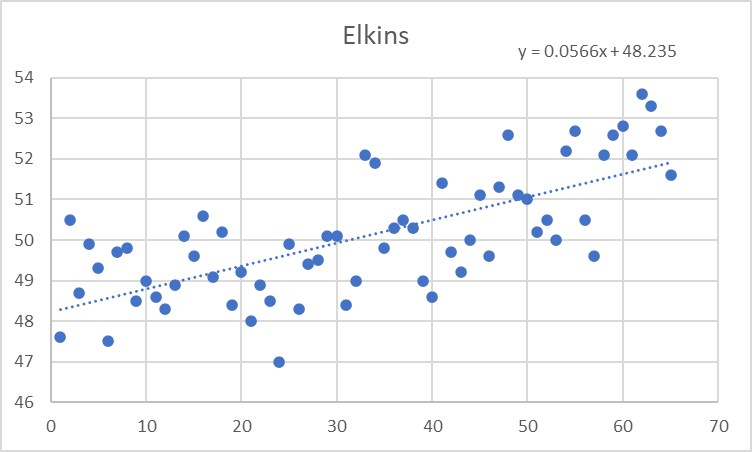
Yes, I took a look at this recently and couldn't find any evidence of an urban heat island effect when comparing Pittsburgh to a few small towns in the northern Appalachians and Allegheny Mountains. Probably most alarming is the warming is approaching 6F per century, but it's actually accelerating rapidly (evidenced by the fact that recent years are almost exclusively above what would be predicted by the linear trend line). Since 1958, Elkins, WV has warmed at 5.7F/century. The population of Elkins is 6,950, and Randolph County is 27,932 as of the 2020 census. Since 1958, Bradford, PA has warmed at 5.6F/century. The population of Bradford is 7,849, and McKean County is 40,432 as of the 2020 census. Since 1958, Pittsburgh, PA has warmed at 5.1F/century. The population of Pittsburgh is 302,971, and Allegheny County is 1,250,578 as of the 2020 census. Since 1963, DuBois, PA has warmed at 4.4F/century. The population of DuBois is 7,510, and Jefferson County is 44,492 as of the 2020 census. DuBois is located in Clearfield County [pop: 80,562], but the airport is in Jefferson County. I can't see an urban heat island effect in this data. These are pristine mountain towns surrounded by national and state forests and park lands - some of the most rural areas east of the Mississippi River. Much, much more rural than Chester County, PA [pop: 534,413], which is the 7th most populated county in the State of Pennsylvania. -
Don, I think what’s even more concerning than the fact it’s warming at a rate of 5-6F/century over the last 65 years at these locations is the fact that, looking at the data, it’s clear there’s an accelerating increase. If the linear trend line was actually explaining all of the trend, you’d expect data points to be distributed equally above and below it throughout the period covered by the trend line. Instead, in recent years, the vast majority of temperatures are exceeding what would be predicted by the linear trend. Looks like we may be warming at an instantaneous rate of 7 or 8 degrees per century now. But it would take a couple decades to confirm that.
-
Interesting, I decided to take a look at this phenomenon with an open mind and selected three remote, rural towns in the mountains mostly surrounded by state and national forest and parkland. And compared them to the records at nearby Pittsburgh. Can't find any evidence of an urban heat island amplifying the warming at Pittsburgh. If anything, as I surmised, the rural locations look to be warming slightly faster. Here is the comparison. All since 1958, except for DuBois [where records extend only to 1963]. Rounded to the nearest tenth of a degree, I found Bradford to be warming at 5.6F per century; Elkins warming at 5.7F per century; Pittsburgh warming at 5.1F per century; and DuBois warming at 4.4F per century.
-
Very impressive, Don. I noticed Bradford, PA reached 86F / 30C at over 2100 feet of elevation, setting a new monthly record (after tying the record of 85 yesterday which was set last year and twice in 1990). There are many years in Bradford where the thermometer has failed to reach 86F / 30C over the entire year. If that had mixed down to the surface, I think we would have been looking at widespread low to mid 90s in the lowlands, with maybe upper 90s in the urban corridor. As an aside, I feel it weird many people say urban heat island effect is responsible for all or part of the warming trend. To me, anyways, it feels like the remote forested mountain locations like Bradford, Pa. are warming faster than anywhere else in recent years. Just not seeing much evidence of an urbanization effect on the trend.
-
Central PA Spring 2023
TheClimateChanger replied to Itstrainingtime's topic in Upstate New York/Pennsylvania
Yeah, awful around here too. Never seen this in April. Must be the mild winter. Kind of related, but I was reading the Lakes & Midwest forum and someone from Minnesota was noting the start of tick season. I wish we had a no-tick season in this subtropical wasteland of a state. My dog was coming out of the woods just covered in those nasty things all winter long. -
Central PA Spring 2023
TheClimateChanger replied to Itstrainingtime's topic in Upstate New York/Pennsylvania
Bradford reached 86 degrees today, setting a new all-time April record high. There are many years where it doesn’t even reach 86 all summer long in Bradford. The airport is at 2106’, not far from the NY line. If we had mixed all the way to that layer, we would have been looking at widespread low to mid 90s today in the lowlands. -
Central PA Spring 2023
TheClimateChanger replied to Itstrainingtime's topic in Upstate New York/Pennsylvania
Bradford reached 85, tying the all-time record for the month of April, set previously on April 24, 2022, April 27, 1990, and April 28, 1990. -
Given there was essentially no change to the annual means from the site change, this is a particularly interesting analysis: Last year with annual mean below 44: 1917 [43.7F] Last year with annual mean below 45: 1926 [44.3F] Last year with annual mean below 46: 1943 [45.6F] Last year with annual mean below 47: 1996 [46.9F] Last year with annual mean below 48: 2014 [47.2F] I think it's safe to say it's impossible at this point for Buffalo to have an annual mean below 46F, and probably not too far off before we can say the same thing for 47F. Already been 27 years since the last sub-47F annual mean; however, it was only a couple of tenths warmer just 9 years ago. So I don't know if it can be completely ruled out.
-
Also, there was no change to the annual mean temperature [less than a 0.1F increase]. So the annual means are directly comparable between the sites with no adjustments needed. The airport has mean high temperatures about 2 degrees warmer than downtown, but mean low temperatures about 2 degrees cooler than downtown. Buffalo Airport Buffalo Downtown Difference 1939 56.1 54.4 1.7 1940 53.7 52.1 1.6 1941 57.4 54.8 2.6 1942 56.3 53.7 2.6 1943 54.8 52.8 2 Avg 55.66 53.56 2.1 Buffalo Airport Buffalo Downtown Difference 1939 38.5 41 -2.5 1940 36.7 39.1 -2.4 1941 39.2 41.8 -2.6 1942 39.5 41 -1.5 1943 37.7 38.7 -1 Avg 38.32 40.32 -2 Buffalo Airport Buffalo Downtown Difference 1939 47.3 47.7 -0.4 1940 45.2 45.6 -0.4 1941 48.3 48.3 0 1942 47.9 47.3 0.6 1943 46.3 45.7 0.6 Avg 47 46.92 0.08
-
Not much of a change over the six Marches with overlapping records at the two sites. The downtown site had a mean maximum of 36.7, versus 37.6 at the airport. Buffalo Downtown March 1939: 36.9 1940: 33.0 1941: 32.4 1942: 42.1 1943: 38.3 1944: 37.2 6-year average: 36.7 Buffalo Niagara International Airport March 1939: 38.0 [+1.1] 1940: 32.3 [-0.7] 1941: 34.5 [+2.1] 1942: 42.4 [+0.3] 1943: 39.8 [+1.5] 1944: 38.5 [+1.3] 6-year average: 37.6 [+0.9]
-
Central PA Spring 2023
TheClimateChanger replied to Itstrainingtime's topic in Upstate New York/Pennsylvania
That would be an average (arithmetic mean) high. Normal highs are smoothed or "normalized" throughout the calendar year to produce a continuous pattern of rising or falling temperatures. -
Well, even the temperatures observed by the U.S. Army Signal Corps back in the 1850s and 1860s seem crazy by today's standards. The average annual mean temperature was observed to be 46F at Buffalo, 47F at Detroit, 47F at Erie, 48F at Chicago, 50F at Pittsburgh, and 52F at Philadelphia. What was considered to be the mean temperature in that era would be top ten coldest on record since 1870s at Detroit and Erie, top twenty coldest at Chicago and Buffalo, and top five coldest at Philadelphia. Not as bad at Pittsburgh, but still a couple degrees cooler than the modern mean observed at Pittsburgh Airport [51.8F], which is at 1200' elevation; whereas the 50F mean determined by the Signal Corps was observed at Fort Pitt, which is identified as 704' in elevation [or a full 500' lower in elevation]. For context, the average lapse rate is something on the order of 3.5-5.4F/1000 feet, and the calculated difference between the city office and the airport was 2.6F during the period of overlap [1952-1979], which would imply the city mean would be 54.4F today - or in line with the changes at the other sites.
-
With a little help from Dall-E:
-
It's not cherry-picking. I used all of the 19th century data available for each site - generally between about 27 and 30 years [30 years being a full climatological period], and compared it to the data since the beginning of the last decade. I did check the numbers with data for 2000-2009, and incomplete data for 2023, and it only decreases a small amount. You are welcome to run the analysis yourself. Average high temperatures were selected to minimize effects of urban heating - which is much more pronounced in the overnight minima. Second, the first skyscraper wasn't even built until 1885. Most weather data was collected on low rise buildings in that era, no more than 100 feet or so above street level - typically even less. Anthony Watts, et al. has shown that rooftop temperatures have a massive warm bias compared to readings taken at ground level. See: https://wattsupwiththat.com/2008/01/23/how-not-to-measure-temperature-part-48-noaa-admits-to-error-with-baltimores-rooftop-ushcn-station/. Look at the data he presents for Baltimore Custom House (a rooftop site) compared to the ground-level readings at Baltimore Harbor. The rooftop site had 81 days of 90+ (including 13 days of 100+), while the ground site had only 38 (and none at or above 100). So, if anything, these early rooftop readings are likely WAY too high, not too low.
-
At some of these locations, typical 19th century March high temperatures are rarely if ever experienced. Since 1990, MKE has seen a March with an average high temperature below the 19th century mean only twice (2013, 36.0 & 2014, 36.7); DTW once (2014, 37.6); ORD, twice (2013, 39.6 & 1996, 40.2); DCA, once (1993, 49.9); NYC, none; and PHL, once (1993, 47.0). In other words, the coldest Marches of some of our lives would have been considered normal weather in the 19th century.
-
Decided to quantify the changes in early spring temperatures by comparing the average March high temperatures in the late 19th century to the most recent 13 years (2010-2022). I used average high temperatures to somewhat minimize the impacts of urban heat island effect. What we can see are absolutely prodigious changes. Large cities in the lower Great Lakes (Cleveland, Detroit, Chicago, Buffalo) experienced 19th century early spring temperatures which were generally cooler than Green Bay, Wisconsin in the most recent 13 years (41.6F). In the case of Buffalo, as well as cities like Minneapolis and Milwaukee, March high temperatures in the 19th century are about equal to (or in the case of MSP) cooler than recent average March high temperatures at places such as Duluth (37.1F) and International Falls (37.4F), and only a couple of degrees warmer than average March high temperatures at Caribou, Maine in the most recent 13 years (34.8F). March high temperatures in New York City during the late 19th century are cooler than recent readings in places such as Milwaukee, Minneapolis, Buffalo and Rochester, and only a couple degrees warmer than recent readings in Green Bay, Wisconsin. By comparison, recent March high temperatures in New York City are about a degree warmer than what was observed in Washington, D.C. in the 19th century. March highs in Pittsburgh, as well, are now 0.6F warmer than D.C. in the late 19th century. Washington, D.C. on the other hand is seeing March high temperatures today only a couple of degrees cooler than places such as Raleigh/Durham and Charlotte, North Carolina experienced in the 19th century. Philadelphia had cooler March highs in the 19th century than places such as Cleveland, Detroit and Chicago. Today, Philadelphia sees March high temperatures which exceed those measured in Washington, D.C. in the 19th century by several degrees. Generally, northern locations have warmed from 5-8F over that timeframe, while southern locations have warmed from 4-5.5F. These temperatures correspond to climate shifts of hundreds of miles. I think if you teleported someone in from the 19th century, they would be very confused by these changes - maybe even moreso than they would be of all the technological changes. Here is what I found: Milwaukee, Wisconsin 1871-1900: 37.1F 2010-2022: 44.1F (+7.0F) Detroit, Michigan 1874-1900: 39.7F 2010-2022: 47.4F (+7.7F) Chicago, Illinois 1873-1900: 40.9F 2010-2022: 47.6F (+6.7F) Cleveland, Ohio 1872-1900: 40.9F 2010-2022: 48.2F (+7.3F) Minneapolis, Minnesota 1873-1900: 36.7F 2010-2022: 43.3F (+6.6F) Buffalo, New York 1874-1900: 37.3F 2010-2022: 43.4F (+6.1F) Rochester, New York 1872-1900: 37.6F 2010-2022: 44.6F (+7.0F) Erie, Pennsylvania 1874-1900: 40.3F 2010-2022: 45.2F (+4.9F) Pittsburgh, Pennsylvania 1875-1900: 47.6F 2010-2022: 50.8F (+3.2F) Keep in mind at Pittsburgh, this is comparing downtown records (elevation: 780-800 feet) to airport records (elevation: 1200 feet), and about 15 miles northwest, which hides a lot of the warming trend. Washington, D.C. 1872-1900: 50.2F 2010-2022: 57.6F (+7.4F) New York, New York 1869-1900: 43.4F 2010-2022: 51.0F (+7.6F) Boston, Massachusetts 1872-1900: 42.0F 2010-2022: 46.9F (+4.9F) Philadelphia, Pennsylvania 1874-1900: 47.2F 2010-2022: 53.8F (+6.6F) Atlanta, Georgia 1879-1900: 61.1F 2010-2022: 66.5F (+5.4F) Memphis, Tennessee 1879-1900: 60.6F 2010-2022: 64.8F (+4.2F) Raleigh/Durham, North Carolina 1887-1900: 59.1F 2010-2022: 63.5F (+4.4F) Charlotte, North Carolina 1879-1900: 59.9F 2010-2022: 65.1F (+5.2F)
-
Another way to look at this is to compare locations today to places in the south in the past. Pittsburgh's average March high from 2010-2022 at 50.8F, is 0.6F warmer than Washington, D.C.'s average March high from 1872-1900 [50.2F]. By comparison, Washington, D.C.'s average March high in the most recent 13 years has been 57.6F.
-
Always interesting to do this exercise... looked at changes in March average high temperatures from 1871-1900, compared to the most recent complete 13 years (2010-2022) in the Great Lakes subforum. Decided to do the same to a few spots in our subforum. Buffalo, New York 1874-1900: 37.3F 2010-2022: 43.4F (+6.1F) Rochester, New York 1872-1900: 37.6F 2010-2022: 44.6F (+7.0F) Erie, Pennsylvania 1874-1900: 40.3F 2010-2022: 45.2F (+4.9F) Pittsburgh, Pennsylvania 1875-1900: 47.6F 2010-2022: 50.8F (+3.2F) Keep in mind at Pittsburgh, this is comparing downtown records (elevation: 780-800 feet) to airport records (elevation: 1200 feet), and about 15 miles northwest, which hides a lot of the warming trend. Based on the numbers, the March climate in Buffalo and Rochester during the late 19th century is about on par with recent (2010-2022) March weather in International Falls [37.4F mean] and Duluth, Minnesota [37.1F mean] and just about 2.5-3F warmer than Caribou, Maine [34.8F] - which is to say the 19th century March climate in Buffalo and Rochester is significantly closer to the modern March climate in Caribou, Maine than it is to the current climate at either location. I think this last point kind of serves to bring home the scope of the changes we are creating. Often times, this reality is lost in the focus on the numbers. But when you point to a concrete modern equivalent for those numbers, it really showcases how dramatically things have changed. Places like Duluth, International Falls and Caribou, Maine are thought of as unbelievably cold. Yet, many cities in in the lower Great Lakes saw comparable early spring temperatures to what those locations experience today.
-
Urban heat island effect can explain some of the local warming. But how can Urban Heat Island effect explain that Minneapolis had a colder average high in March from 1873-1900 [1900 population: 202,000] than International Falls [a town of 5800 on the Canadian border known as the "icebox of the nation] or Duluth, Minnesota [a city of 86,000 on the shores of Lake Superior]? Or that the average March high in Chicago [1900 population: 1.7M], Detroit [1900 population: 286,000], and Cleveland [1900 population: 382,000] in the same period is less than Green Bay's [pop: 107,000] high in the most recent 13 years?
-
The 19th century March high temperatures for these big cities, mostly in the southern Great Lakes, are comparable to modern averages at places like International Falls, Duluth, and Green Bay! How can the urban heat island effect cause that? This is an incredible shift, considering how cold we consider those locations today. Cleveland, Ohio 1872-1900: 40.9F Milwaukee, Wisconsin 1874-1900: 37.1F Detroit, Michigan 1874-1900: 39.7F Chicago, Illinois 1873-1900: 40.9F Minneapolis, Minnesota 1873-1900: 36.7F Modern Equivalents Green Bay, Wisconsin 2010-2022: 41.6F [warmer than Cleveland, Detroit and Chicago, and significantly warmer than Minneapolis and Milwaukee in the 19th century] Duluth, Minnesota 2010-2022: 37.1F [same as Milwaukee, warmer than Minneapolis, only a couple/few degrees cooler than lower Lakes] International Falls, Minnesota 2010-2022: 37.4F [warmer than 19th century Milwaukee and Minneapolis, a couple/few degrees cooler than lower Lakes]
-
Rockford only has sporadic 19th century data. I can offer Toledo, Ohio, as a somewhat smaller city. The airport is in a mostly rural part of Lucas County, southwest of the city. It does show the same general pattern with a bit less warming, with no change in January, nearly 6 degrees of warming in March, and between 3 and 4 degrees of warming in July & September. January 1874-1900: 33.4F 2010-2023: 33.4F (no change) March 1873-1900: 42.5F 2010-2022: 48.3F (+5.8F) July 1873-1900: 82.1F 2010-2022: 85.9F (+3.8F) September 1873-1900: 73.2F 2010-2022: 76.7F (+3.5F)
-
Well, this was a March thread. But here's what I got for those months. Generally March shows the most warming, which I assume is due to changes in snow and ice cover. July & September an intermediate level of warming, and January the least warming (although northern sites show more warming than southern sites). January Cleveland, Ohio 1871-1900: 33.5F 2010-2023: 35.4F (+1.9F) Milwaukee, Wisconsin 1874-1900: 27.1F 2010-2023: 30.7F (+3.6F) Detroit, Michigan 1874-1900: 31.1F 2010-2023: 32.9F (+1.8F) Chicago, Illinois 1873-1900: 31.1F 2010-2023: 31.6F (+0.5F) Minneapolis, Minnesota 1873-1900: 26.8F 2010-2023: 29.9F (+3.1F) July Cleveland, Ohio 1871-1900: 79.3F 2010-2023: 84.1F (+4.8F) Milwaukee, Wisconsin 1874-1900: 77.7F 2010-2022: 82.3F (+4.6F) Detroit, Michigan 1874-1900: 81.2F 2010-2022: 85.2F (+4.0F) Chicago, Illinois 1873-1900: 79.3F 2010-2022: 84.5F (+5.2F) Minneapolis, Minnesota 1873-1900: 82.8F 2010-2022: 84.9F (+2.1F) September Cleveland, Ohio 1871-1900: 72.2F 2010-2023: 76.1F (+3.9F) Milwaukee, Wisconsin 1874-1900: 69.8F 2010-2022: 73.5F (+3.7F) Detroit, Michigan 1874-1900: 72.0F 2010-2022: 75.5F (+3.5F) Chicago, Illinois 1873-1900: 71.5F 2010-2022: 76.0 (+4.5F) Minneapolis, Minnesota 1873-1900: 71.1F 2010-2022: 74.2F (+3.1F)
-
Mean March maxima for various cities in the Midwestern U.S. Using high temperatures here to minimize impacts of urban heat island effect. Any thoughts? Seems a lot more of an increase than I would have expected, considering the warming is said to be about 1C. Cleveland, Ohio 1872-1900: 40.9F 2010-2022: 48.2F (+7.3F) Milwaukee, Wisconsin 1874-1900: 37.1F 2010-2022: 44.1F (+7.0F) Detroit, Michigan 1874-1900: 39.7F 2010-2022: 47.4F (+7.7F) Chicago, Illinois 1873-1900: 40.9F 2010-2022: 47.6F (+6.7F) Minneapolis, Minnesota 1873-1900: 36.7F 2010-2022: 43.3F (+6.6F)
-
The Ohio Weather Review reported phenological data ever year for many years around 1900. In northern Ohio, at that time, the first leaf did not appear on soft maple trees until May 1 to May 10, with elm and birch occurring in mid to late May. Not sure about the latter two species, but I know the first leaf on soft maple species probably averages mid April now. Maybe late April to May 1 in a particularly cold spring. So on average, I'd say it's moved up 2-3 weeks in a little over 100 years. And in 2012, there were leaves in March in Toledo. A full six weeks earlier. I don't know how this can be disputed. Springtime temperatures have warmed nearly 5 degrees in Cleveland comparing the 1871-1900 mean [45.98F] to the 2010-2022 mean [50.62F], and more than 4 degrees at Detroit when comparing the 1874-1900 mean [45.50F] to the 2010-2022 mean [49.61F]. These are massive changes. The 1871-1900 (1874-1900 at DTW) means are comparable to the 2010-2022 means at Traverse City, MI [46.62F] and Green Bay, Wisconsin [44.80F], meaning a late 19th century spring in Cleveland and Detroit saw temperatures that are only slightly warmer than what is now a typical Green Bay spring, and about a degree cooler than modern springs in Traverse City, in northern Michigan. You may not like the data but that's what the data shows. You're welcome to perform your own analysis on the data. And this is all on topic - this is a banter thread, observations are about spring, and relevant to the Great Lakes/Ohio Valley weather discussion.
-
Pittsburgh/Western PA Spring 2023 Discussion
TheClimateChanger replied to Ahoff's topic in Upstate New York/Pennsylvania
Very heavy rain here. Lots of thunder and lightning. Water everywhere.