

TriPol
-
Posts
2,013 -
Joined
-
Last visited
Content Type
Profiles
Blogs
Forums
American Weather
Media Demo
Store
Gallery
Posts posted by TriPol
-
-
Valid 00Z Monday Sep. 28, 8 PM Sunday EDT, the GFS has the center down near the waters south of Long Island / east of New Jersey, while filling rapidly to 999 mb.
Compare the evolution:
F72: 993 mb, offshore
F84: 993 mb, moving west
F90: 995 mb, farther west
F96: 999 mb, farther west againSo this is no longer ambiguous model-map noise. The 00Z GFS explicitly depicts a cyclone that stalls offshore and then tracks back toward the coast while weakening.
And the precipitation character changes substantially by F96. The intense compact wraparound band from earlier has weakened considerably, but the circulation is still producing a huge area of rain from NJ/NY through New England. So by Sunday evening the modeled problem has transitioned from a compact, intense coastal cyclone toward a broad, weakening circulation still capable of producing prolonged rainfall.
What strikes me most is how much farther the GFS has come compared with the runs we were watching yesterday. The disagreement used to be something like:
GFS: northeast and gone.
European guidance: trapped, then west.Now the 00Z GFS itself is showing trapped, then west.
The exact center, rainfall amounts and timing can absolutely still change. But the synoptic mechanism of a trapped cyclone retrograding toward the Northeast has now survived another GFS cycle, and we're getting into the 3–4 day range.
-
Out to 72... the storm is stalled. Just completely stalled off of Long Island. About 150 miles SE. Lots of rain and wind for our areas.
-
Holy crap did the GFS absolutely CAVE to the EURO! This is more west than 18z!
-
 1
1
-
-
0z EURO out to 24... At F24, I do not see an obvious early Bermuda run. The low is still close enough to the Mid-Atlantic coastal zone that the later interaction with the block is very much alive. God if we got this in 3 months from now this forum would be going nuts.
-
1 minute ago, Rmine1 said:
Will the sun angle hold down accumulations?
That darn September sun angle!
-
Just now, wthrmn654 said:
Just another dumb piece to the puzzle I don't really feel like dealing with. Lol
Watch 0z GFS hit Bermuda.
-
It just stalls off the cape. And then, 8 pm Sunday it retrogrades West to Long Island! Just like the EURO had.
-
2 minutes ago, wthrmn654 said:
Hours 66 to 72 it doesn't move... down to 993 mb
This is enough of a shift west that I think either 0z or 12z will bow to the EURO. I'm not saying this thing gives us memories of Sandy and goes into NJ, but I think maybe Eastern Long Island will get the brunt of it. Will it retrograde? That depends on the placement of the high pressure up north and how strong it is.
-
GFS is west at hr 60
-
1 minute ago, wthrmn654 said:
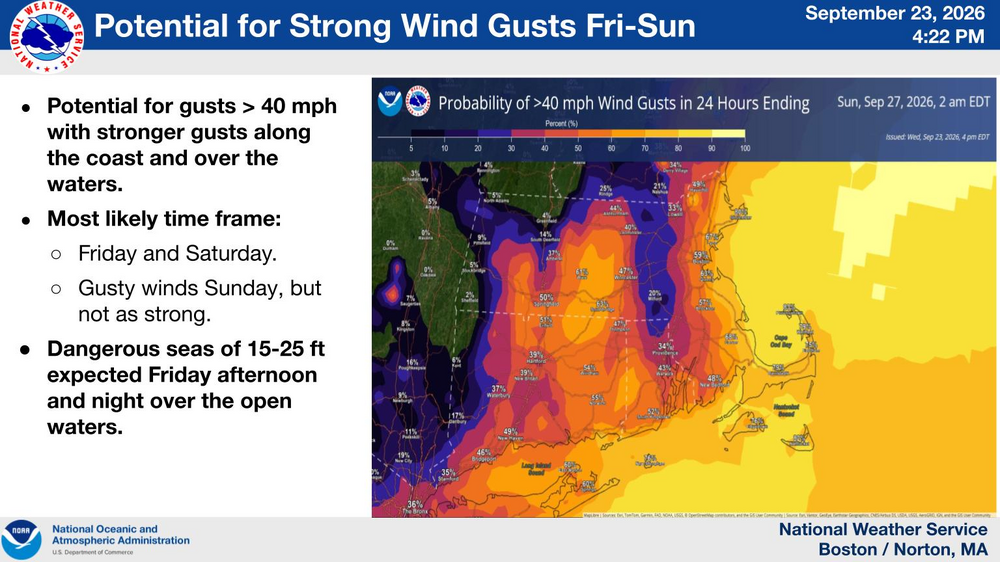
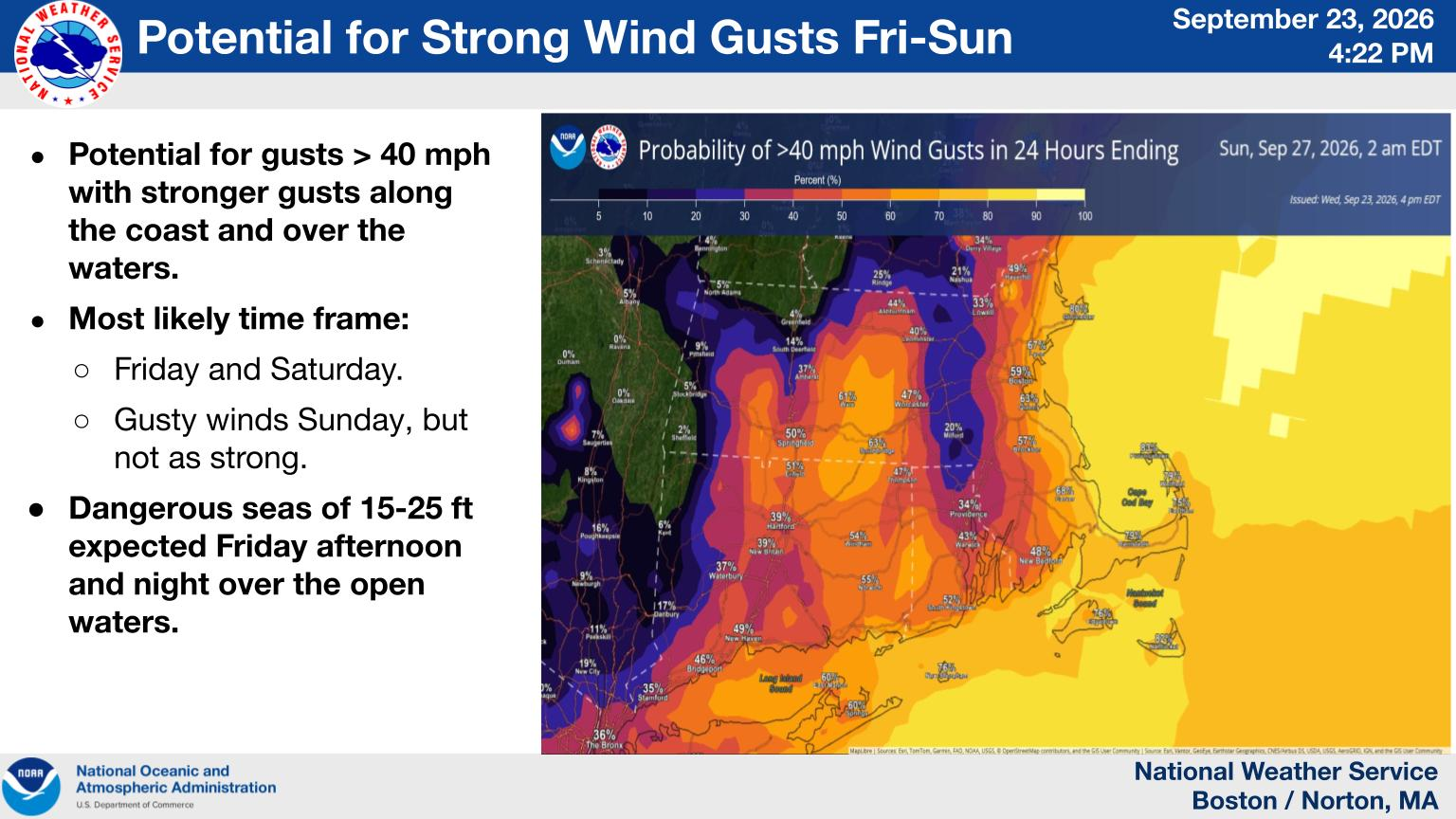
What blows my mind is how nws weather offices don't really seem to like to work either each other sometimes? Example, 430 pm Boston wind probability image shows eastern Long Island at 60%or better chance setting 40 or higher gusts. And places east.
But Upton says likely stay below even advisory level...

Upton had balls last winter. Maybe they misplaced them when El Nino came. They should find them again because I have faith the 18z GFS is going to cause them to hoist Gale Watches.
-
2 minutes ago, Snowlover11 said:
So expect anything from nothing to a major impact. Got it.

This is going to be a FUN winter.-
1
-
-
9 minutes ago, wthrmn654 said:
Icon looks about same maybe a little west
Rgem looks better even.
Nams are west.

We'll see if the 18z GFS bows to the EURO
-
Just now, wthrmn654 said:
They did good with sandy imo
Ok, a broken clock is right twice a day. The EURO is king. The EURO AI has performed better than most other models for over a year now.
-
Just now, LCPhotowerx said:
the Weather Channel seems to be going with the easterly solution...
The last time the Weather Channel was accurate was 1993 on the Storm of the Century.
-
6
-
 1
1
-
-
Just now, Brian5671 said:
Hard to say for the city proper. But we're having east/northeast winds right now which is piling up water so I would think moderate at least for LI/CT/NJ coasts
Also, the ground is pretty saturated from the prior rain storms we've had this summer/autumn. With high winds, I'd be concerned about a lot of trees falling.
-
1
-
-
12z EURO is the same track its been for a while. Slams it into Long Island and retrogrades west. The low weakens while it does this.
-
3
-
-
06z EURO looked pretty great for this area
-
The new 00Z EC-AIFS has become more aggressive with the cyclone.
At F78, 06Z Saturday Sep. 26, it's down to about 989 mb. Compare that with the 18Z AIFS at roughly the same point, which was around 997 to 988 mb depending on the exact six-hour frame. More importantly, look at the position: the 00Z AIFS still has the center much farther west than the 00Z GFS, sitting roughly east of the Delmarva/NJ corridor rather than racing harmlessly toward the open Atlantic.
And look at the structure. The isobars are extremely tightly packed on the western and northwestern side, right toward the Mid-Atlantic and southern New England. That's a very substantial pressure gradient between the cyclone and the 1026 mb high to the north.
The deepening sequence on this 00Z AIFS is also worth watching. We had approximately 999 mb at F54, and now 989 mb at F78. That's 10 mb in 24 hours, so this particular 24-hour interval is not bombogenesis. But the cyclone is already quite deep by Saturday morning, and what happens during the next 12 to 24 hours is the fascinating part.
-
1
-
-
Is there any way to increase the maximum file size of an upload? 52.47 kB isn't really a lot.
-
The 00Z GFS has shifted the developing low a bit farther east than the 18Z run, at least in these early frames.
On the 18Z GFS, by early Friday the center was tucked closer to roughly the 70°W corridor. On the new 00Z run, the F48 center is still farther offshore, around the upper-60s west longitude, so call it roughly 100 to 150 miles east of where the prior run was trying to organize the cyclone at a comparable stage.
That is not a huge jump, but it is definitely not another westward correction yet.
The important part is that the blocking high is still very strong, so an initially farther-east low does not necessarily mean the later retrograde will also be farther east. With this setup, the bigger question is still where the storm gets captured and starts bending back.
So, early read:
18Z: farther west early.
00Z: modest eastward shift early.
Block: still very much there.The F60-F84 frames will tell us whether that eastward difference survives or whether the 00Z run bends it back toward the 18Z/Euro idea.
-
1
-
-
1 minute ago, SnoSki14 said:
RGEM was coming in west too. Think gfs starts to cave.
I'd say its time to get bread and milk, but there isn't going to be any snow.
-
 1
1
-
-
57 minutes ago, MarcmmKU said:
Oh right I remember october 2022 was delightfully cool and crisp. No ugly 80s rearing their heads.
Warm October = Cold Winter
-
1 hour ago, NEG NAO said:
GFS/Canadian/Ukie Vs. Euro's - the HP location will have the final say IMO
Even with the strong NE flow today the warm water temps and breaks of sun allowed North Central NJ temps this afternoon to reach 70 expect the same right into the weekend - Upton not expecting much rain this weekend only 40% chance of showers according to PM update
We have the same argument every winter and the EURO usually more or less runs correct.
-
I have no idea what the 12z GFS is smoking, but it brings our nor'easter up the coast and slams it into Maine then has it at the same latitude as New Jersey.
-
2
-
Strong Nor'Easter/Hybrid Storm Late September 2026
in New York City Metro
Posted
If you don't care, why post? There are people who care. It'll fascinating watching the Titans at MetLife Stadium during a huge wind and rain storm on Sunday afternoon.