Brian D
-
Posts
3,330 -
Joined
-
Last visited
Content Type
Profiles
Blogs
Forums
American Weather
Media Demo
Store
Gallery
Everything posted by Brian D
-
Low-mid 40's here. 20's-30's for lows this morning. Seasonably cool. Rain coming in later tonight into tomorrow will be welcome.
-
MN HS Football playoffs start tomorrow with rain in the forecast. Should make for an interesting evening of games. THHS ended with a 6-2 record. They play a weak team to start the 1st round. Will see how far they get this year.
-
October 26 2010: The lowest pressure on record for Minnesota occurs in the town of Bigfork, with a reading of 28.21 inches of mercury (955.30 mb). Very strong winds were widespread throughout the state, with peak gusts of 65 mph recorded at both Georgeville (Stearns County) and Mehurin Township (Lac Qui Parle County). 1996: A severe weather outbreak combined with a blizzard occurred across the upper Midwest. Intense low pressure tracking into Minnesota produced blizzard conditions over portions of South Dakota, while further east in Minnesota, unseasonably mild temperatures developed. Temperatures climbed to near 70, with dew points in the 50s. 1 to 1 3/4 inch hail and strong winds were reported in Lac Qui Parle, Yellow Medicine, Chippewa, and Swift Counties. These storms produced 12 tornadoes; the strongest of which received F2 ratings. Southwest of Alexandria in Douglas County, an F2 tornado with a 9 mile track destroyed several homes. One woman sustained broken bones and internal injuries when a portion of her house, with her inside, was launched 200 feet onto the interstate. This tornado also pushed over a 500 pound fuel tank. Tornadoes also touched down in Swift, Kandiyohi, Pope, Stearns, and Isanti Counties. For Monday, October 26, 2026 1859 - New York City had their earliest substantial snow of record as four inches blanketed the city. (David Ludlum) 1919 - The temperature at Bismarck, ND, plunged to ten degrees below zero, the earliest subzero reading of record for the city, and a record for the month of October. (The Weather Channel) 1926 - Barrow, AK, received a record fifteen inches of snow, and also established a 24 hour precipitation record of 1.00 inch which lasted until the 21st of July in 1987. (The Weather Channel) 1962 - A storm brought five to six inches of snow to Vermont and New Hampshire, with up to ten inches reported in the mountains. (The Weather Channel) 1983 - A heat wave was in progress over the Northern Rockies, with record highs of 81 degrees at Sheridan WY and Billings MT.(Sandra and TI Richard Sanders - 1987) 1987 - Five cities in south central Texas reported record high temperatures for the date, including Corpus Christi and Del Rio with readings of 93 degrees. Laredo TX was the hot spot in the nation with a high of 98 degrees. Thunderstorms moving over the Lower Mississsippi Valley deluged Lake Charles LA with 2.70 inches of rain in one hour resulting in severe local flooding. (The National Weather Summary) (Storm Data) 1988 - Thunderstorms moving out of northern Texas spawned five tornadoes in Louisiana during the morning hours. The thunderstorms also produced wind gusts to 75 mph at Jennings LA, and the driver of a vehicle was killed by a falling tree near Coushatta LA. Snow squalls in the Lower Great Lakes Region produced heavy snow in western New York State, with 12 inches reported at Colden. (The National Weather Summary) (Storm Data) 1989 - Unseasonably warm weather continued in the north central U.S. Afternoon highs of 78 degrees at Alpena MI, 75 degrees at Duluth MN, 79 degrees at Fargo ND, 77 degrees at International Falls MN, 76 degrees at Marquette MI, 75 degrees at Sault Ste Marie MI, and 80 degrees at Saint Cloud MN, were all the warmest of record for so late in the season. Morning lows of 63 degrees at Concordia KS and Omaha NE were the warmest of record for the date. (The National Weather Summary) Observances: 26 Mon National Pumpkin Day 26 Mon National Day of the Deployed 26 Mon Accession Day 26 Mon National Chicken Fried Steak Day 26 Mon National Financial Crime Fighter Day 26 Mon National Microneedling Day 26 Mon National Mincemeat Day 26 Mon National Mule Day 26 Mon National Tennessee Day 26 Mon National Transgender Children Day 26 Mon Worldwide Howl at the Moon Night
-
October 25 1887: Albert Lea sets a record low of -6 degrees F. 1830: A 'heat wave' hits Ft. Snelling. The high temperature reached 80. For Sunday, October 25, 2026 1921 - A hurricane with 100 mph winds hit Tampa, FL, causing several million dollars damage. (David Ludlum) 1977 - Dutch Harbor in Alaska reported a barometric pressure reading of 27.31 inches (925 millibars) to establish an all-time record for the state. (The Weather Channel) 1981 - A northbound tornado caused two million dollars damage to Bountstown, FL, in less than five minutes. Fortunately no deaths occurred along its six mile path, which was 30 to 100 yards in width. Radar at Apalachicola had no indication of a tornado or severe weather. (The Weather Channel) 1987 - A storm system moving across the Saint Lawrence Valley produced 40 to 50 mph winds east of Lake Ontario. High winds downed some trees around Watertown NY, and produced waves seven feet high between Henderson Harbor and Alexandria Bay. Mason City IA and Waterloo IA tied for honors as cold spot in the nation with record lows for the date of 19 degrees. Severe thunderstorms in Oklahoma and northern Texas produced golf ball size hail and wind gusts to 65 mph. (The National Weather Summary) (Storm Data) 1988 - Severe thunderstorms erupted over northeastern Texas during the late evening producing softball size hail at Newcastle and Jonesboro. Low pressure over James Bay in Canada continued to produced showers and gale force winds in the Great Lakes Region. (The National Weather Summary) (Storm Data) 1989 - Low pressure over Nevada produced high winds in the southwestern U.S., and spread heavy snow into Utah. Winds gusted to 63 mph at the Mojave Airport in southern California. Snowfall totals in Utah ranged up to 12 inches at Snowbird, with 11 inches at Alta. "Indian Summer" type weather continued in the central and eastern U.S. Twenty cities in the north central U.S. reported record high temperatures for the date. Highs of 77 degrees at Alpena MI and 81 degrees at Saint Cloud MN were the warmest of record for so late in the season. (The National Weather Summary) (Storm Data) Observances: 25 Sun World Pasta Day 25 Sun National Art Day 25 Sun National I Care About You Day 25 Sun National Mother-in-Law Day 25 Sun International Artist Day 25 Sun International Dwarfism Awareness Day 25 Sun World Opera Day 25 Sun National Chucky Day 25 Sun National Fine Art Appreciation Day 25 Sun National Greasy Foods Day 25 Sun National Hope for Henry Day 25 Sun Punk For A Day Day 25 Sun Sourest Day
-
High around 70 (potential record) on a S wind. Beautiful late Oct day with rain in the picture
-
October 24 1922: A powerful low pressure system over Minnesota brings 55 mph winds to Collegeville. For Saturday, October 24, 2026 1785 - A four day rain swelled the Merrimack River in New Hampshire and Massachusetts to the greatest height of record causing extensive damage to bridges and mills. (David Ludlum) 1878 - A hurricane produced widespread damage across North Carolina, Virginia, Maryland, New Jersey and Pennsylvania. At Philadelphia PA, the hurricane was the worst of record. (David Ludlum) 1937 - A snow squall in Buffalo NY tied up traffic in six inches of slush. (David Ludlum) 1947 - The Bar Harbor holocaust occurred in Maine when forest fires consumed homes and a medical research institute. The fires claimed 17 lives, and caused thirty million dollars damage. (David Ludlum) 1951 - Sacramento, CA, reported a barometric pressure of 29.42 inches, to establish a record for October. (The Weather Channel) 1969 - Unseasonably cold air gripped the northeastern U.S. Lows of 10 degrees at Concord, NH, and 6 degrees at Albany NY established October records. (The Weather Channel) 1987 - Snow fell across northeast Minnesota and northwest Wisconsin overnight, with five inches reported at Poplar Lake MN and Gunflint Trail MN. Thunderstorm rains caused flash flooding in south central Arizona, with street flooding reported around Las Vegas NV. Strong northwesterly winds gusting to 50 mph downed some trees and power lines in western Pennsylvania and the northern panhandle of West Virginia. (The National Weather Summary) (Storm Data) 1988 - Strong winds circulating around a deep low pressure centered produced snow squalls in the Great Lakes Region, with six inches reported at Ironwood MI. Wind gusts to 80 mph were reported at State College PA. (The National Weather Summary) (Storm Data) 1989 - A storm in the western U.S. produced up to three feet of snow in the mountains around Lake Tahoe, with 21 inches reported at Donner Summit. Thunderstorms in northern California produced 3.36 inches of rain at Redding to establish a 24 hour record for October, and bring their rainfall total for the month to a record 5.11 inches. Chiefly "Indian Summer" type weather prevailed across the rest of the nation. Fifteen cities in the north central U.S. reported record high temperatures for the date as readings soared into the 70s and 80s. Record highs included 74 degrees at International Falls MN, and 86 degrees at Yankton SD. (The National Weather Summary) (Storm Data) 2005 - Hurricane Wilma reached the U.S. coastline near Everglades City in Florida with maximum sustained winds near 120 mph. The hurricane accelerated across south Florida and the Miami/Fort Lauderdale area, exiting the coast later the same day. There were 10 fatalities in Florida, and nearly 6 million people lost power, the most widespread power outage in Florida history. Preliminary estimates of insured losses in Florida were over $6 billion, while uninsured losses were over $12 billion. Observances: 24 Sat Stock Market Crash 24 Sat National Bologna Day 24 Sat National Make A Difference Day 24 Sat World Development Information Day 24 Sat United Nations Day 24 Sat World Polio day 24 Sat Disarmament Week 24 Sat My Best Winter Skin Day 24 Sat National Food Day 24 Sat National Jamaican Jerk Day 24 Sat National Senior UTI Awareness Day 24 Sat World Tripe Day
-
Been foggy here in town since yesterday aftrn. A little mist mixed in, as well. Temps steady between 45-50.
-
October 23 1899: An unseasonably warm day occurs in the Twin Cities, with a high of 82. For Friday, October 23, 2026 1761 - A hurricane struck southeastern New England. It was the most violent in thirty years. Thousands of trees blocked roads in Massachsuetts and Rhode Island. (David Ludlum) 1843 - "Indian Summer" was routed by cold and snow that brought sleighing from the Poconos to Vermont. A foot of snow blanketed Haverhill NH and Newberry VT, and 18 to 24 inches were reported in some of the higher elevations. Snow stayed on the ground until the next spring. (22nd-23rd) (Sandra and TI Richard Sanders - 1987) (The Weather Channel) 1987 - Thirteen cities in the southeastern U.S. reported record low temperatures for the date. It marked the sixth record low of the month for Greer SC and Columbia SC, and the ninth of the month for Montgomery AL. Showers and thunderstorms deluged Corpus Christi TX with five inches of rain. Winnemucca NV reported their first measurable rain in ninety-two days, while Yakima WA reported a record 96 days in a row without measurable rainfall. (Storm Data) (The National Weather Summary) 1988 - Denver, CO, reported their first freeze of the autumn, and Chicago, IL, reported their first snow. In Texas, afternoon highs of 93 degrees at Austin and San Antonio were records for the date. (The National Weather Summary) 1989 - A storm moving out of the Gulf of Alaska brought rain and high winds to the Central Pacific Coast Region. High winds in Nevada gusted to 67 mph at Reno, and thunderstorms around Redding CA produced wind gusts to 66 mph. Locally heavy rains in the San Francisco area caused numerous mudslides, adding insult to injury for earthquake victims. (The National Weather Summary) (Storm Data) Observances: 23 Fri National Paralegal Day 23 Fri National TV Talk Show Host 23 Fri Mole Day 23 Fri National Boston Cream Pie Day 23 Fri National Croc Day 23 Fri National iPod Day 23 Fri Swallows Depart from San Juan Capistrano Day 23 Fri T.V. Talk Show Host Day
-
October 22 1938: Sleet and wind cause damage along the Minnesota/Wisconsin border. 1913: Long Prairie receives a record low of 8 degrees F. For Thursday, October 22, 2026 1965 - The temperature soared to 104 degrees at San Diego, CA. Southern California was in the midst of a late October heat wave that year. Los Angeles had ten consecutive days with afternoon highs reaching 100 degrees. (David Ludlum) (The Weather Channel) 1985 - A guest on the top floor of a hotel in Seattle, WA, was seriously injured while talking on the phone when lightning struck. Several persons are killed each year when the electrical charge from a lightning bolt travels via telephone wiring. (The Weather Channel) 1987 - Yakutat, AK, surpassed their previous all-time yearly precipitation total of 190 inches. Monthly records were set in June with 17 inches, in September with 70 inches, and in October with more than 40 inches. (Sandra and TI Richard Sanders - 1987) Twenty-two cities in the eastern U.S., most of them in the southeast states, reported record low temperatures for the date. Morning lows of 30 degrees at Athens GA, 28 degrees at Birmingham AL, and 23 degrees at Pinson AL, were the coldest of record for so early in the season. (The National Weather Summary) Showers produced heavy rain in southern California, with amounts ranging up to five inches at Blue Jay. Flash flooding resulted in two deaths, ten injuries, and more than a million dollars damage. (The National Weather Summary) (Storm Data) 1988 - A "nor'easter" swept across the coast of New England. Winds gusted to 75 mph, and large waves and high tides caused extensive shoreline flooding. A heavy wet snow blanketed much of eastern New York State, with a foot of snow reported in Lewis County. (The National Weather Summary) (Storm Data) 1989 - A storm system moving out of the Gulf of Alaska brought rain to the Northern and Central Pacific Coast Region, with snow in some of the mountains of Oregon, and wind gusts to 60 mph along the Oregon coast. Six cities in Florida reported record low temp-eratures for the date, including Tallahassee with a reading of 34 degrees. (The National Weather Summary) (Storm Data) Observances: 22 Thu National Nut Day 22 Thu International Stuttering Awareness Day 22 Thu International Caps Lock Day 22 Thu National Color Day 22 Thu National Kristopher NaJee Roebuck Day 22 Thu National Make a Dog’s Day 22 Thu Scar Appreciation Day 22 Thu Smart is Cool Day
-
Congrats. May her pregnancy go well with a healthy kid in the end
-
October 21 1916: A three-day blizzard ends. Also, a sharp temperature drop occurs at Bird Island, falling from 65 to 13. For Wednesday, October 21, 2026 1934 - A severe windstorm lashed the northern Pacific coast. In Washington State, the storm claimed the lives of 22 persons, and caused 1.7 million dollars damage, mostly to timber. Winds, gusting to 87 mph at North Head WA, produced waves twenty feet high. (David Ludlum) 1957 - The second in a series of unusual October storms hit southern California causing widespread thunderstorms. Santa Maria was drenched with 1.13 inches of rain in two hours. Hail drifted to 18 inches in East Los Angeles. Waterspouts were sighted off Point Mugu and Oceanside. (20th-21st) (The Weather Channel) 1987 - Cold arctic air continued to invade the central U.S. Eleven record lows were reported in the Great Plains Region, including lows of 12 degrees at Valentine NE, and 9 degrees at Aberdeen SD. Temperatures warmed rapidly during the day in the Southern and Central Plains Region. Goodland KS warmed from a morning low of 24 degrees to an afternoon high of 75 degrees. (The National Weather Summary) 1988 - Joan, the last hurricane of the season, neared the coast of Nicaragua packing 125 mph winds. Joan claimed more than 200 lives as she moved over Central America, and total damage approached 1.5 billion dollars. Crossing more than 40 degrees of longitude, Hurricane Joan never strayed even one degree from the 12 degree north parallel. (The National Weather Summary) (Storm Data) 1989 - Unseasonably cold weather continued to grip the south central and southeastern U.S. Twenty cities reported record low temperatures for the date, including Calico AR with a reading of 26 degrees, and Daytona Beach FL with a low of 41 degrees. Squalls in the Great Lakes Region finally came to an end, but not before leaving Marquette MI buried under 12.7 inches of snow, a record 24 hour total for October. (The National Weather Summary) Observances: 21 Wed National Pets for Veterans Day 21 Wed Back to the Future Day 21 Wed Global Dignity Day 21 Wed National Apple Day 21 Wed National Reptile Day 21 Wed National Medical Assistants Day 21 Wed American Frog Day 21 Wed Celebration of the Mind Day 21 Wed Count Your Buttons Day 21 Wed Everyone Writes Day 21 Wed National Archives Day 21 Wed National Check Your Meds Day 21 Wed National Pumpkin Cheesecake Day 21 Wed Reptile Awareness Day 21 Wed Global Iodine Deficiency Disorders Prevention Day 21 Wed Get to Know Your Customers Day
-
October 20 2002: Heavy snow impacts central Minnesota. It fell in a 10-20 mile wide band from southeast North Dakota to around Grantsburg, Wisconsin. Little Falls picked up 9 inches. 1916: Accumulating snow falls in south central Minnesota with 4.5 inches recorded in New Ulm, 4 inches in Farmington and Hutchinson, 3.5 inches in Montevideo, and 3 inches in Faribault. 1835: 6 inches of snow falls at Ft. Snelling. For Tuesday, October 20, 2026 1770 - An exceedingly great storm struck eastern New England causing extensive coastal damage from Massachusetts to Maine, and the highest tide in 47 years. (David Ludlum) 1983 - Remnants of Pacific Hurricane Tico caused extensive flooding in central and south central Oklahoma. Oklahoma City set daily rainfall records with 1.45 inch on the 19th, and 6.28 inches on the 20th. (17th-21st) (The Weather Channel) 1987 - Cold arctic air invaded the Upper Midwest, and squalls in the Lake Superior snowbelt produced heavy snow in eastern Ashland County and northern Iron County of Wisconsin. Totals ranged up to 18 inches at Mellen. In the western U.S., the record high of 69 degrees at Seattle WA was their twenty-fifth of the year, their highest number of record highs for any given year. Bakersfield CA reported a record 146 days in a row with daily highs 80 degrees or above. (The National Weather Summary) (Storm Data) 1988 - Unseasonably warm weather continued in the western U.S. In California, afternoon highs of 96 degrees at Redding and Red Bluff were records for the date. (The National Weather Summary) 1989 - Forty-nine cities reported record low temperatures for the date as readings dipped into the 20s and 30s across much of the south central and southeastern U.S. Lows of 32 degrees at Lake Charles LA and 42 degrees at Lakeland FL were records for October, and Little Rock AR reported their earliest freeze of record. Snow blanketed the higher elevations of Georgia and the Carolinas. Melbourne FL dipped to 47 degrees shortly before midnight to surpass the record low established that morning. Showers and thunderstorms brought heavy rain to parts of the northeastern U.S. Autumn leaves on the ground clogged drains and ditches causing flooding. Up to 4.10 inches of rain soaked southern Vermont in three days. Flood waters washed 600 feet of railroad track, resulting in a train derailment. (The National Weather Summary)(Storm Data) Observances: 20 Tue National Youth Confidence Day 20 Tue World Statistics Day 20 Tue International Day of the Air Traffic Controller 20 Tue International Chefs Day 20 Tue International Sloth Day 20 Tue National Day on Writing 20 Tue National Pharmacy Technician Day 20 Tue World Osteoporosis Day 20 Tue Vijaya Dashami 20 Tue Miss American Rose Day 20 Tue National Brandied Fruit Day 20 Tue Talent Transformation Day 20 Tue World CRISPR Day 20 Tue Information Overload Day
-
Highs near 60 with a chilly start to the day with lows in the 20's inland to 30's along the shoreline this morning. Really need more rain, but that's looking meager for the rest of the month.
-
October 19 2000: The warmest October 19th in Minnesota history occurs for many towns. Many cities had highs in the 80s, with the Twin Cities hitting 84. Appleton in Swift County reported 90 degrees. 1972: A cold snap moves through Minnesota, with lows of 1 above in Tower and 9 in St. Peter and Luverne. 1916: Redwood Falls receives a record-setting 7 inches of snow. For Monday, October 19, 2026 1844 - The famous "Lower Great Lakes Storm" occurred. Southwesterly winds were at hurricane force for five hours, driving lake waters into downtown Buffalo NY. The storm drowned 200 persons. (David Ludlum) 1961 - Rain changed to a record early season, heavy wet snow over the southern mountains of West Virginia. Leaves were still on trees, resulting in the worst forest disaster since the fires of 1952 and 1953. One to two feet of snow fell near Summersville and Richwood. (19th-20th) (The Weather Channel) 1984 - Thunderstorms deluged the town of Odem, TX (located 15 miles northwest of Corpus Christi) with 25 inches of rain in just three and a half hours. Most businesses in Odem were flooded, as were 1000 homes in nearby Sinton. (The Weather Channel) 1987 - A cold front brought rainshowers to parts of the central U.S., and ushered cool Canadian air into the Great Plains Region. Daytime highs were only in the 30s in North Dakota and eastern Montana. (The National Weather Summary) 1988 - Thunderstorms produced high winds in eastern Colorado, with gusts to 63 mph reported at La Junta. (Storm Data) (The National Weather Summary) 1989 - Record breaking snows fell across northern and central Indiana. Totals ranged up to 10.5 inches at Kokomo, and 9.3 inches was reported at Indianapolis. The 8.8 inch total at South Bend was a record for the month as a whole. Up to seven inches of snow fell in extreme southern Lower Michigan, and up to six inches fell in southwestern Ohio. The heavy wet snow downed many trees and power lines. Half the city of Cincinnati OH was without electricity during the morning hours. Temperatures dipped below freezing across much of the Great Plains Region. Twenty cities, including fourteen in Texas, reported record low temperatures for the date. North Platte NE reported a record low of 11 degrees. In Florida, four cities reported record high temperatures for the date. The record high of 92 degrees at Miami also marked a record fourteen days of 90 degree weather in October, and 116 such days for the year. Observances: 19 Mon National Kiss Your Crush Day 19 Mon National New Friends Day 19 Mon National Clean Your Virtual Desktop Day 19 Mon Evaluate Your Life Day 19 Mon LGBT Center Awareness Day 19 Mon National Kentucky Day 19 Mon National Seafood Bisque Day 19 Mon World Humanitarian Action Day 19 Mon World Pediatric Bone and Joint Day
-
Go NFC North! And Go Brewers starting Friday
-
Beautiful, but dry wx. Highs in the low-mid 60's the last couple days. Lows in the 40's.
-
October 18 1950: Record high temperatures are set across the area as highs reached the mid to upper 80s. Minneapolis and Farmington saw highs of 87 degrees Fahrenheit, while Albert Lea reached 86 degrees. 1916: A blizzard impacts Minnesota. A sharp temperature drop begins as well; Hallock drops from the 60s to 2 above by the 20th. For Sunday, October 18, 2026 1906 - A hurricane struck South Florida drowning 124 persons stranded in the Florida Keys. (David Ludlum) 1910 - Northeasterly winds as high as 70 mph (from a hurricane moving northward up the Florida peninsula) carried water out of Tampa Bay and the Hillsboro River. The water level lowered to nine feet below mean low water. Forty ships were grounded. (The Weather Channel) 1930 - A big early season lake effect snowburst on the lee shores of Lake Erie and Lake Ontario produced 47 inches at Governeur NY and 48 inches just south of Buffalo. (David Ludlum) 1987 - Thunderstorms in northeastern Texas produced golf ball size hail at Atlanta, along with wind gusts to 86 mph, and four inches of rain. Damage from the storm was estimated at more than a million dollars. Sunny and mild weather continued across much of the rest of the nation. (The National Weather Summary) (Storm Data) 1988 - Eight cities in the southwestern U.S. reported record high temperatures for the date, including Red Bluff CA with a reading of 96 degrees. (The National Weather Summary) 1989 - Unseasonably cold air began to invade the central and eastern U.S. Light snow fell across northern Maine, and snow was also reported in the Great Lakes Region, including the Chicago area. Bismarck ND was the cold spot in the nation with a low of 9 degrees above zero. Five cities in Florida reported record high readings for the date, as temperatures warmed above 80 degrees. Miami FL reported a record high of 90 degrees. (The National Weather Summary) 2005 - With the formation of Hurricane Wilma, the 2005 Atlantic hurricane season tied the record for the most named storms for any season (21 storms in 1933), and also tied the record for the most hurricanes in a single season (12 in 1969). Wilma peaked at category-5 intensity on the 19th, with a minimum central pressure falling to 882 millibars (26.05 inches of mercury), the lowest pressure ever recorded in the Atlantic Basin. Wilma also became the most rapidly-intensifying storm on record, with a maximum-sustained surface wind speed increase of 105 mph in a 24-hour period. Observances: 18 Sun National Chocolate Cupcake Day 18 Sun Alaska Day 18 Sun National No Beard Day 18 Sun World Okapi Day 18 Sun National Alaska Day 18 Sun National Mashed Potato Day 18 Sun National Prayer Day 18 Sun National Speak Up for Victims of Sexual Abuse Day 18 Sun National Sunday Day 18 Sun Ride To Work Day 18 Sun World Menopause Day
-
October 17 1971: Heavy rain falls in NW Minnesota. 4.02 inches is recorded at Georgetown (20 miles N of Moorhead). 1952: Record lows between 10 to 15 degrees are reported across central Minnesota, including a low of 10 at St. Cloud, 12 at Glenwood, and 14 at Alexandria, Litchfield, and Mora. For Saturday, October 17, 2026 1781 - General Cornwallis attempted to escape encirclement by crossing York River, "but a violent storm arose" dispersing his boats causing him to ask for an armistice. (Sandra and TI Richard Sanders - 1987) 1910 - A hurricane made a loop off the southwest coast of Florida. Winds above 100 mph were reported at Fort Myers FL, and the barometric pressure at Sand Key reached 28.40 inches. (David Ludlum) 1950 - Small but powerful Hurricane King struck Miami, FL. The hurricane packs winded to 122 mph, with gusts to 150 mph. Hurricane King then moved up the Florida peninsula to Georgia. Four persons were killed and damage was 28 million dollars. (David Ludlum) (The Weather Channel) 1971 - Great balls of fire were observed just ahead of a tornado moving down the main street of Wray CO. However, little other electrical activity accompanied the storm. Nine persons were injured in the tornado, all at a trailer court at the edge of town. (The Weather Channel) 1984 - A snowstorm struck northern Utah producing a record 18 inches in 24 hours at Salt Lake City, and 40 inches at the nearby Alta Ski Resort. The town of Magna, located ten miles west of Salt Lake City, did not receive any snow at all. The storm was responsible for a fifty vehicle pile-up along Interstate 15 near Farmington UT. (Storm Data) 1987 - It was a great day for an Oktoberfest, or to enjoy the colors of autumn, as much of the nation enjoyed sunny and mild weather. Columbia SC dipped to 34 degrees, marking their third morning in a row of record cold. Bakersfield CA reached 80 degrees for the 143rd day in a row to break a record established in 1940. (The National Weather Summary) 1988 - Thunderstorms produced severe weather in the Middle Mississippi Valley and the Lower Ohio Valley. Severe thunderstorms spawned three tornadoes in Indiana, including one which injured four persons. Strong thunderstorm winds at Connerville IND caused three million dollars damage. Thunderstorms in Illinois produced hail two inches in diameter Colfax. (The National Weather Summary) (Storm Data) 1989 - Showers and thunderstorms representing the remnants of Hurricane Jerry deluged southeast Kentucky with four to six inches of rain in 18 to 24 hours, resulting in widespread flash flooding. Flooding resulted in more than five million dollars damage. Temperatures again warmed into the 80s and lower 90s in the southeastern U.S. Lakeland FL and Orlando FL reported record highs of 95 degrees. (The National Weather Summary) (Storm Data) Observances: 17 Sat National Pasta Day 17 Sat Sweetest Day 17 Sat International Day for the Eradication of Poverty 17 Sat National Fetch Day 17 Sat National Pay Back a Friend Day 17 Sat Black Poetry Day 17 Sat World Trauma Day 17 Sat International Archaeology Day 17 Sat Child Poverty Day 17 Sat National Catholic Men’s Conference Day 17 Sat National Edge Day 17 Sat National Mulligan Day 17 Sat Wear Something Gaudy Day 17 Sat Women in Military Service for America Memorial Anniversary
-
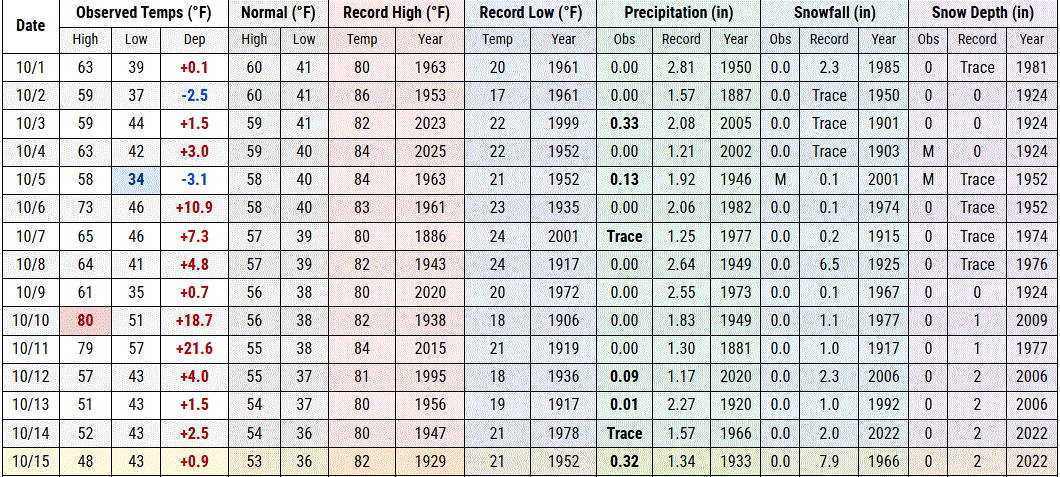
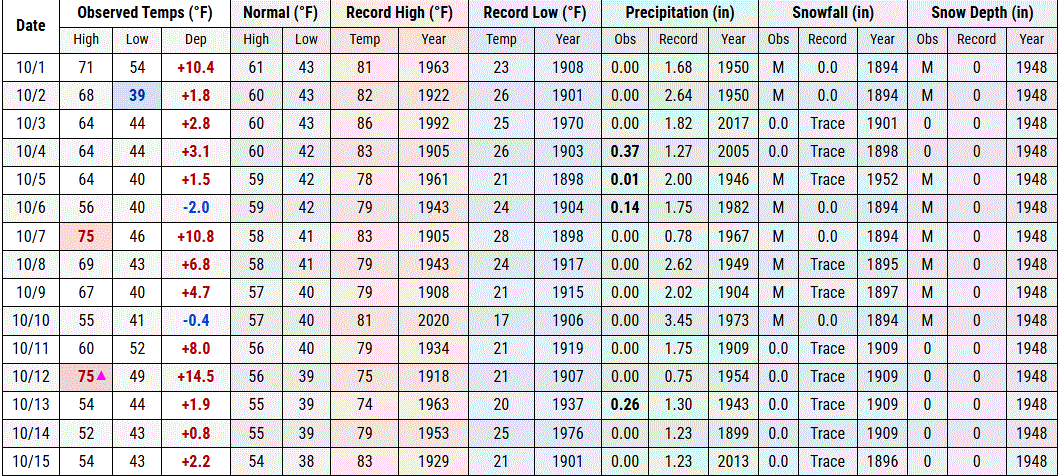
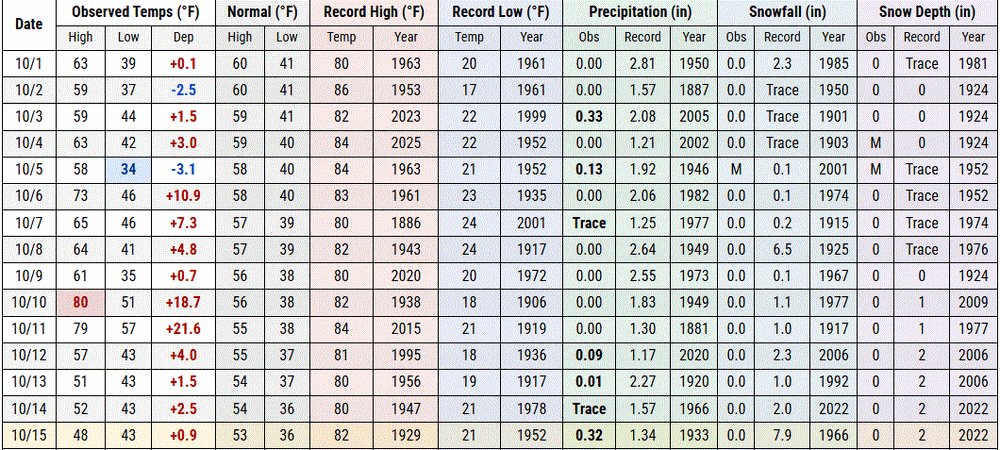
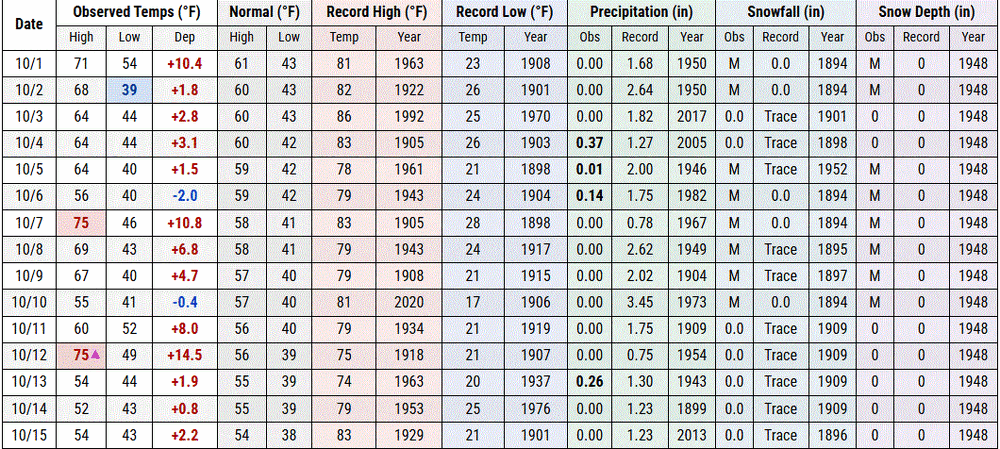
0.43" of rain yesterday. Chilly N wind today. 1st half of Oct round up at DLH & TH. DLH TH
-
October 16 1996: Early evening storms produce 3/4 to 1 3/4 inch hail in Nicollet, Dakota, Brown, Watonwan, and Martin Counties. In Scott County near St. Patrick, hail fell intermittently for an hour and the area received 3 1/2 inches of rainfall. In Watonwan County, wind gusts up to 63 mph moved several garages off their foundations, destroyed a cattle shed and a corn crib, and uprooted and toppled trees. Southwest of Lake Crystal in Blue Earth County, a garage was blown over onto a vehicle. A 250 gallon fuel tank was also blown over. 1937: A snowstorm dumps 10 inches at Bird Island. 1880: An early blizzard occurs in Minnesota. The blizzard struck western Minnesota and the eastern Dakotas especially hard. Over a foot of snow fell in western counties. Railroads were blocked, and damage was done to Great Lakes shipping. For Friday, October 16, 2026 1913 - The temperature in Downtown San Francisco soared to 101 degrees to equal their record for October. (The Weather Channel) 1937 - An unlikely winter-like storm produced as much as ten inches of snow in Minnesota and Iowa. 1987 - Ten cities in the southeastern U.S. reported record low temperatures for the date. The low of 34 degrees at Augusta GA marked their third straight morning of record cold. A cold front brought showers and thunderstorms to parts of the central U.S. Lightning struck a bull and six cows under a tree near Battiest OK. (The National Weather Summary) 1988 - Late afternoon thunderstorms produced severe weather in southwestern Lower Michigan and northern Indiana. One thunderstorm spawned a tornado north of Nappanee IN which caused half a million dollars damage. Six cities in California reported record high temperatures for the date. The afternoon high of 100 degrees at Red Bluff CA was the latest such reading of record for so late in the autumn season. (The National Weather Summary) (Storm Data) 1989 - Heavy snow blanketed the foothills of Colorado. Up to three inches was reported around Denver. Echo Lake was buried under nineteen inches of snow. Temperatures again warmed into the 80s and lower 90s in the eastern and south central U.S. Thirteen cities reported record high temperatures for the date, including Atlantic City NJ with a reading of 84 degrees. (Storm Data) (The National Weather Summary) Observances: 16 Fri World Food Day 16 Fri National Sports Day 16 Fri Boss's Day 16 Fri Dictionary Day 16 Fri Global Cat Day 16 Fri National Mammography Day 16 Fri Department Store Day 16 Fri World Spine Day 16 Fri National Boss's Day 16 Fri National Department Store Day 16 Fri National Feral Cat Day 16 Fri National Liqueur Day 16 Fri World Allergy Awareness Day
-
High around 50 with rain today. Bring it, we need it.
-
October 15 1968: Unseasonably warm weather moves into central and southern Minnesota. The high was 85 in the Twin Cities. 1899: Heavy rain falls, with 3.2 inches in the St. Cloud area and 2.1 inches in Willmar. For Thursday, October 15, 2026 1880 - A violent early season blizzard raked Minnesota and the Dakotas. Winds gusted to 70 mph at Yankton SD, and snow drifts 10 to 15 feet high were reported in northwest Iowa and southeast South Dakota. Saint Paul MN reported a barometric pressure of 28.65 inches on the 16th. Railroads were blocked by drifts of snow which remained throughout the severe winter to follow. Gales did extensive damage to ship on the Great Lakes. (15th-16th) (David Ludlum) (The Weather Channel) 1954 - Hurricane Hazel struck the Carolina coastline. The hurricane demolished every pier along a 170 mile stretch from Myrtle Beach SC to Cedar Island NC, and obliterated entire lines of beach homes. Hurricane Hazel also destroyed 1500 homes as it moved inland with seventeen foot tides. Winds between Myrtle Beach SC and Cape Fear NC gusted to 150 mph. Hurricane Hazel caused 163 million dollars damage, and claimed the lives of 98 persons. (David Ludlum) (The Weather Channel) 1966 - Iowa experienced its worst late season tornado of record. In just one minute a twister tore through the town of Belmond leveling 75 percent of the businesses, and 100 homes, causing more than eleven million dollars damage. (The Weather Channel) 1987 - Unseasonably cold weather continued in the eastern U.S., with thirteen cities reporting record low temperatures for the date. The low of 34 degrees at Montgomery AL was their coldest reading of record for so early in the season. Lows of 32 degrees at Harrisburg PA and 34 degrees at Parkersburg WV marked their third straight morning of record cold. (The National Weather Summary) 1988 - The cold high pressure system responsible for the record low temperatures in the eastern U.S. began to move out to sea, giving way to a trend toward "Indian Summer". Thunderstorms developing ahead of a cold front produced golf ball size hail at Altamont KS and hail two inches in diameter at Yates City IL. (Storm Data) (The National Weather Summary) 1989 - Hurricane Jerry made landfall at Galveston, TX, at 6 30 PM (CDT). Winds at the Galveston Airport reached 75 mph, with gusts to 100 mph. Tides along the island were six to eight feet, and rainfall totals ranged up to slightly more than six inches north of Beaumont. Three persons were killed when their vehicle was blown off the Galveston seawall into the pounding surf. Total damage along the Upper Texas Coast was estimated at fifteen million dollars. Thunderstorms produced severe weather in Lower Michigan during the late morning. Two persons were injured when a tree fell on their camper at the Traverse City State park. While strong northerly winds ushered much colder air into the central U.S., unseasonably warm weather continued in the south central and eastern U.S. The afternoon high of 82 degrees at Bluefield WV was a record for October. (The National Weather Summary) (Storm Data) Observances: 15 Thu White Cane Safety Day 15 Thu National Grouch Day 15 Thu Global Handwashing Day 15 Thu National Mushroom Day 15 Thu International Day of Rural Women 15 Thu National Cheese Curd Day 15 Thu National Expense Report Day 15 Thu National Esthetician Day 15 Thu National Latino AIDS Awareness Day 15 Thu National Lemon Bar Day 15 Thu Pregnancy and Infant Loss Remembrance Day 15 Thu World Students’ Day 15 Thu HSA Day 15 Thu I Love Lucy Day
-
October 14 1966: An enormous hailstone crashes through the windshield of a truck near Claremont in Dodge County. It was reported to be 16 inches in circumference. For Wednesday, October 14, 2026 1957 - Floodwaters roared through a migrant labor camp near the town of Picacho AZ flooding fifty cabins and a dozen nearby homes. 250 migrant workers lost their shelters. The month was one of the wettest Octobers in Arizona weather history. (The Weather Channel) 1965 - Heavy rains hit the coastal areas of southeastern Florida. In a 24 hour period rains of twenty inches were reported from Deerfield Beach to Fort Lauderdale, with 25.28 inches on the Fort Lauderdale Bahia-Mar Yacht Basin. Flooding that resulted caused considerable damage to roads and streets. The rains inundated numerous newly planted vegetable fields, and some residences. Ten miles away just 4.51 inches of rain was reported. (14th- 15th) (David Ludlum) (The Weather Channel) 1981 - Four days of heavy rain across northern Texas and southern Oklahoma came to an end. The heaviest rains fell in a band from southwest of Abilene TX to McAlester OK, with up to 26 inches reported north of Gainesville, in north central Texas. The heavy rains were the result of decaying Hurricane Norma, which also spawned thirteen tornadoes across the region. Seven deaths were attributed to the flooding. (Storm Data) 1984 - Dense fog contributed to a 118 vehicle accident on I-94, just south of Milwaukee WI. It was the seventh day of an eight day stretch of dense fog. At the time of the accident the visibility was reportedly close to zero. (Storm Data) 1987 - Sixteen cities, mostly in the Appalachain Region, reported record low temperatures for the date. Record lows included 43 degrees at Lake Charles LA, 35 degrees at Augusta GA, and 27 degrees at Asheville NC. Gale force winds buffeted the Carolina coast. Light snow fell across parts of Wyoming, Colorado, and western South Dakota. (The National Weather Summary) 1988 - Forty cities in the eastern U.S. reported record low temperatures for the date. Elkins WV was the cold spot in the nation with a record low of 18 degrees above zero. Thunderstorms in Arizona drenched Phoenix with nine inches of rain in nine hours, the fifth highest total for any given day in ninety-two years of records. Carefree AZ was soaked with two inches of rain. (The National Weather Summary) 1989 - Thunderstorms produced severe weather over Michigan during the morning, and over New York State and Connecticut during the afternoon and evening hours. Thunderstorms spawned two tornadoes, and there were ninety reports of large hail or damaging winds, including seventy reports of damaging winds in New York State. A tornado at McDonough NY killed one person and injured three other people. Strong thunderstorm winds gusted to 105 mph at Somerset. Temperatures warmed into the 80s and lower 90s over much of the nation east of the Rockies, with eleven cities reporting record high temperatures for the date. Afternoon highs of 81 degrees at Beckley WV and Bluefield WV equalled October records. (Storm Data) (The National Weather Summary) Observances: 14 Wed National Dessert Day 14 Wed National Emergency Nurses Day 14 Wed National Stop Bullying Day 14 Wed National Fossil Day 14 Wed World Standards Day 14 Wed Be Bald and Be Free Day 14 Wed National I Love You Day
-
Made into the low 50's today with 0.26" of rain yesterday in the mid 50's. Cloudy all day, but looks to be breaking up, so any clearing will allow for some colder temps tomorrow am. Seasonable wx for mid Oct.
-
October 13 1917: Record low temperatures occur across central Minnesota with temperatures ranging from the low to mid teens to the upper teens and lower 20s. St. Cloud records the coldest temperature of 10 degrees, while Mora records a low of 13. 1880: An early blizzard strikes parts of southwest and west central Minnesota. Huge drifts exceeding 20 ft in the Canby area would last until the following spring. 1820: A snowstorm at Ft. Snelling dumps 11 inches. For Tuesday, October 13, 2026 1846 - A great hurricane tracked across Cuba, Florida, Georgia, the Carolinas, Virginia and Pennsylvania. The hurricane inflicted major damage along its entire path, which was similar to the path of Hurricane Hazel 108 years later. The hurricane caused great damage at Key West FL, and at Philadelphia PA it was the most destructive storm in thirty years. (David Ludlum) (The Weather Channel) 1986 - Four tornadoes struck southeastern Virginia late in the night causing three million dollars damage. Tornadoes at Falls Church VA caused a million dollars damage. (Sandra and TI Richard Sanders) 1987 - Fifteen cities in the eastern U.S. reported record low temperatures for the date. Record lows included 34 degrees at Meridian MS, 28 degrees at Paducah KY, and 26 degrees at Beckley WV. Another surge of arctic air entered the north central U.S. bringing snow to parts of Wyoming and Colorado. (The National Weather Summary) 1988 - A total of forty-three cities in the eastern U.S. and the Upper Midwest reported record low temperatures for the date, including Elkins WV and Marquette MI where the mercury dipped to 18 degrees. (The National Weather Summary) 1989 - Sixteen cities reported record high temperatures for the date as readings warmed into the 80s and low 90s from the Southern and Central Plains to the Southern and Middle Atlantic Coast. Evansville IND and North Platte NE reported record highs of 91 degrees. (The National Weather Summary) Observances: 13 Tue National Train Your Brain Day 13 Tue Ada Lovelace Day 13 Tue Navy Birthday 13 Tue National No Bra Day 13 Tue International Day for Disaster Risk Reduction 13 Tue World Thrombosis Day 13 Tue Breast Cancer Awareness Day 13 Tue Disaster Day 13 Tue International Civility For the Girl Child Day 13 Tue International Day for Failure 13 Tue International Day for Natural Disaster Reduction 13 Tue International Skeptics Day 13 Tue Iris Film Festival 13 Tue National M&M Day 13 Tue National Transfer Money to Your Son Day 13 Tue Herpes Awareness Day