

midatlanticweather
-
Posts
4,939 -
Joined
-
Last visited
Content Type
Profiles
Blogs
Forums
American Weather
Media Demo
Store
Gallery
Posts posted by midatlanticweather
-
-
2 hours ago, Eskimo Joe said:
That's terrible news. St. Louis University has turned out some incredible meteorologists and climatologists.
It is OK - Weather Weenies have us covered! (OF COURSE tons of sarcasm)
It is bad news
-
On 8/30/2026 at 10:59 AM, WinstonSalemArlington said:
Summer’s last prolonged flex might be loud, but the end is in sight
That did not age well based on latest model runs.
-
 1
1
-
-
NWS Site seems down or seriously crippled at the moment
-
6 minutes ago, Kmlwx said:
That sure looks like a supercell for Loudoun
Did give the Tornado Possible in the warning. Good looking hook at times.
-
2 minutes ago, H2O said:
It will clear off at 12:52pm and be sunny for exactly one hour and 22 min. That will give enough time for one cell to form near Winchester to miss east coast npz and give a severe warning to leesburgtownville up to Frederick. Then a dc split will happen with one red box over laurel for broad rotation on radar
Well here in Purcellville we may get a warning... and have it dropped as downslope of the Blue Ridge/Mount Weather (probably some Government experiment, but keep that a secret) splits it and then reforms exactly like you said!
-
 2
2
-
-
This storm popped up in Purcellville is dumping rain!! Man! Lots of water being rung out.
-
76/76 now but breezes from the south have been more steady and the lower foggy haze is lifting. Also seing very bright patches as the clouds seem to want to break up. Little patches of thinner clouds are showing up on satellite. We shall see if this enhances anything. Air is thick
-
1
-
-
7 minutes ago, AdamHLG said:
These are the days I feel potential. It's the "all in" days that usually disappoint. For example: No crapvection today. Sunny. Only 10:30 am.
Super humid too. Need some triggers and storms should erupt once we get to a hotter temp this afternoon.
-
1
-
-
Severe Thunderstorm Warning  NWS Baltimore MD/Washington DC 246 PM EDT Thu Aug 6 2026

The NWS in Sterling Virginia has issued a

* Severe Thunderstorm Warning for... West central Montgomery County in central Maryland... East central Loudoun County in northern Virginia... North central Fairfax County in northern Virginia...

* Until 330 PM EDT.

* At 246 PM EDT, a severe thunderstorm was located over Oatlands, or near Broadlands, moving northeast at 15 mph.

HAZARD...60 mph wind gusts.

SOURCE...Radar indicated.

IMPACT...Damaging winds will cause some trees and large branches to fall. This could injure those outdoors, as well as damage homes and vehicles. Roadways may become blocked by downed trees. Localized power outages are possible. Unsecured light objects may become projectiles.

* Locations impacted include... Reston, Leesburg, Broadlands, Lansdowne, Lowes Island, Brambleton, Poolesville, Ashburn, Sterling, Great Falls, Countryside, Belmont, Gleedsville, Beallsville, and Sterling Park.

PRECAUTIONARY/PREPAREDNESS ACTIONS...

For your protection move to an interior room on the lowest floor of a building.

TIME...MOT...LOC 1846Z 241DEG 13KT 3904 7757

KJP

WIND...60 MPH - Radar indicated
HAIL...<0.75" - Radar indicated
-
Been watching the models and CPC now jumping on the near to slightly below normal in the long range. Like that.. let's see how it pans out. Not of a war going on but it does seem to favor us in cooler than average after the middle of next week.
-
big 0.07 inches of rain today. Not helpful!
-
2
-
-
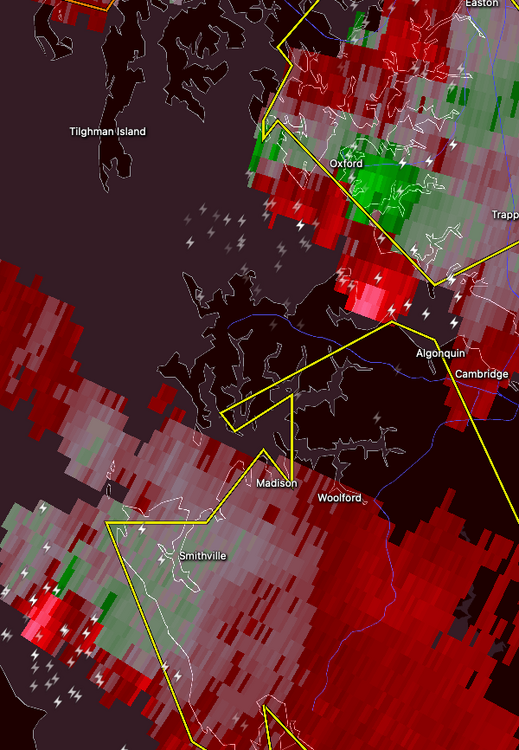
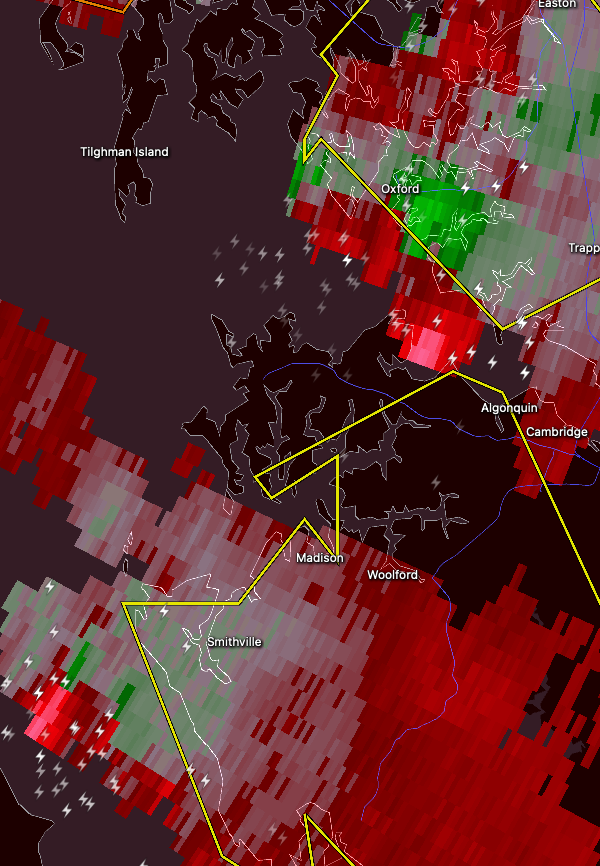
Stuff east of the Bay near Oxford and Smithfield looks a bit interesting for sure.
-
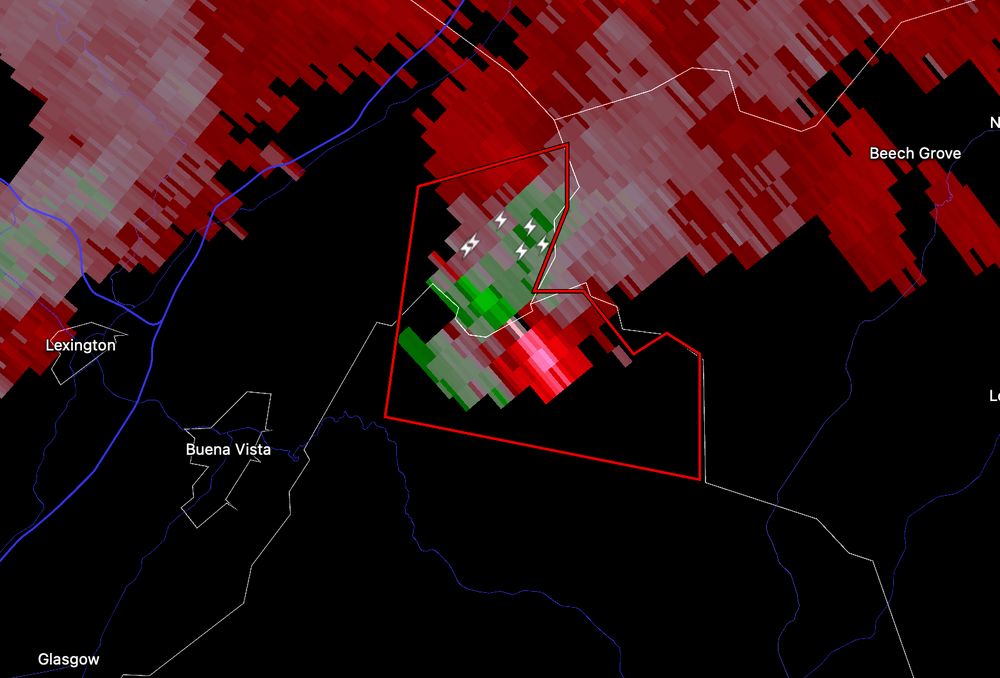
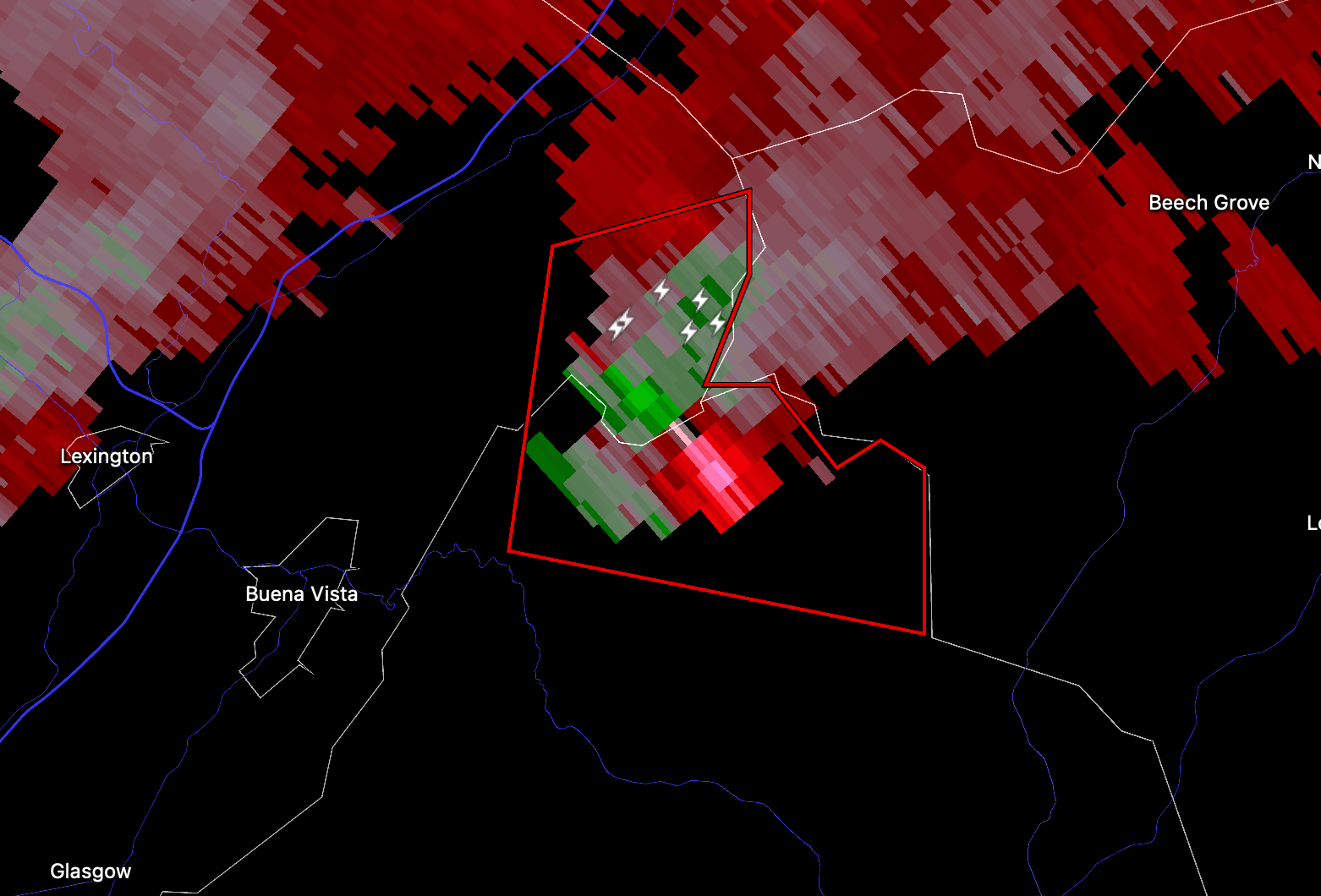
Man, that warned cell in West central VA
-

Mesoscale Discussion 1691 NWS Storm Prediction Center Norman OK 1253 PM CDT Tue Jul 21 2026 Areas affected...portions of the Mid-Atlantic Concerning...Severe potential...Watch likely Valid 211753Z - 211930Z Probability of Watch Issuance...80 percent SUMMARY...Multiple rounds of numerous, strong to severe thunderstorms will bring a risk for primarily damaging wind gusts to portions of the Mid-Atlantic through this evening, with a couple of brief tornadoes and isolated large hail also possible. DISCUSSION...Scattered thunderstorms have developed along the Blue Ridge as of 1750 UTC ahead of a mid-level shortwave trough that is progressing eastward across the upper Ohio Valley. Expectation is for this activity to spread eastward this afternoon with additional thunderstorms likely to progress into the region from the northwest this evening. Filtered heating of the downstream environment has resulted in temperatures warming into the upper 80s/near 90 F. With dewpoints in the low/mid 70s, this is supporting moderately strong buoyancy across the region. While effective shear of 35-45+ kts will favor storm organization, widespread thunderstorm development and cold pool consolidation are anticipated to yield a multicellular/outflow-dominant storm mode, with damaging to severe wind gusts the primary risk. A couple of brief tornadoes and isolated large hail will also be possible. Additionally, guidance suggests that air mass recovery will occur in the wake of these initial storms, which may allow the severe threat to persist into this evening as additional convection progresses southeastward into the region. Given this severe potential, watch issuance will likely be needed in the next hour or two. ..Chalmers/Mosier.. 07/21/2026 ...Please see www.spc.noaa.gov for graphic product... ATTN...WFO...PHI...AKQ...LWX...RNK... LAT...LON 37348031 38057950 39047840 39467763 39467704 39397660 39147596 38857550 38557536 38147544 37417580 37067629 36927689 36917711 36747834 36737931 36818019 37078049 37218043 37348031 MOST PROBABLE PEAK TORNADO INTENSITY...85-110 MPH MOST PROBABLE PEAK WIND GUST...55-70 MPH MOST PROBABLE PEAK HAIL SIZE...1.00-1.75 IN-
1
-
-
I swear NAM was showing a activity right where it fired up earlier. Dang!
-
15 minutes ago, high risk said:
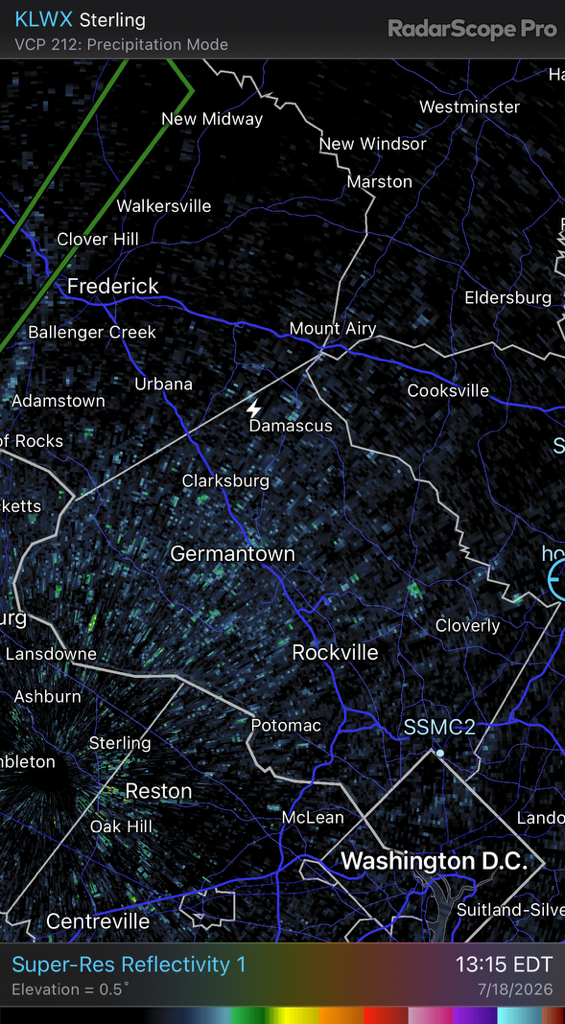
What the heck is that random lightning strike near Damascus???
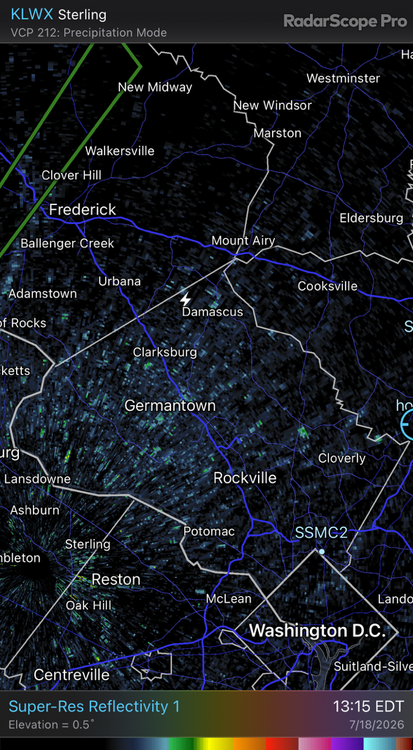
Strike out of the blue (well haze today) I got one around July 4th that lit up the outside even with the sunshine. A year ago one struck behind the neighbor's house and fired the well pump. That one there is furthest one I have seen from the main cell, maybe a storm is trying to form there
-
Some clearing but hazy skies.
The air is THICK! Temp is 88 and the humidity is at 80% here in Purcellville!
Instant sweat factory! LOL! -
HRRR has said smoke should improve over the next 2 hours and I am thinking that will help with heat. No problems on moisture outside!! It is thick. Sunshine has been seriously shrouded in fog and smoke here in Loudoun
-
16 minutes ago, WxUSAF said:
Why has the NAM just looked like shit for any shower/storm day we’ve had this year from any range >6 hours??
I asked Chat GPT - Here is what it thinks (LOL) Waste of time, but I could not resist!

-------------------------
I've noticed the same thing this warm season, especially across the Mid-Atlantic. The NAM (both 12 km and 3 km Nest) has had a habit of looking terrible beyond about 6–12 hours for convective days, then suddenly "finding" storms in the final few runs. A few reasons:
-
It's heavily driven by its own physics
-
The NAM tends to overmix the boundary layer during the day.
-
That lowers dewpoints too much.
-
CAPE gets underdone and convective initiation is delayed or suppressed.
-
-
Small errors explode in summertime
-
July convection in Virginia often depends on:
-
a leftover outflow boundary
-
a weak differential heating zone
-
a tiny vorticity maximum
-
terrain circulations along the Blue Ridge
-
-
If the model is off by 20 miles or an hour on any of those, the entire simulated radar looks different.
-
-
Data assimilation doesn't capture morning boundaries well
Once radar, satellite, surface observations, and morning soundings are ingested, the 6–12 hour forecasts improve dramatically because the model finally "knows" where the atmosphere actually is. -
The FV3-based CAMs have generally been outperforming it
This year I've found:-
RRFS
-
HRRR
-
WoFS (short range)
-
even the HRDPS at times
have handled scattered convection better than the NAM Nest.
-
-
The pattern we've been in is especially unfriendly
We've had a lot of:-
weak northwest flow
-
pulse convection
-
little synoptic forcing
-
abundant moisture
That's almost the worst-case scenario for deterministic CAMs. The difference between "nothing" and "10 storms" can literally be one county's outflow boundary.
-
For Loudoun County specifically
The NAM has repeatedly shown this sequence:
-
24–36 hr: mostly dry
-
18 hr: isolated showers
-
12 hr: scattered storms
-
6 hr: widespread afternoon convection
-
Reality: the 6-hour run ends up being closest.
For your forecasting, I'd probably trust the NAM mainly for:
-
temperature trends
-
dewpoint trends
-
low-level winds
-
large-scale forcing
...and lean much more on the HRRR/RRFS for actual storm placement once you're inside about 18 hours.
The other thing I've noticed this summer is that the ECMWF AI (AIFS) has often had a better "feel" for whether the day would end up active than the NAM did 24–48 hours out. It obviously can't tell you exactly where a cell will pop, but its broader convective signal has been surprisingly consistent.
-
-
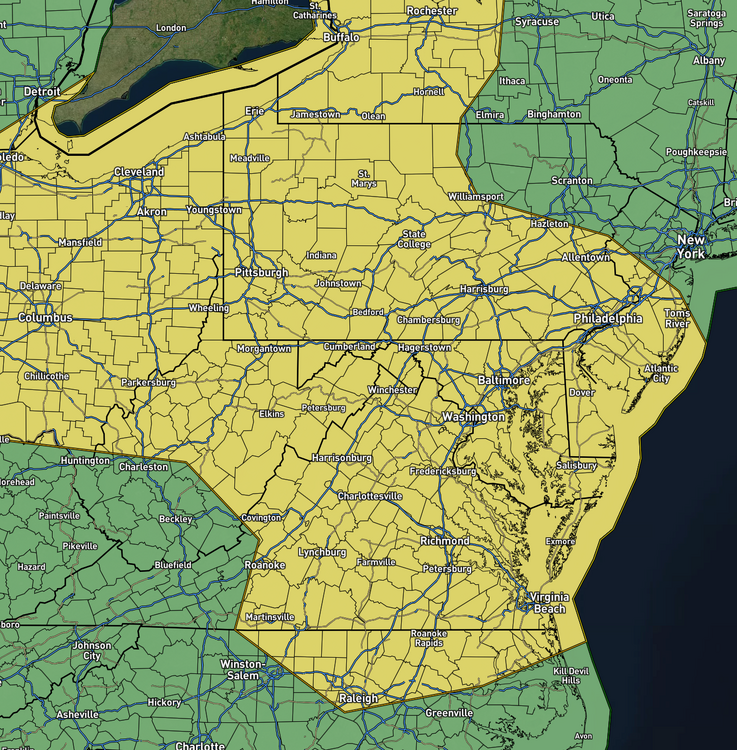
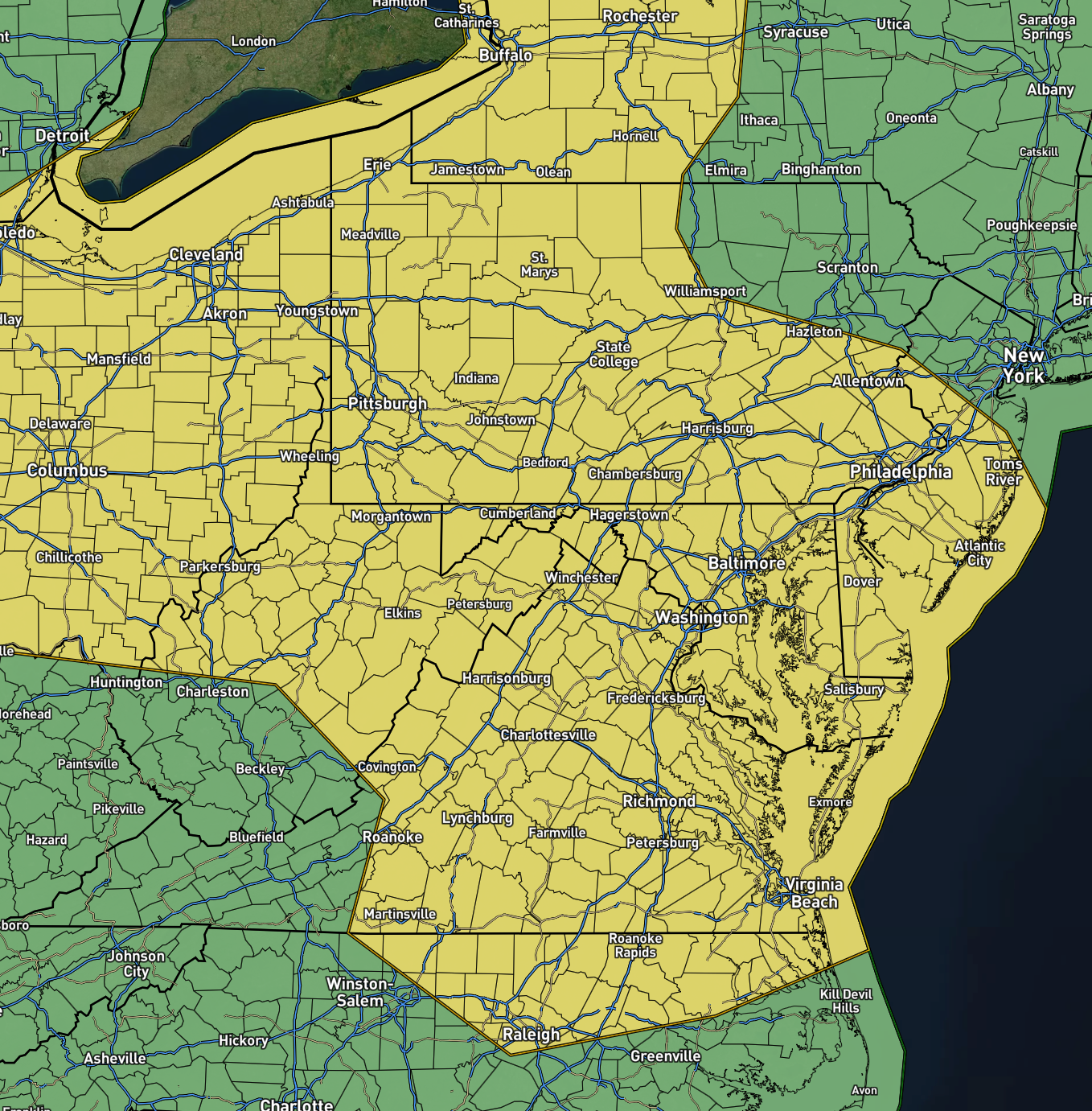
Slight risk Saturday. Guess it depends how much clearing we get and heating ahead of the energy and way too many unknowns.
ZCZC SPCSWODY3 ALL
ACUS03 KWNS 160734
SPC AC 160734
Day 3 Convective Outlook
NWS Storm Prediction Center Norman OK
0234 AM CDT Thu Jul 16 2026
Valid 181200Z - 191200Z
...THERE IS A SLIGHT RISK OF SEVERE THUNDERSTORMS ACROSS PORTIONS OF THE OHIO VALLEY INTO THE MID-ATLANTIC...
...SUMMARY...
Severe thunderstorms will be possible across portions of the Ohio Valley during the late afternoon and evening hours before moving southeast toward the Mid-Atlantic overnight. Additional strong-to-severe thunderstorms will be possible during the afternoon across portions of the Mid-Atlantic.
... Synopsis ...
The CONUS-wide mid-level ridge centered over the north-central Plains for much of the past week will have retrograded west by Saturday and be located across the US and Canadian Rockies. Strong mid-level westerlies will persist on the ridge's northwest, north, and northeast periphery. Embedded within the westerlies, a series of short-wave troughs and smaller-scale vorticity/speed maxima will move across the Great Lakes and Northeast.
At the start of the forecast period, the main short-wave trough will be located across central Ontario, with its associated jet streak located across the Upper Midwest. This feature will dig southeast on Saturday, ending up in the vicinity of northern New England by Sunday morning. Ahead of this main wave, the 20260716/00 UTC guidance suite shows multiple speed/vorticity maxima moving through the west-northwesterly flow, each of which will be capable of aiding the development of scattered elevated thunderstorms.
At the surface, a weak surface low should develop Saturday morning across southern Ontario/the northern Great Lakes. This low will slowly deepen during the day as it digs southeast, reaching upstate New York by evening. Ahead of the surface low, southwesterly low-level flow will transport a very moist airmass northeast into the Lower Great lakes, with 70F surface dewpoints possible as far northeast as western New York.
To the southwest of the surface low, a surface cold front will serve as an initiating boundary for thunderstorms during the afternoon. An unstable and strongly sheared airmass will be in place by later afternoon across Ohio northeast into western New York. As thunderstorms initiate along the front, large hail will be possible before thunderstorm outflows eventually congeal into one or more linear clusters posing a threat for damaging winds. This line of storms will push south and east during the evening and overnight with a continued threat of strong, damaging thunderstorm winds.
Farther southeast across the Mid-Atlantic, most model guidance indicates the development of a surface trough to the east of the Appalachians during the late afternoon. To the east of this trough axis, temperatures will warm into the 90Fs, although there is some uncertainty how far north the hot boundary layer will extend. Given the presence of this surface trough and strong diurnal heating, several clusters of thunderstorms will be possible during the afternoon, especially if any of the previously discussed vorticity/speed maxima can interact with the low-level trough. Strong, damaging winds will be possible with any thunderstorm complex during the afternoon. Additional severe potential will also exist overnight as the remnants of the convection along the cold front approaches the region. Gusty thunderstorm winds will be the likely threat with these storms.
..Marsh.. 07/16/2026
-
1
-
-
Anyone have thoughts after 12z runs?
-
1
-
-
10:50 AM in Purcellville --> 89.9/79/106 --> It is thick outside - a wall of steamy madness!
-
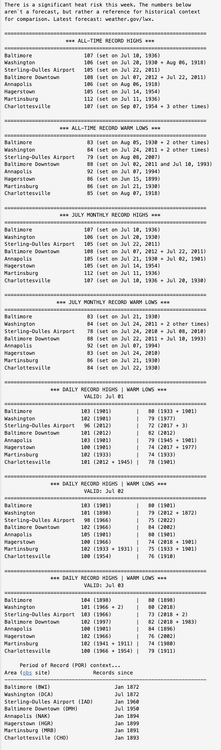
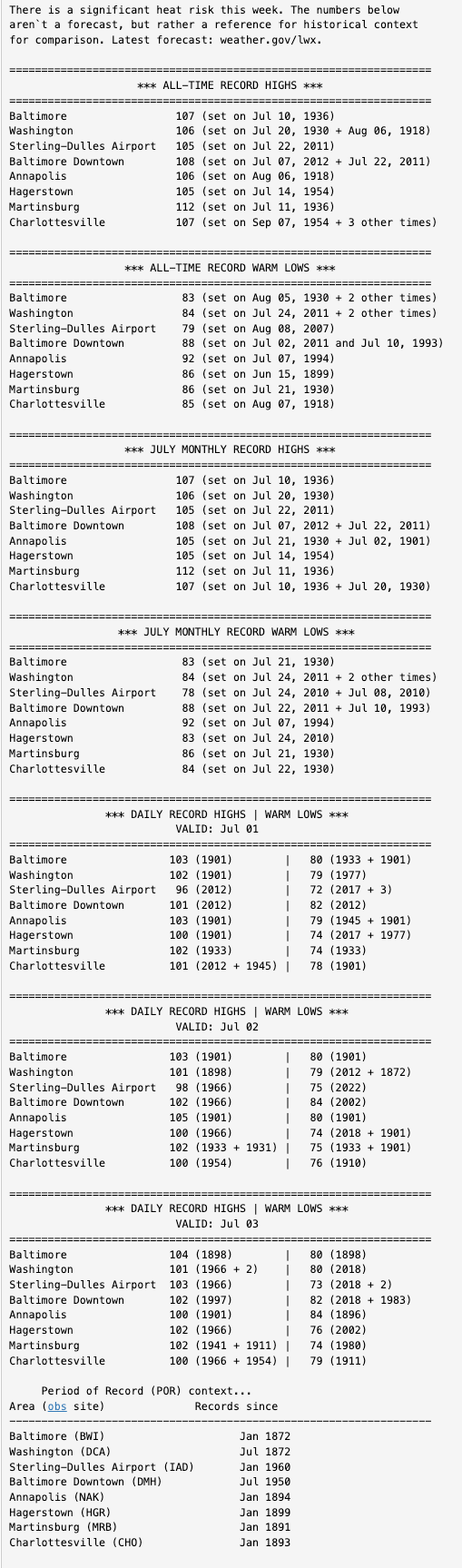
LWX Discussion had some good Climate Summary data
-
2
-
-
September 2026 Medium/Long Range
in Mid Atlantic
Posted
12z GFS back to bringing in some cooler air in the long range! Better than the blowtorch yesterday, but it is really flip-flopping! Euro 12z will shed light, but it keeps it pretty warm/hottish on previous runs.