Jns2183
-
Posts
5,869 -
Joined
-
Last visited
Content Type
Profiles
Blogs
Forums
American Weather
Media Demo
Store
Gallery
Everything posted by Jns2183
-
Central PA Summer 2026 Discussion/Obs Thread
Jns2183 replied to Voyager's topic in Upstate New York/Pennsylvania
Somerset County at around 2500' to 3100' feet is the place to be. 85 and 83 degrees respectfully yesterday at the flight 93 memorial and Mt Davis, which makes sense assuming 5.5 degrees per 1000 ft Sent from my SM-S731U using Tapatalk -
Central PA Summer 2026 Discussion/Obs Thread
Jns2183 replied to Voyager's topic in Upstate New York/Pennsylvania
99.4 was my max thank God dewpoint is only 69 Sent from my SM-S731U using Tapatalk -
Central PA Summer 2026 Discussion/Obs Thread
Jns2183 replied to Voyager's topic in Upstate New York/Pennsylvania
Haha, I spent far too much time and money playing around with temperature sensor locations and shielding all around my yard. It was a frustrating eye opening experience. Sent from my SM-S731U using Tapatalk -
Central PA Summer 2026 Discussion/Obs Thread
Jns2183 replied to Voyager's topic in Upstate New York/Pennsylvania
Any green grass left goes poof by monday Sent from my SM-S731U using Tapatalk -
Central PA Summer 2026 Discussion/Obs Thread
Jns2183 replied to Voyager's topic in Upstate New York/Pennsylvania
All I got to today was 91, dp 68, hi 95 Sent from my SM-S731U using Tapatalk -
Central PA Summer 2026 Discussion/Obs Thread
Jns2183 replied to Voyager's topic in Upstate New York/Pennsylvania
Every top heatwave aside 1953 in August hit this week Sent from my SM-S731U using Tapatalk -
Central PA Summer 2026 Discussion/Obs Thread
Jns2183 replied to Voyager's topic in Upstate New York/Pennsylvania
You have one of the most studied watersheds in America in your backyard relatively speaking. 1966. Produced some of the most cited and best done hydrology research in the world to this day. https://www.tucson.ars.ag.gov/icrw/Proceedings/Gburek.pdf They have minute by minute rainfall data since the 1960s!!! Only a handful of places in world have that Sent from my SM-S731U using Tapatalk -
Central PA Summer 2026 Discussion/Obs Thread
Jns2183 replied to Voyager's topic in Upstate New York/Pennsylvania
What I mean is the elevation is accounting for less than 10% of that difference. Everything else is due to what type of area it was placed it, canopy location, if it had good radiation shielding, if it used an aspirator, location of it to buildings, decks, house, rows. Realistically elevation is almost certainly less than 5% of the difference Sent from my SM-S731U using Tapatalk -
Central PA Summer 2026 Discussion/Obs Thread
Jns2183 replied to Voyager's topic in Upstate New York/Pennsylvania
I guarantee you those differences are nearly all placement. I would bet my life on that. Sent from my SM-S731U using Tapatalk -
Central PA Summer 2026 Discussion/Obs Thread
Jns2183 replied to Voyager's topic in Upstate New York/Pennsylvania
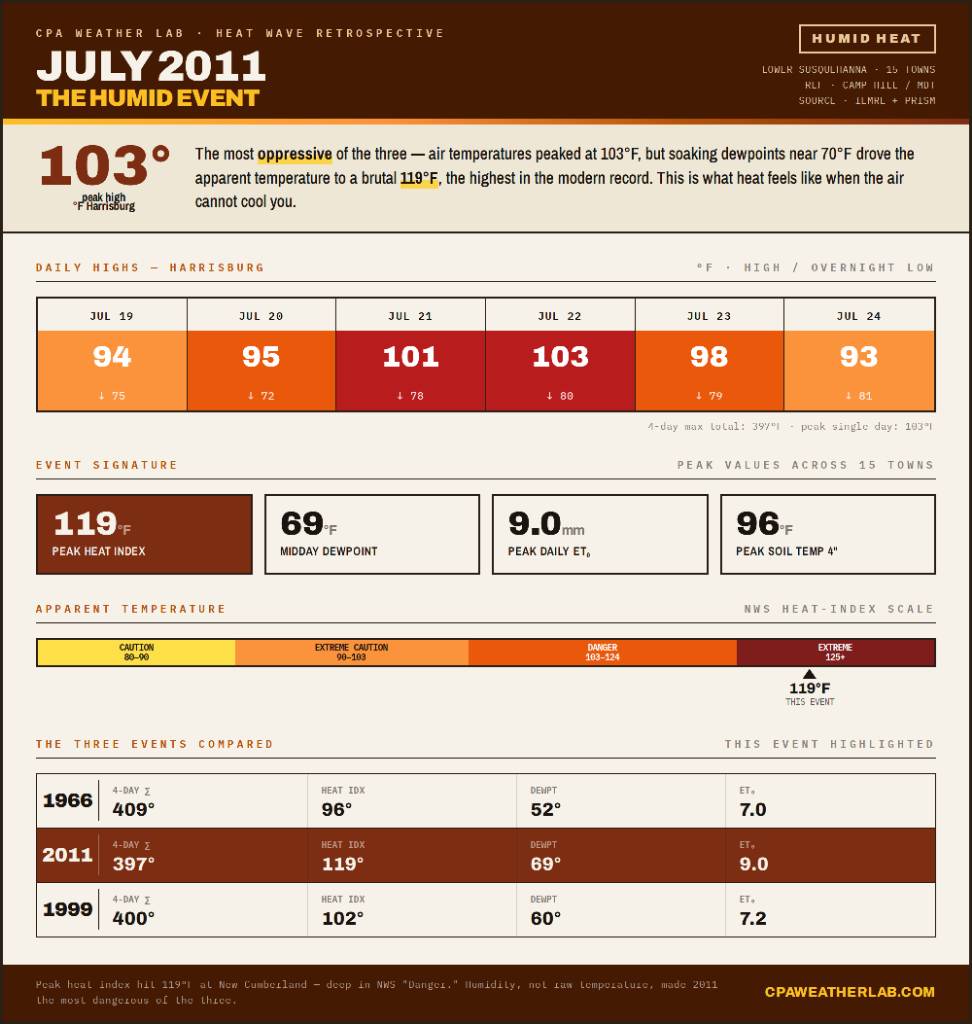
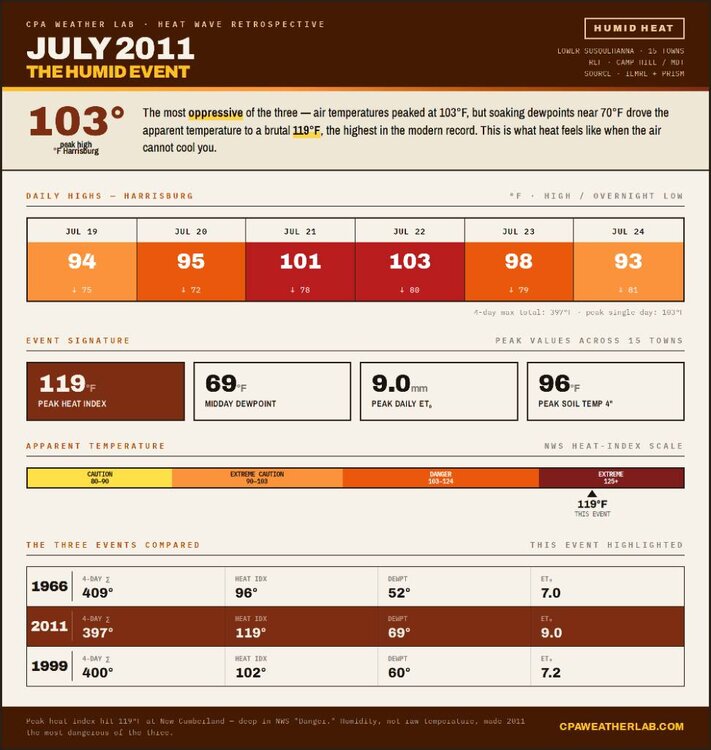
I think in 2011 New Cumberland had confirmed heat index of 122 or something similar. That's the highest I've ever seen around here. Sent from my SM-S731U using Tapatalk -
Central PA Summer 2026 Discussion/Obs Thread
Jns2183 replied to Voyager's topic in Upstate New York/Pennsylvania
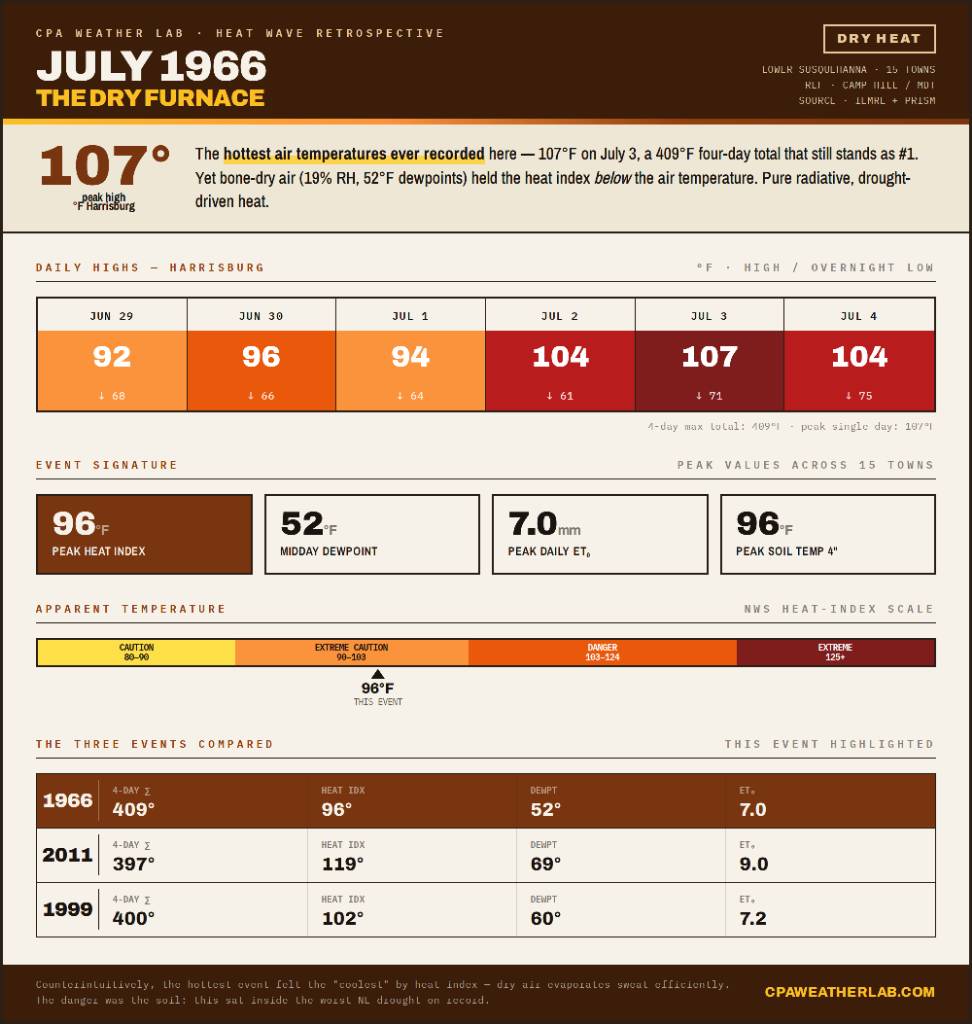
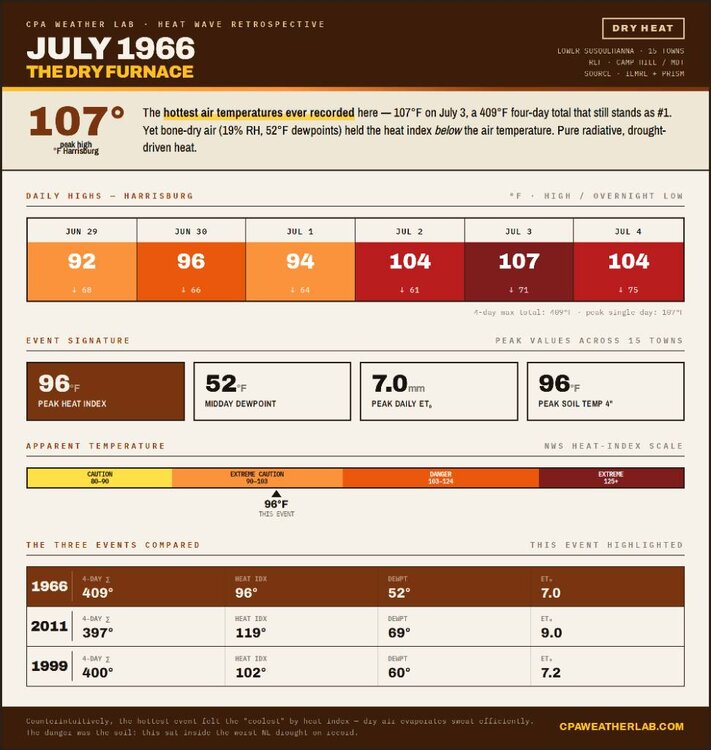
We've never hit 4 days above 100. I don't think weve had 4 days above 98 or 99. in a week a bunch will be in d3/d4 territory with no real break in 16 day forcast. 1966 was in a different stratosphere. In the midst of a 3-year severe drought and going into June with 15% rainfall. If you want to see something left look at the low temperatures not summer it would fly up into the mid and upper 90s and drop down to 60 at night. Basically we turned into Arizona Sent from my SM-S731U using Tapatalk -
Central PA Summer 2026 Discussion/Obs Thread
Jns2183 replied to Voyager's topic in Upstate New York/Pennsylvania
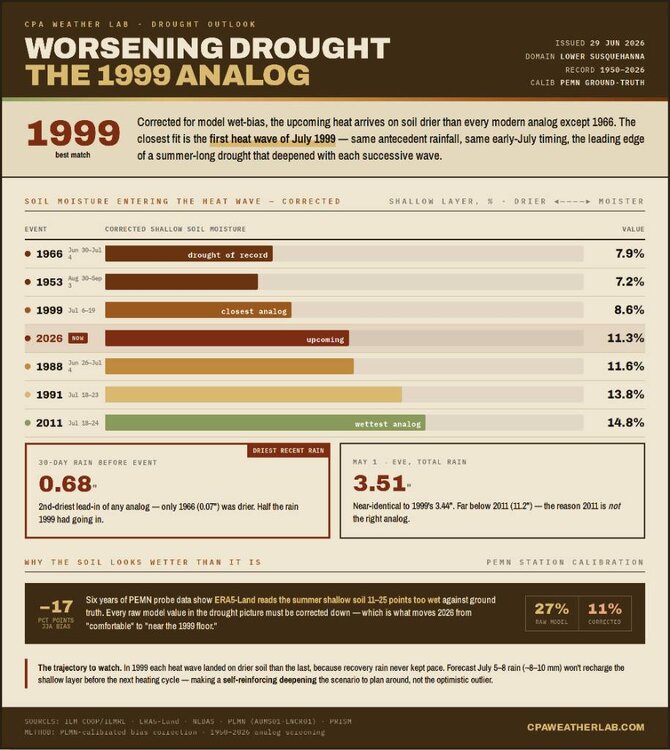
This one is going to be bad. It also sets us up for a legit possibility of something worse later in July if drought doesn't break. I think the bigger story is due to the frost and our current trajectory, PA agriculture, especially in this area is going to have top 3 worse year in last 100. I have no idea just how bad it may become for them. Sent from my SM-S731U using Tapatalk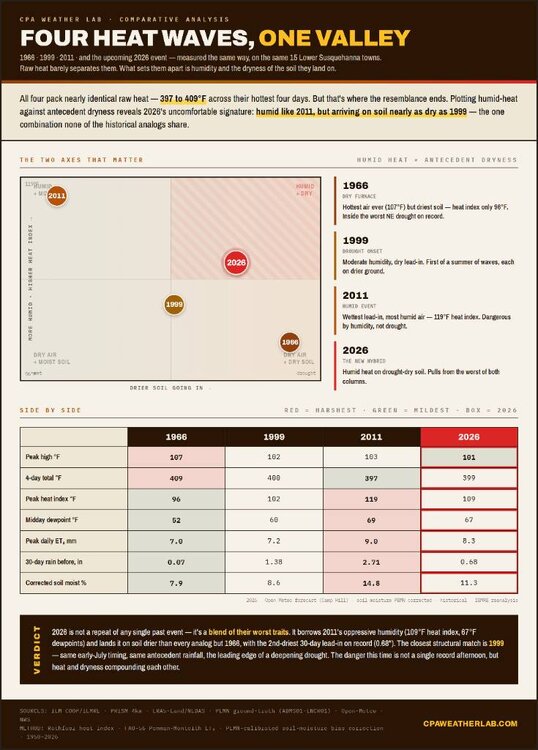
-
Central PA Summer 2026 Discussion/Obs Thread
Jns2183 replied to Voyager's topic in Upstate New York/Pennsylvania
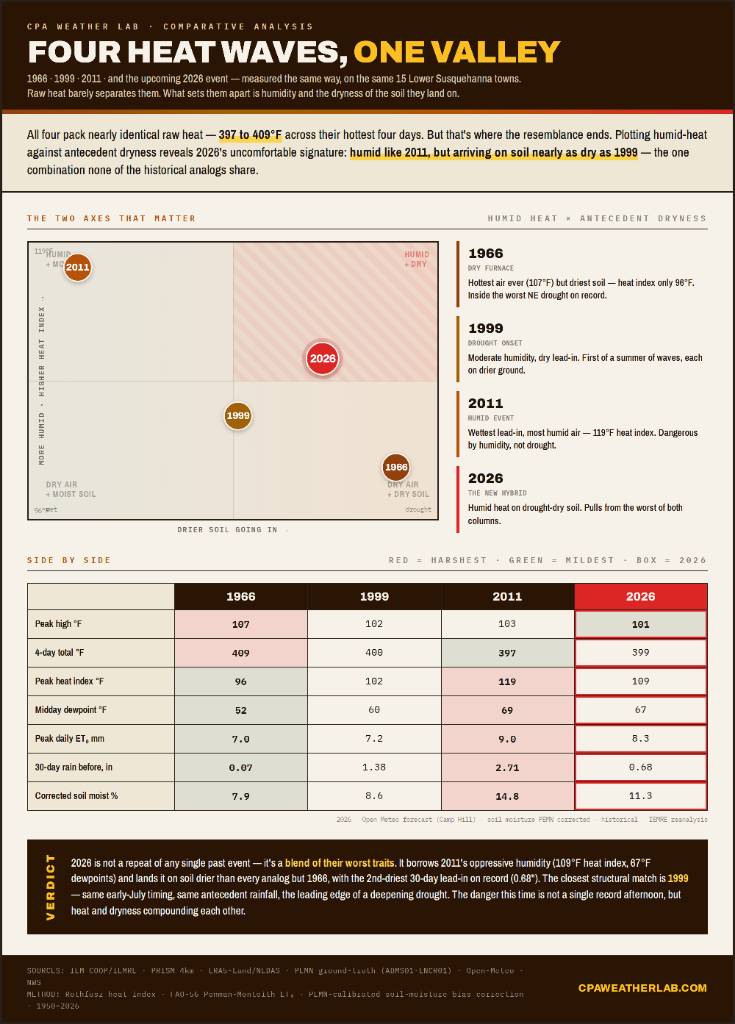
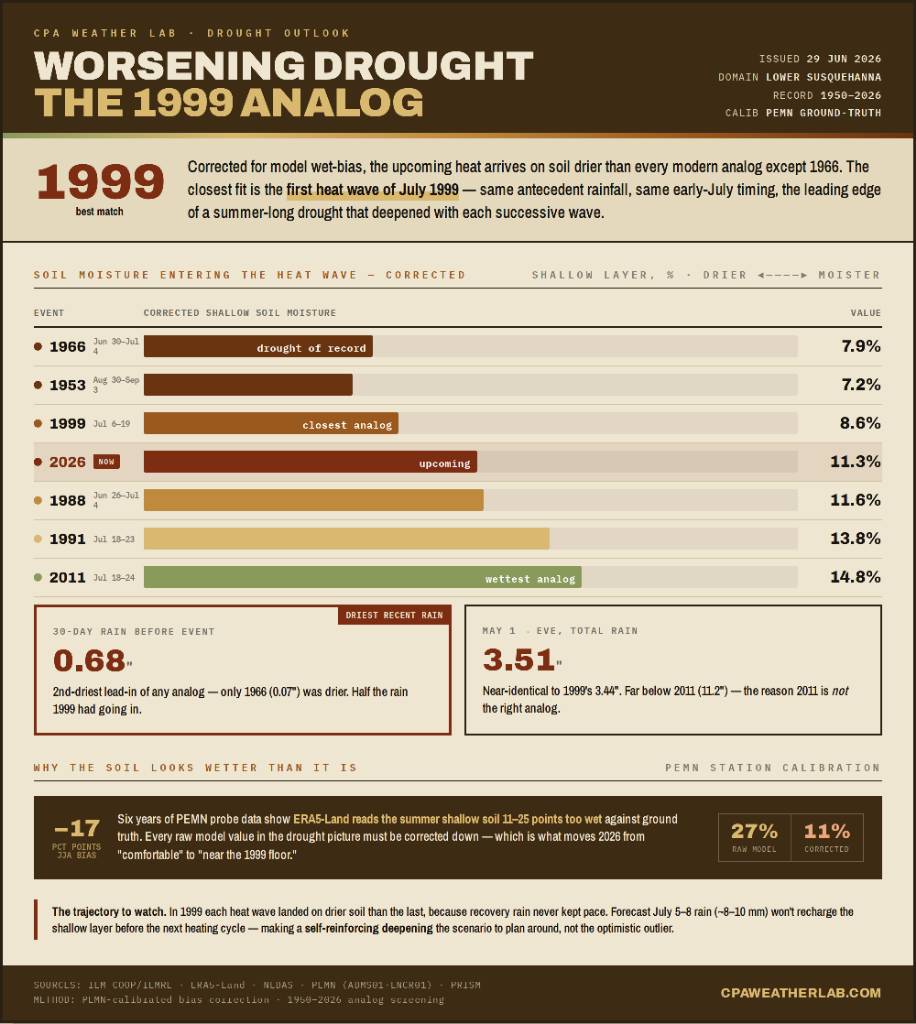
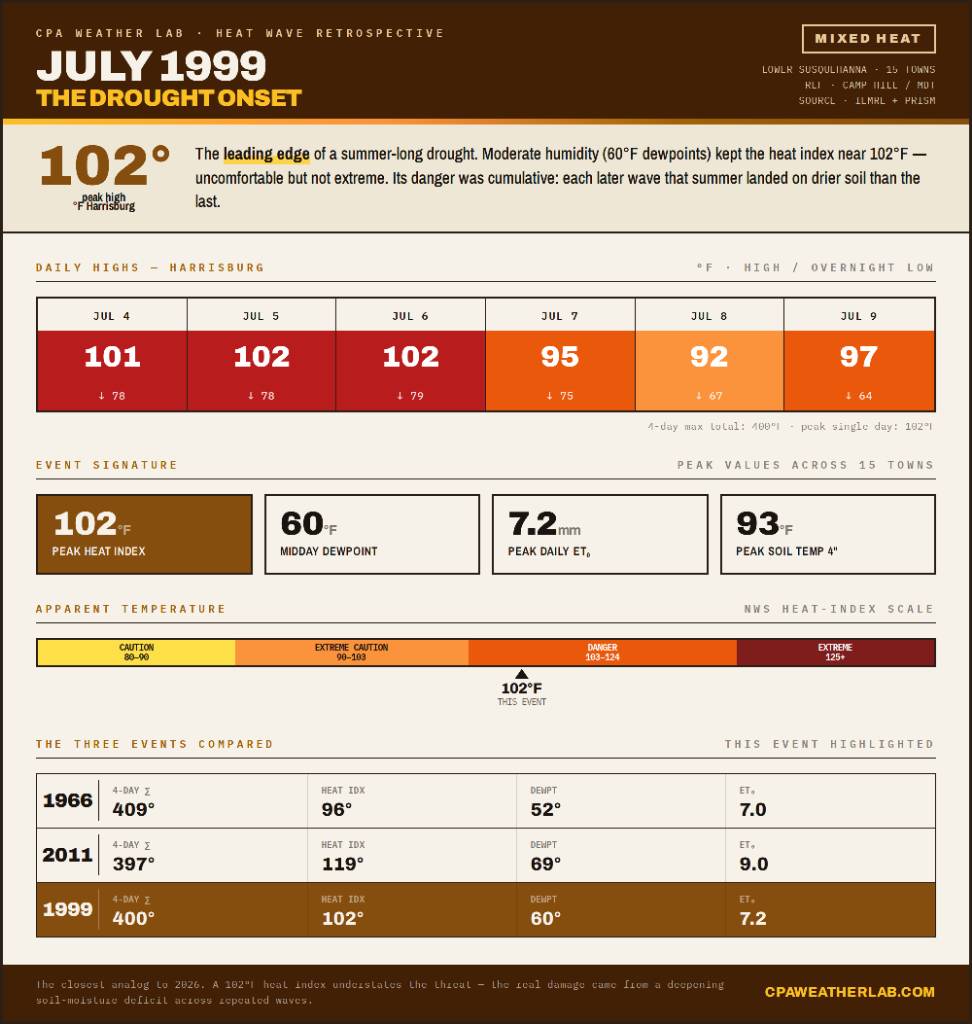
I had some testing today so spent far too many hours waiting in between tests. Enough hours to download 50gb or so of all kinds of reanalysis data for land, soil, atmosphere, hydro. Anyways. Here are the top heat analogs when taking into account hydro and soil. 1999, 1966, 1991, 1953. Here is some info attached. 2011 thrown in for recent and ungodly dewpoints. Sent from my SM-S731U using Tapatalk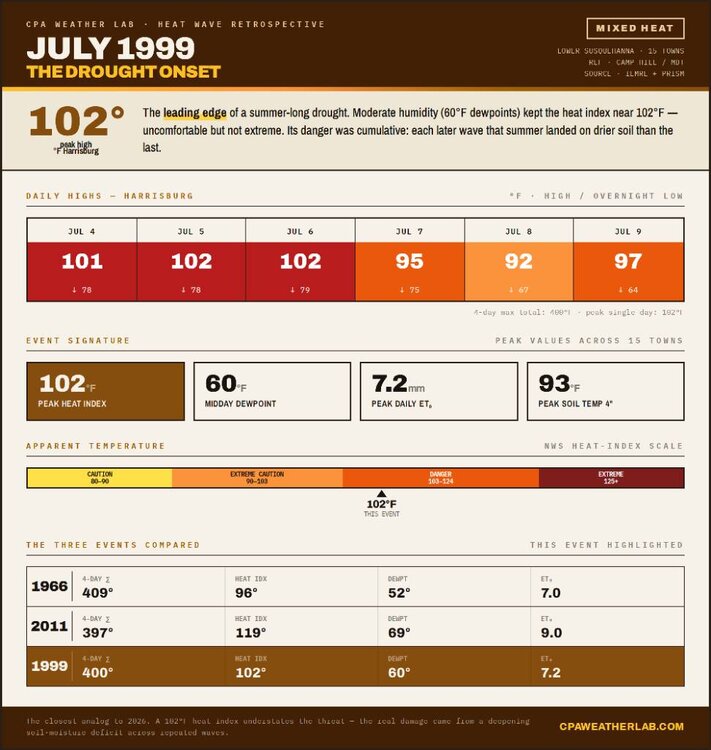
-
Central PA Summer 2026 Discussion/Obs Thread
Jns2183 replied to Voyager's topic in Upstate New York/Pennsylvania
I thought 1999 was the gold standard for bad recent droughts over the summer. Anyways that yearr keeps popping up in any kind of analysis I run Sent from my SM-S731U using Tapatalk -
Central PA Summer 2026 Discussion/Obs Thread
Jns2183 replied to Voyager's topic in Upstate New York/Pennsylvania
The top soil layer is bone dry. We can usually add a bunch of moisture to systems like this, but not right now and for a long while. Any and all moisture we can use has to brought in right now and these systems won't cut it Sent from my SM-S731U using Tapatalk -
Central PA Summer 2026 Discussion/Obs Thread
Jns2183 replied to Voyager's topic in Upstate New York/Pennsylvania
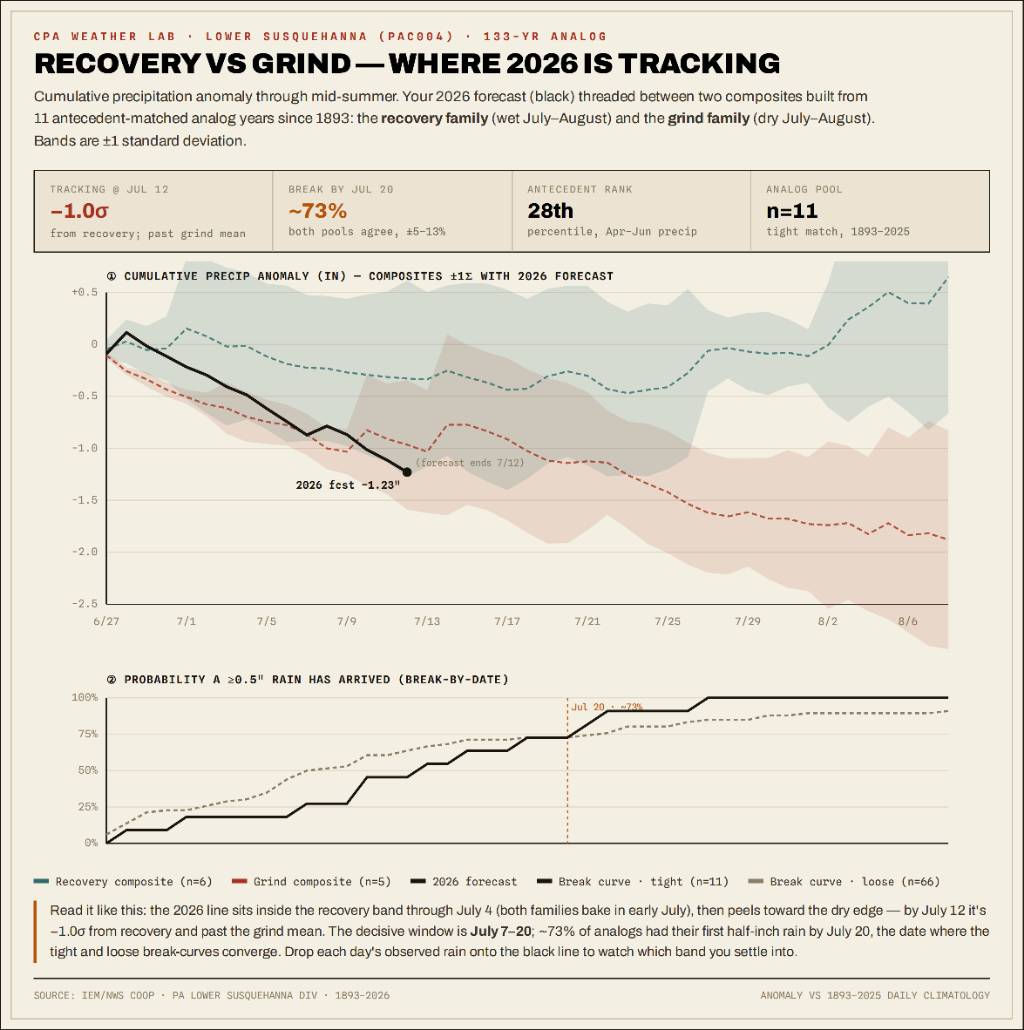
This is a PAC004 Lower Susquehanna analog monitor using 133 years of data. The analogs split into two camps: recovery years, where a real July/August rain break arrived, and grind years, where the pattern stayed dry enough that small rains failed to reset the soil. Recovery camp: 1898, 1900, 1921, 1934, 2010, 2024. Grind camp: 1913, 1944, 1964, 1966, 1999. The 2026 line starts inside the recovery envelope, but by July 12 it peels toward the dry edge, about -1.0σ from recovery and past the grind mean. The key window is July 7–20. Around 73% of analogs had their first half-inch rain by July 20. So this is not a locked-in drought verdict yet, but the current track is leaning grind unless we get a meaningful half-inch-plus rain event by mid-July. Sent from my SM-S731U using Tapatalk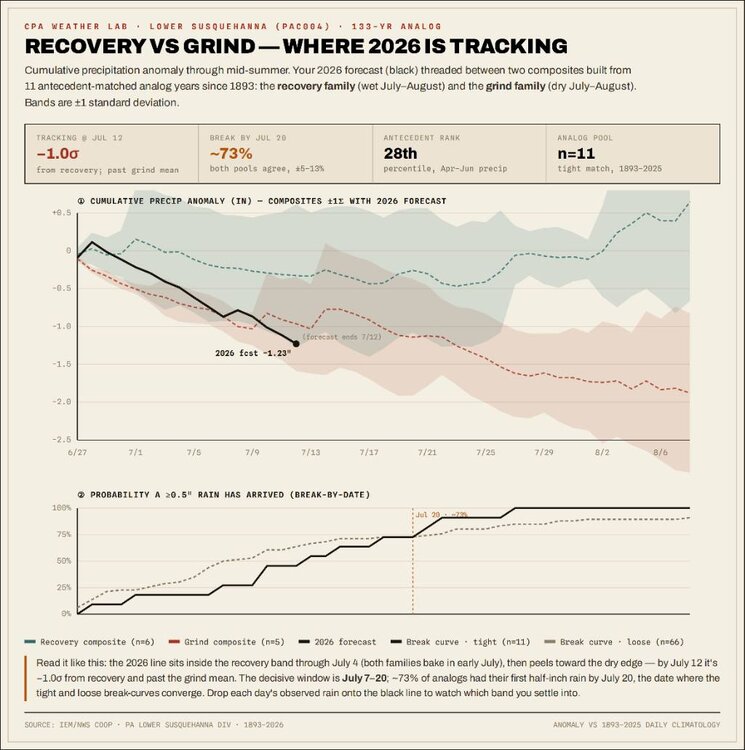
-
Central PA Summer 2026 Discussion/Obs Thread
Jns2183 replied to Voyager's topic in Upstate New York/Pennsylvania
Whenever I see 1988 and 1999 pop up as the two most likely analogs it is not going to be a good time Sent from my SM-S731U using Tapatalk -
Central PA Summer 2026 Discussion/Obs Thread
Jns2183 replied to Voyager's topic in Upstate New York/Pennsylvania
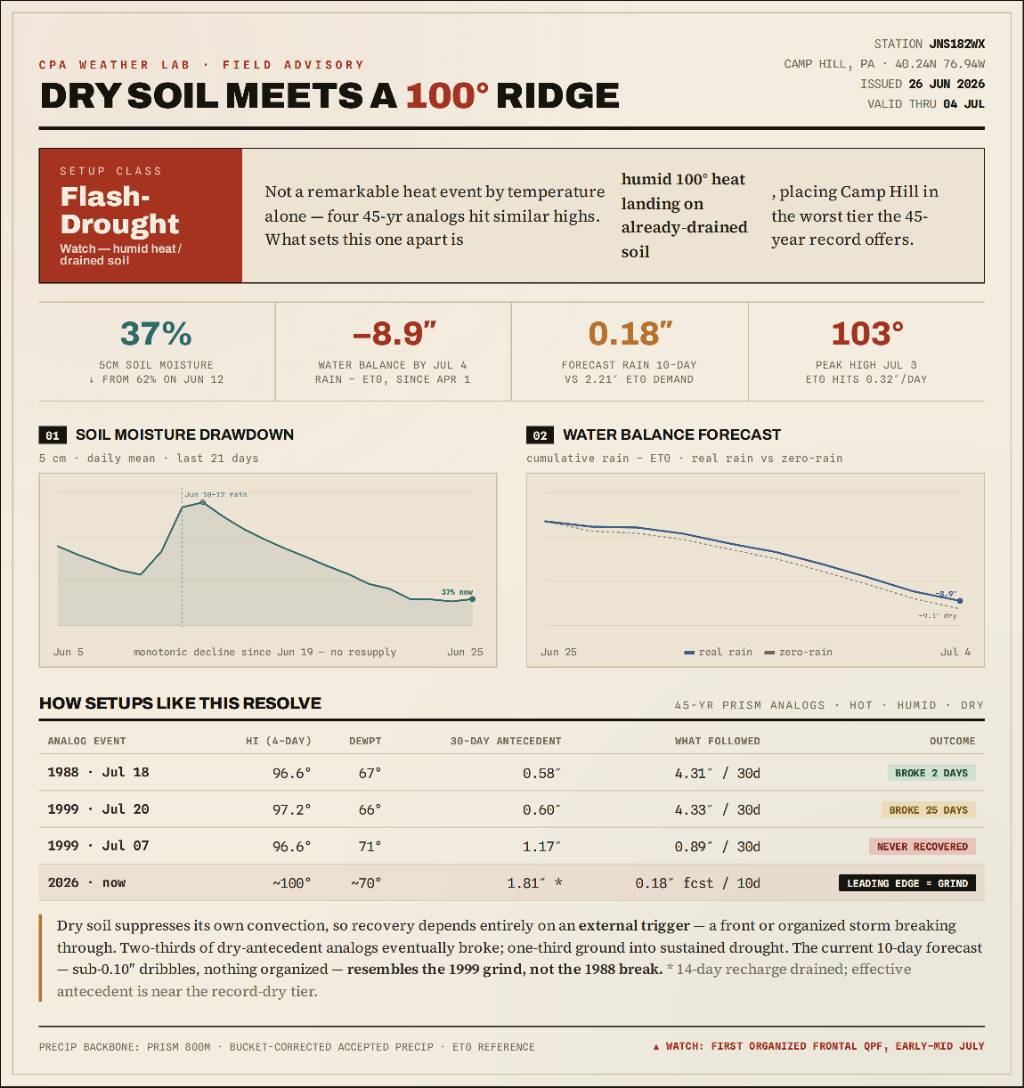
Camp Hill enters the late-June/early-July heat with essentially no water in the bank. PRISM put just 0.76" on the cell over June 12–24, and my 5cm soil moisture tells the real story: it peaked near 62% after the June 10–12 rain and has bled straight down to ~37% since, with no resupply. The cumulative water balance (PRISM rain minus reference ET0) sits around −6.9" since April 1 — and that's before the heat arrives. This is a drained antecedent state, not a buffered one. @canderson I don't think you remember remember 1999 here because I was in high school still I remember that summer vividly as unbearable The forecast offers no relief. Pulling real Open-Meteo QPF rather than a zero assumption, the next ten days deliver about 0.18" of rain against ~2.2" of ET0 demand, dragging the balance to roughly −8.9" by July 4. ET0 ramps to 0.28–0.32"/day as highs hit 99–103° on July 1–3. Worse, the little rain that's offered falls before the heat peak and in sub-0.10" dribbles that largely evaporate before reaching the root zone. Functionally, plan as if it's a zero-rain stretch. To gauge where this goes, I searched 45 years of PRISM for 4-day stretches matching the upcoming signature — mean highs near 100°, dewpoints around 70°, near-zero rain — and found seven. The key split is antecedent moisture. The two most recent analogs (2011, last June 2025) walked in wet, with a soil buffer, and broke within days. The genuinely dry-antecedent cases — 1988 and the two 1999 events — are the right comparison for 2026, and they resolved three different ways: 1988 broke in 48 hours, 1999b ground on 25 days before a 2" dump, and 1999a never recovered, posting under 0.9" over the following month of compounding drought. Bottom line: this isn't a remarkable heat event by temperature alone — four analogs hit similar highs. It's the combination of humid 100° heat onto drained soil that puts us in the worst tier the record offers, alongside the late-1990s flash-drought setups rather than the well-watered recent years. Dry soil suppresses its own convection, so recovery depends entirely on an external trigger — a front or organized storm breaking through. The single thing worth watching is the medium-range guidance for that first genuine frontal passage in early-to-mid July. Its arrival is the 1988 path; its continued absence is the 1999a grind. Right now the forecast's leading edge looks more like the latter. Sent from my SM-S731U using Tapatalk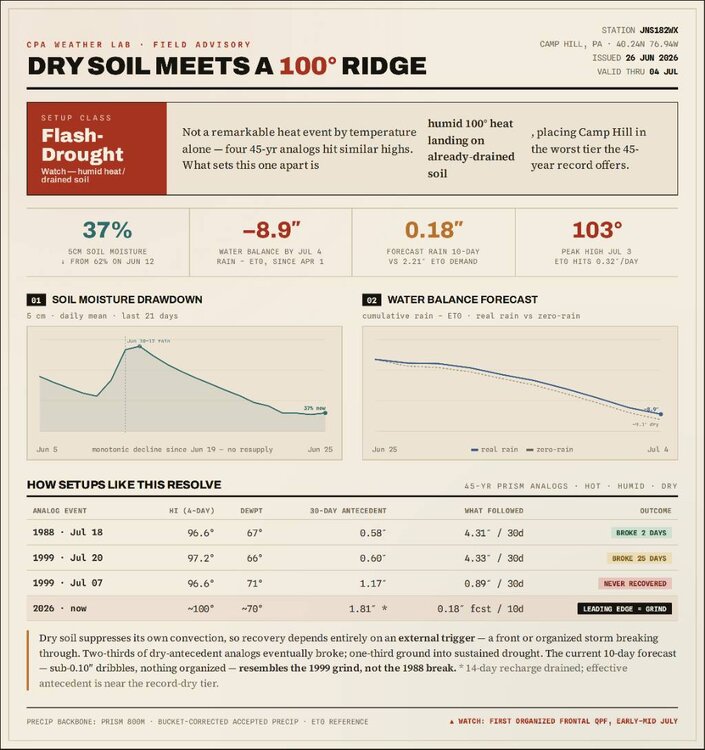
-
Central PA Summer 2026 Discussion/Obs Thread
Jns2183 replied to Voyager's topic in Upstate New York/Pennsylvania
It goes in and out Sent from my SM-S731U using Tapatalk -
Central PA Summer 2026 Discussion/Obs Thread
Jns2183 replied to Voyager's topic in Upstate New York/Pennsylvania
Those first 4 days July is going to burn out the grass here and send us into not good drought conditions. For whatever reason @canderson and I have missed most of the rain this month. I sit at 1.25". We are in not good shape here and have been muddling along due to cool temperatures. That's all about io change and my soil moisture sensor already is at lowest ever 35%. Sent from my SM-S731U using Tapatalk -
Central PA Summer 2026 Discussion/Obs Thread
Jns2183 replied to Voyager's topic in Upstate New York/Pennsylvania
.08" puts me at 1.31" for June and 15.14" YTD. 4.53" below normal and good for 11th driest out of 131 years. Sent from my SM-S731U using Tapatalk -
Central PA Summer 2026 Discussion/Obs Thread
Jns2183 replied to Voyager's topic in Upstate New York/Pennsylvania
Some light reading Sent from my SM-S731U using Tapatalk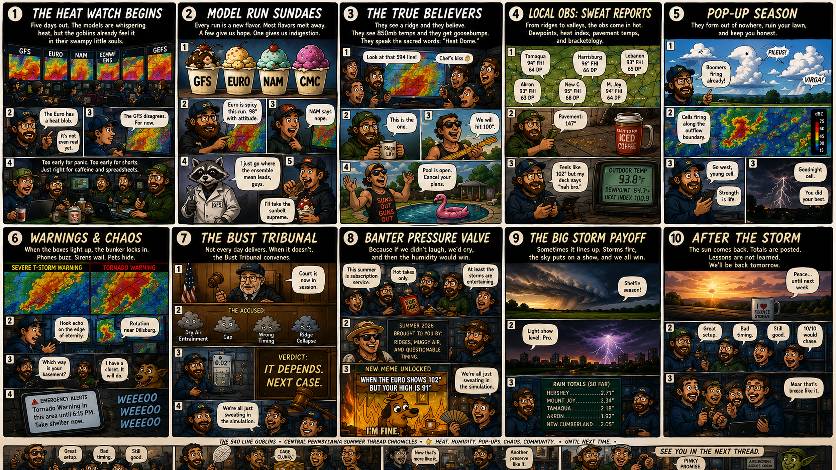
-
Central PA Summer 2026 Discussion/Obs Thread
Jns2183 replied to Voyager's topic in Upstate New York/Pennsylvania
Watching the Great outdoors I am one with the racoons Sent from my SM-S731U using Tapatalk
-
Central PA Summer 2026 Discussion/Obs Thread
Jns2183 replied to Voyager's topic in Upstate New York/Pennsylvania
Is there some aspect of it that you were looking for mostly I could probably guide you even further Sent from my SM-S731U using Tapatalk -
Central PA Summer 2026 Discussion/Obs Thread
Jns2183 replied to Voyager's topic in Upstate New York/Pennsylvania
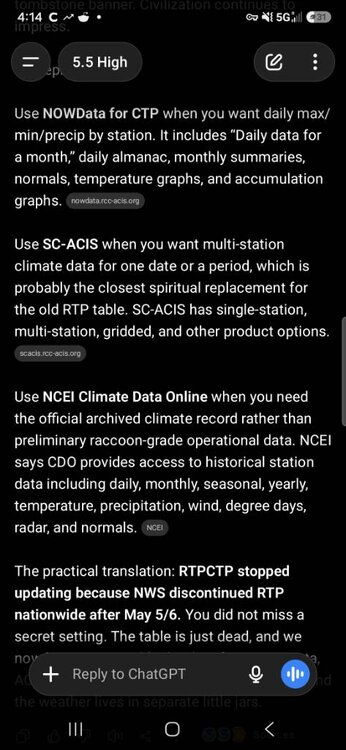
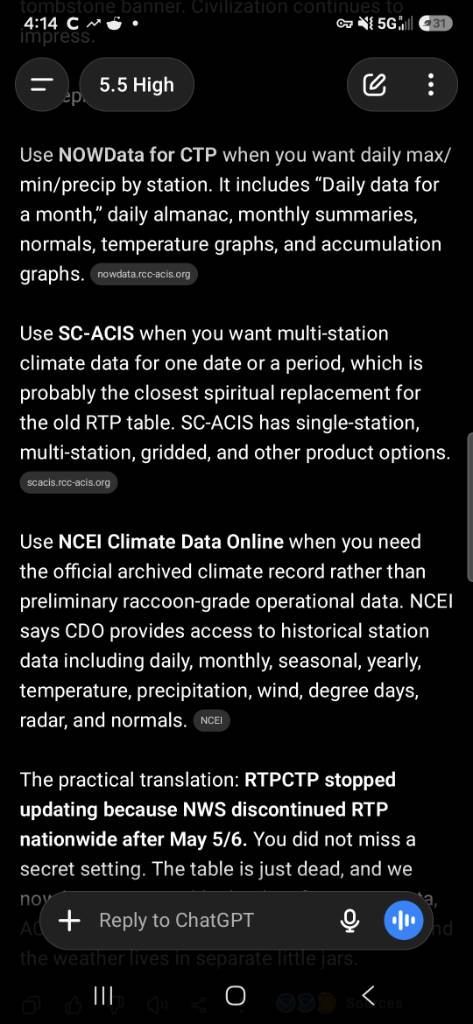
It's because they took it out to the wood shed and discontinued the product https://www.weather.gov/media/notification/pdf_2026/scn26-34_AR_ER_WR_RTP_Discontinuation.pdf The screenshot there has your best chances to find a replacement Sent from my SM-S731U using Tapatalk