
WolfStock1
-
Posts
255 -
Joined
-
Last visited
Content Type
Profiles
Blogs
Forums
American Weather
Media Demo
Store
Gallery
Everything posted by WolfStock1
-
Gotta figure many places will cancel. LoCo is on 2-hour delay but said "stay tuned". Based on history I bet they'll cancel. Haven't looked at the roads yet but there's lots on the ground and it's snowing now, and it's cold enough the roads won't melt easy.
-
Occasional Thoughts on Climate Change
WolfStock1 replied to donsutherland1's topic in Climate Change
Thought this bit was kind of odd: "The revised analysis shows economic damages from climate change till mid-century are substantial and outweigh the costs of mitigation" It seems the relationship of the costs shouldn't necessarily be 1:1 or anything like that. Every dollar spent on mitigation doesn't lessen the costs of CC by a dollar - it may be much less or it may be much more; and you may actually want one or the other. E.g. say the costs due to CC (generally storms - wind and flooding) end up being $500 billion in a given area over the next 25 years, if no mitigation was done. You could spend say twice that - say $1 trillion - on sea walls, stricter building codes, river flood mitigation (drainage and walls), and lessen the resulting damage costs from $500B to say $300B. Was it bad to spend the $1 trillion, since the net loss is $700B? Maybe, but maybe not if you consider that there are also lives involved; presumably less lives lost in the do-mitigate case. Looking from a strictly financial standpoint - it seems like you generally would *want* your mitigation costs to be less than the damage costs, right? This is due to the unpredictable nature of storms. If you spend more money to mitigate then the delta between the two is by definition wasted money - generally. That said - there's probably some low-hanging fruit that is worthwhile. E.g. the US built a series of flood-control dams after the big Ohio river flood in 1937; this likely ended up saving money in the long run, so that might be a case where the cost of mitigation reduced the likely cost of non-mitigation damages. Same is true for flood walls in various places - usually it's money well spent. But it's rarely a 1:1 tradeoff though; so comparing the two sets of figures seems odd. -
Occasional Thoughts on Climate Change
WolfStock1 replied to donsutherland1's topic in Climate Change
A pretty devastating article in WSJ today on the negative effects of the renewable energy push on the European economy: https://www.wsj.com/business/energy-oil/europes-green-energy-rush-slashed-emissionsand-crippled-the-economy-e65a1a07 While the existence of warming is undeniable (e.g. see new record low Arctic ice extent in other thread), this illustrates how hard of a problem this is to solve. -
Indeed - seems a bit misleading to present a subset of the data (the area around Canada) and discuss it as if it was the full set (the Arctic). That's the kind of thing that causes finger-pointing.
-
Occasional Thoughts on Climate Change
WolfStock1 replied to donsutherland1's topic in Climate Change
Import duties on Chinese EVs are irrelevant - they are not legal to drive in the US. Electricity prices in the US are amongst the lowest in the world, so it's not that. https://www.statista.com/statistics/263492/electricity-prices-in-selected-countries/?srsltid=AfmBOoqfk-WgVGYRIpGDuUwvfazUcrDxpPwXNEyFvUDUiI8qOR-Dq7J8 China does indeed have lower electricity prices; with many factors including that allowing them to have continued growth in EV sales (though it appears to be slowing there some as well). Amongst that is that they don't have as much low-hanging fruit of fossil as we do (oil), extremely low wages (about 1/3 of US), and a regime that generally doesn't care about environmental or social conditions; instead with a "build at all costs" policy. Do we really want that in the US? Germany is probably a good example of policy gone bad, with their aggressive push towards solar and wind. This has resulted in extremely high electricity prices, and stalled EV sales (though there appears to be an uptick this year at least). Gemany generally has about 2.8M car sales per year, so they've topped out at roughly 30% being electric. They've picked the low-hanging fruit. Keep in mind that these to-date numbers are in a policy regime where EV sales have been heavily subsidized. (that includes China BTW)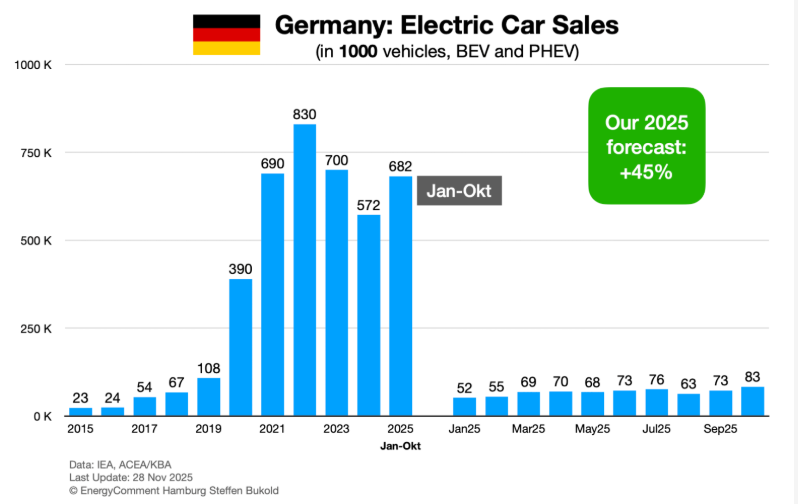
-
Occasional Thoughts on Climate Change
WolfStock1 replied to donsutherland1's topic in Climate Change
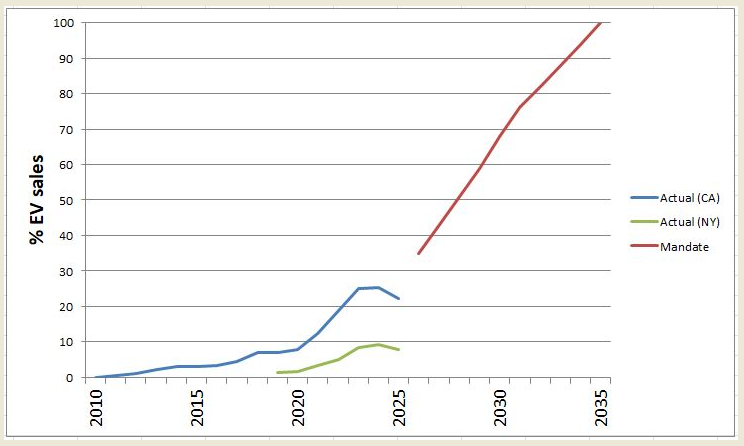
One thing I often talk about is "low hanging fruit". It depends on the technology, but very often trend bias applies when predicting future growth (the same thing that often happens with stocks, BTW). Looking at EV sales as example: Note that that prediction was made in what appears to be 2022 or 2023. However here is what has actually happened after that (in the two largest states, which have online dashboards with mandates): After the low-hanging fruit (rich people with easily-accessible charging at home or work) buying a second car was picked - sales are now falling - not continuing the upwards trend predicted. Same is true for solar and wind electricity generation. Note where all the larger solar and wind farms are - it's a lot easier to be less expensive when you install them in the easy low-hanging-fruit places to supply local electricity. Not so much when you need to feed the entire grid.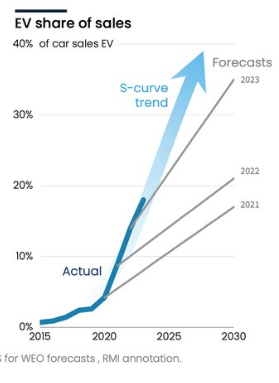
-
Occasional Thoughts on Climate Change
WolfStock1 replied to donsutherland1's topic in Climate Change
Wow. Just wow. I have news for you - I used to live in South Florida, and visited Miami regularly, and I have family that live on the west coast in Florida and still visit there regularly. It's nothing like you characterize. The primary source of flooding we generally saw was due to occasional heavy rains - not some kind of creeping ocean. You're quite the drama queen. You know nothing about the interactions of cities and oceans. Is there sometimes flooding from hurricanes? Yes there can be (I was there during Andrew). But it's always been the case - it's nothing new, and it's nothing horribly destructive and regular as you present. I'm quite sure that *you* do not and have not lived in such a place. If it was so bad - why do you think so much construction is going on there? Wouldn't people be moving *away* from there, instead *into* Miami (and Florida overall)? Miami's population has increased over 20% just in the last 20 years. I guess those people must be dolphins or something. I realize the NFL team is the dolphins - but I'm pretty sure the people that live there aren't *actually* dolphins. -
Occasional Thoughts on Climate Change
WolfStock1 replied to donsutherland1's topic in Climate Change
Miami being "under water" in 2075 or 2125 is the kind of absurdly-hyperbolic alarmism that I allude to in my other post. Sea levels have risen about 6 inches in a century, and you're proposing that Miami might be "under water" going forward in less than that time? Seriously? Can't you see how ludicrous this is? And no - the costs aren't the same. Infrastructure generally turns over every few decades or so. Miami as a whole is only 125 years old, and didn't really exist anywhere close to its current form until after WW2 70-80 years ago. Having it be destroyed over the course of say 30-50 years would be *way* more expensive than having it be destroyed over the course of say 300 years, because over the course of 300 years it would essentially be replaced anyhow (without any sea level rise) due to natural aging and replacement. Sea-level-induced replacement (inland and/or higher) would essentially be free. This discussion assumes, obviously incorrectly, that Miami wouldn't attempt to remediate via sea walls and the like. Even simply raising up the land and building new islands is not that hard - just look at the UAE. Regarding sources - IMO a research organization presenting a raft of sourced facts and figures is a lot more credible than some random poster on a message board. -
Occasional Thoughts on Climate Change
WolfStock1 replied to donsutherland1's topic in Climate Change
Stepping back - I would like to say, believe it or not, that I'm not anti-renewable-energy, by any stretch. It will eventually be inevitable and necessary, and will be a good thing in the long run. I'm being devil's advocate here because I see a big sales job being done - some would say a con job even - in overstating the progress of renewables, and in understating the downside costs of the big renewable push, in terms of the hit it's causing on the prosperity of our society. The migration to renewable is going to take a long time - likely well over a hundred years IMO if not two hundred, and it's going to cause significant and unavoidable pain. We have been in a golden age of easy energy with fossil fuels, and it will end. Fossil is simply easier than renewables, because of physics - primarily energy density; with us living within a few hundred years period reaping the benefits of millions of years of natural storage and compaction of energy into tiny masses of burnable stuff. It will eventually be gone, with us having to transition to renewables. (Short the other alternative which is extinction or at least near-extinction of humans) In pushing the transition to renewables as hard as we are we are though - before the transition would otherwise happen organically, we are only serving to increase that transition pain. And I'm talking net pain; after any benefit to slowing MMGW (which IMO is negligible) is included in the equation. -
Occasional Thoughts on Climate Change
WolfStock1 replied to donsutherland1's topic in Climate Change
Actually no - they're not Specifically a key benefit to fossil that is not achieved from renewables is baseline reliability. This is of course huge, and a complete deal-breaker when it comes to trying to use renewables for the lion's share of our energy sources, for the foreseeable future. As it is now renewables can only act as a supplement to the primary energy sources of fossil, nuclear, and to a small extent hydro. Renewables cannot act as a primary source without completely redundant systems (a deal breaker cost-wise) or huge growth in battery storage (also a deal-breaker for the foreseeable future). Somehow this keeps getting ignored/forgotten about. It's moving its way towards center stage though, as our electrical grid becomes increasingly unreliable, and our EV sales growth sputters as it has. The demand growth due to AI certainly isn't helping the situation - it is certainly pushing the issue more to the center of the stage. Add to that the scale factor. So far renewables have mostly been picking the low-hanging fruit - with power being supplied to the grid in areas where wind and solar are easy - the desert southwest for solar and the flyover country for wind. Trying to scale wind and solar from its current 15% of electrical supply in those regions to the 75-80% or so required nationwide (particularly in the harder-to-reach NE population corridor), and adding the increased demand due to EVs and AI is going to require incredible growth in our electrical grid infrastructure. The benefits-vs-cost equation starts to change dramatically after the low-hanging fruit has been picked. -
Occasional Thoughts on Climate Change
WolfStock1 replied to donsutherland1's topic in Climate Change
Nope. Read the links I posted for actual numbers. As of 2022 renewable energy comprised 53 percent of all energy subsidies. This includes tax incentives. And this despite renewables only being 21% of production. https://www.instituteforenergyresearch.org/fossil-fuels/renewable-energy-still-dominates-energy-subsidies-in-fy-2022/ The "when all financial factors are included" thing throws a bunch of subjective factors in that allow the author to twist the numbers to meet their agenda (like including "costs" in the equation for fossil fuel but not including the benefits). -
Occasional Thoughts on Climate Change
WolfStock1 replied to donsutherland1's topic in Climate Change
Bingo. chubbs and donaldsutherland1 don't seem to understand that "subsidies" and "costs" are not the same thing. You can't just lump them in together like that. If you're going to do that - you also have to include "benefits". Not doing so simply invalidates the argument. It's an attempt to distract from the actual argument, which is explicit subsidies. That is a valid discussion, and the data clearly shows that renewable energy receives far more subsidies than fossil-fuel energy. -
Occasional Thoughts on Climate Change
WolfStock1 replied to donsutherland1's topic in Climate Change
Sorry but that's laughable. They throw throw the whole kitchen sink in and call it "implicit subsidies". Traffic congestion is a fossil fuel subsidy? Why would traffic congestion from an ICE vehicle be any more a subsidy than than for an EV? Can you somehow magically fit EV's into a smaller space or something? I just bought some groceries at the local supermarket. I'm guessing that somehow fits into their "implied subsidies" bucket. No - renewable energy is far more subsidized than fossil, by about 30x as much. Lots of data here: https://www.cato.org/blog/fossil-fuel-subsidies-are-mostly-fiction-real-energy-subsidies-should-go https://www.eia.gov/analysis/requests/subsidy/pdf/subsidy.pdf https://www.instituteforenergyresearch.org/fossil-fuels/renewable-energy-still-dominates-energy-subsidies-in-fy-2022/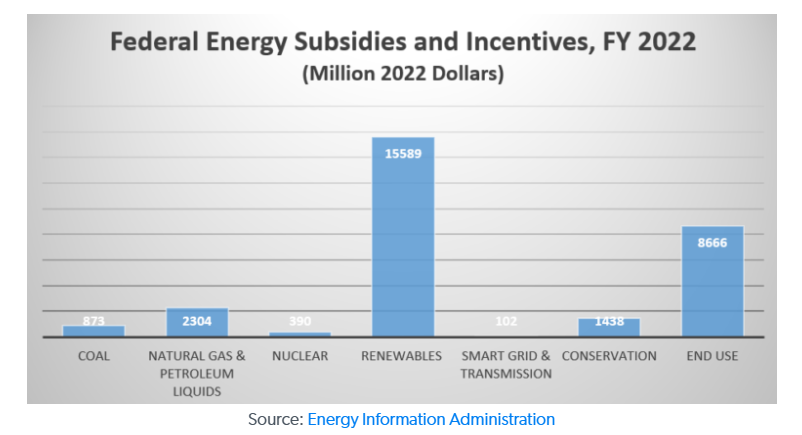
-
Occasional Thoughts on Climate Change
WolfStock1 replied to donsutherland1's topic in Climate Change
Yes and why have their costs been going up? Because of increasingly-onerous environmental regulations, including for CO2 emissions. It is not due to organic costs. E.g. the EPA in April 2024 implemented new regs requiring coal plants to cut C02 emissions by 90% by 2039 or be shut down. The cost to try to reduce emissions by this much is extremely high, and they know this. They are being forced closed, with "cost" as an excuse to hide the real reason. It's not naturally due to cost. -
Occasional Thoughts on Climate Change
WolfStock1 replied to donsutherland1's topic in Climate Change
I don't disagree with regards to the cost of new builds (though again - they generally don't take into account many factors including regulations, transmission lines, and opportunity cost effect on reliability). But the title of the article, and your comment, is referring to the cost of electricity, not the cost of new plants. They are not the same thing. Specifically a big contributor to rising electricity prices is the shutdown of existing operational plants, lowering the supply and thus increasing prices. You seem to keep ignoring/forgetting that. Electricity isn't just created by new-build plants. -
Occasional Thoughts on Climate Change
WolfStock1 replied to donsutherland1's topic in Climate Change
That article, and your preface, are very misleading. First of all - that's a prediction, not an observation. We see where many of the alarmists' predictions have gone - many have not come true. Second - "prices" aren't what's important - costs are. When you take away subsidies for something prices will naturally go up. But that's a good thing, because it means that the actual costs are passed to the end users, where they should be - not hidden in the form of higher taxes and general inflation. Third - most of the increase predicted there is not due to the slowing down of renewables, but rather due to the shutdown of fossil production, which is pushed by the climate alarmists; and also due to the ramp-up of demand due to AI, which has nothing to do with renewables or fossil, as well as new tariffs. The article states that the administration "is trying to suppress solar and wind" but presents zero evidence of that. In general that article is a hugely slanted (anti-fossil) fluff piece. Had to laugh at this: "Through 2030, fossil electricity from coal and gas can provide 40-75% of demand growth in the U.S." The guy apparently doesn't even understand the difference between supply and demand. Coal and gas provide supply, not demand. -
Occasional Thoughts on Climate Change
WolfStock1 replied to donsutherland1's topic in Climate Change
Picking some nits: Comparing averages across drivetrains isn't apples-to-apples, because it doesn't account for the mix; instead the comparison needs to be between like-vehicles - e.g. comparison for compact sedans, for mid-size sedans, etc. Also comparison needs to account for quality levels. "Lower price" doesn't equate to "out competing". In this case specifically - EV sales in China are only 37% of current sales (per your previous link). So non-EV are still out-competing EV. Re-iterating my point about subsidies; "out-competing" also implies level playing field. China, like pretty much every other country, heavily subsidizes their EV's, so it's not a level playing field. -
Occasional Thoughts on Climate Change
WolfStock1 replied to donsutherland1's topic in Climate Change
So basically two where EV sales are "out-competing": - Norway (super-cheap and easy electric via their natural setting for almost 100% hydro; sales boosted by subsidies) - Singapore (very wealthy and tiny; less than half the car sales of Iowa; sales boosted by subsidies) EV sales are certainly making progress (though now stalled in many areas), but I think you're overselling it a bit; especially given the subsidies that have been boosting them (thus my quotes around "out-competing"). As a point of US comparison - here's a chart showing the recent sales slump, and stalling of progress towards the CARB-mandated growth in 13 states, with the two key states of CA and NY shown: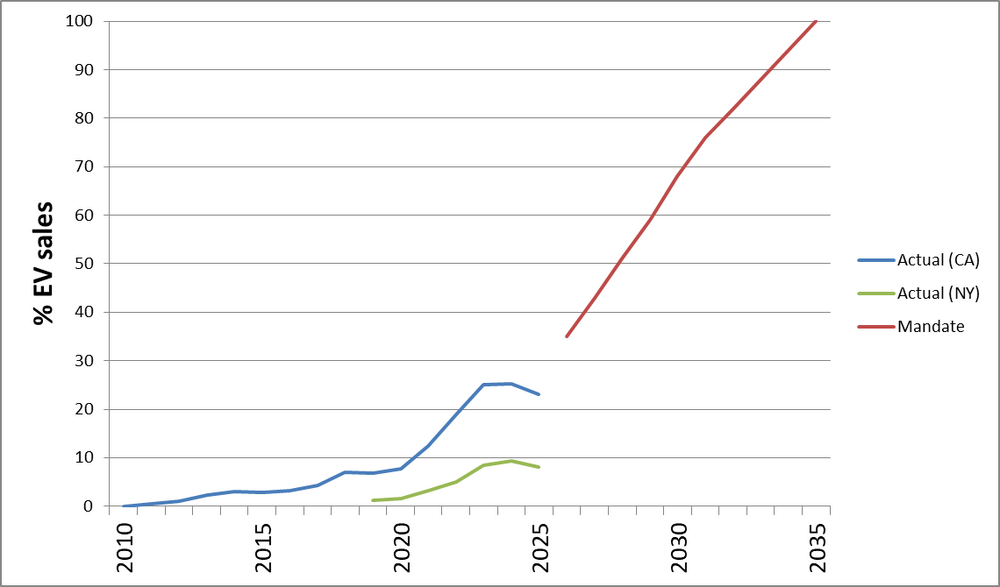
-
Occasional Thoughts on Climate Change
WolfStock1 replied to donsutherland1's topic in Climate Change
What markets? In the US - California has by far the highest percentage of EV sales of any state - and even there ICE vehicles are outselling EVs by over 3 to 1. And that was before the $7k tax incentive got removed recently. -
Occasional Thoughts on Climate Change
WolfStock1 replied to donsutherland1's topic in Climate Change
I don't have access to the study itself, but I wonder what all they include when calculating payback times. 6.1 months seems small. E.g. do they include: The energy to clear the forest, and grade the roads to the sites? The energy to build and install the additional power lines required to transport power from the generally-remote sites? The energy to run the vehicles to drive the workers to the sites? To provide their housing, food, etc.? In addition to the energy to build and transport the wind turbines - does it include the energy to build, transport, and run the cranes that erect them? The energy to mine the ore used for the steel for the turbines? The energy to create the trucks that mine said ore, to transport the ore to smelters, etc. ? Etc. etc. - probably thousands of components that could be included, that go into creating, installing, and running wind turbines ? (Obviously the same factors apply to all energy sources, not just wind) How far one goes with the energy required to do something ends up being a hard-to-define thing; the farther removed it goes from the end product the harder it is to gauge, since the uses of that energy end up overlapping with other uses (e.g. a given truck used to mine iron ore would mine ore used both for a wind turbine and for say an airplane). Nevertheless the fact that it's hard to measure doesn't mean it doesn't exist. There *is* a lot more iron, aluminum, etc. required to support wind farms; in no small part because they are mostly-redundant systems; they don't replace baseline systems (mostly nuclear, hydro, fossil) but instead are generally additive. With a number of only 6.1 months payback - I'm guessing they didn't go that far out the chain of dependencies. That number seems very small to me. I'm willing to be it's compiled by people who have a vested interest in making it as small as they can. -
Occasional Thoughts on Climate Change
WolfStock1 replied to donsutherland1's topic in Climate Change
I'm sorry, but those numbers don't even come close to passing the sniff test. E.g.: ---------------------------- Alternatively, energy payback may be measured by ‘number of times payback’ – meaning, the amount of energy paid back to society versus the energy needed in the lifetime of that turbine. Over the life cycle of a V117-4.2 MW wind power plant, it will return 50 times more energy back to society than it consumed. That means that when 1 kWh is invested in a wind energy solution, you get 50 kWh in return. For coal, however, if you invest 1kWh you typically get below 0.4 kWh in return. ------------------------ They're honestly asserting that the trillions of $ invested in the coal and oil industries have provided *negative* energy returns? That makes no sense. Given the source though - a windmill manufacturer - it doesn't surprise me. Much like the oil industry shills - they have a vested interest (no pun intended) in making competing technologies look bad. -
Occasional Thoughts on Climate Change
WolfStock1 replied to donsutherland1's topic in Climate Change
No. -
Occasional Thoughts on Climate Change
WolfStock1 replied to donsutherland1's topic in Climate Change
Perhaps Vogtle is an outlier, but it's still clear that costs are way above where they should be, based on the skyrocketing trend in the late 80's; and noting that that was generally for just completion of plants whose initial planning and design was done *before* TMI. Not sure what you mean by "the workforce" being the primary road block. Workforce expertise is flexible - if we started getting serious about nuclear energy and ramping it up, the workforce would follow, just like it has always done for so many other things (e.g. look at the explosion in AI recently, the explosion of the internet in the late 90's, etc. etc.). Demand creates the workforce - the workforce doesn't create demand. -
Occasional Thoughts on Climate Change
WolfStock1 replied to donsutherland1's topic in Climate Change
BTW w/regards to the US and renewable - we have in fact been trending strongly on that recently. This year about 3/4 of our new generation capacity was solar. https://www.utilitydive.com/news/us-installed-nearly-26-gw-of-new-generating-capacity-from-january-to-august/804848/ As it has for most of the past two years, solar continued to dominate new generation resources, accounting for 2.7 GW out of 4 GW brought online in August alone, and 19 GW — about three-quarters — of generation capacity additions this year. (Not sure if that capacity is peak or average; average on solar is of course a fraction of peak) There's a new field being done near me (at Dulles airport). Unfortunately these things take tons of space - this will be about 100 MW peak on 835 acres. By comparison there's a 774 MW natural gas plant down the road on 100 acres. So it takes about 200x the land area per unit of energy. If we can find the space great - just please don't use areas that otherwise could be forests. (not sure about this area since it's airport property) -
Occasional Thoughts on Climate Change
WolfStock1 replied to donsutherland1's topic in Climate Change
100% agree - and thanks for the chart. (though I would quibble with the China trendline - having it slope down IMO is a stretch - it appears the downslope is based solely on those couple of early 90's extreme outliers; in reality the trend is flat, if it were based on median not mean). That's a good illustration of how badly skewed the American view on nuclear energy risk is. We need to fix that. Much as I dislike Trump, he's at least taken some steps in that direction on this issue; though I think it's a drop in the bucket to what really needs to be done. The cost #'s for the two new Vogtle units are simply shocking; especially given the location - in a state that's generally been more friendly to nuclear power. NY recently announced intent to pave the way for one new unit, and I had to laugh, knowing that state's history. Good luck with that.