WolfStock1
-
Posts
279 -
Joined
-
Last visited
Content Type
Profiles
Blogs
Forums
American Weather
Media Demo
Store
Gallery
Everything posted by WolfStock1
-
Occasional Thoughts on Climate Change
WolfStock1 replied to donsutherland1's topic in Climate Change
Why would a negative feedback be required to stop warming? Warming is by definition not a state of equilibrium. Cessation of warming would only require removal of positive influence, not the introduction of a negative influence. Specifically - at some point we're going to run out fossil fuels to burn (albeit slowly). Unless I miss my guess - that will result in CO2 growth in the atmosphere slowing to a halt, and then probably reversing some as it gets re-absorbed by existing plant life. (That offset is already taking place to some extent vis a vis the greening that's being seen; though the effects are small right now). That aside - surely you understand that there are all kinds of as-yet-unmodeled effects that can happen, right? Despite the growth of AI - we are not yet omniscient. (Of note: Your question isn't actually relevant to the question at hand, since we're talking about world death, and even the most extreme models e.g. RCP 8.5 don't call for that. I don't believe *any* models call for that.) -
Occasional Thoughts on Climate Change
WolfStock1 replied to donsutherland1's topic in Climate Change
Well except that wasn't the topic, if you follow the discussion back. The topic was existential crisis, which is not the same as progressive or even accelerating levels of impacts. ("Exist" of course being the root of "existential") To equate those two would require a third assumption - that the progression would either continue forever, or that it would reach a pace where adaptation is impossible. The first is physically impossible. For the latter - given the adaptability level of humans - our ability to live in both in the arctic and the extreme tropics, and the fact that earth has transitioned through *all* extremes several times in the past, with life still thriving, it will certainly not be happening. -
Occasional Thoughts on Climate Change
WolfStock1 replied to donsutherland1's topic in Climate Change
There are many elephants here. In this case I'm just giving an example of how the world benefits from fossil fuel use. Multiply that times a couple billion, and you can see how it has brought prosperity - including things like the ability for humanity to help the world in various ways - including helping to do things like preserve endangered species. And... doing things like flying hundreds of jets each year to climate conferences (?) -
Occasional Thoughts on Climate Change
WolfStock1 replied to donsutherland1's topic in Climate Change
Yes - specifically referring to the pre-1990s period when a lot of disasters went unreported, due to lack of detection (satellites) or mechanisms (internet). (it's talked about elsewhere on the page that's from) Surely you wouldn't propose that detection/reporting rate has gone *down* would you? What would be the reason for such a thing? Re: insurance - obviously the financial damages from disasters has gone up tremendously. And FWIW - I wouldn't propose that there isn't at least *some* increase in actual disaster levels in the works due to CC (despite the chart I posted); it's hard to tease out the level due to the noise of natural random variation. I'm just illustrating that it's clear that there's not some kind of world-threatening trend here, by any stretch. -
Occasional Thoughts on Climate Change
WolfStock1 replied to donsutherland1's topic in Climate Change
It is?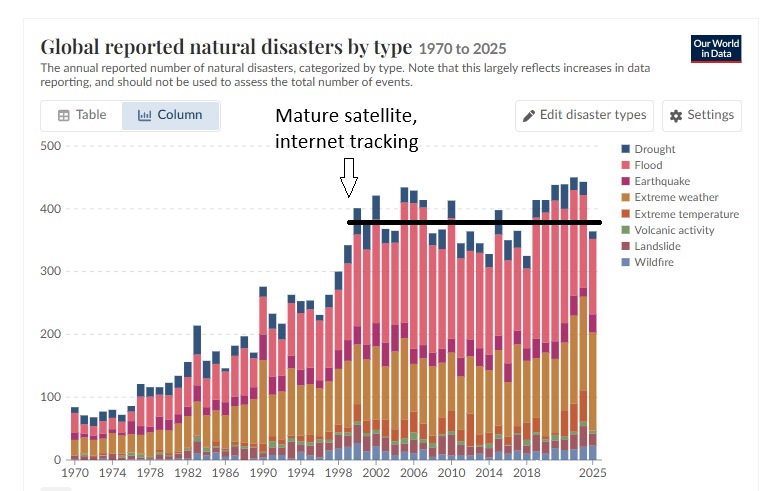
-
Occasional Thoughts on Climate Change
WolfStock1 replied to donsutherland1's topic in Climate Change
The increased economic damage is due to the huge increase in building on the coasts, in particular of luxury properties. I lived right on the coast in both FL and CA over the past few decades, and have seen in firsthand. Much of it also is due to generally increased economic prosperity (and population increase), and due to inflation. As your economy grows, you're going to have a lot more stuff that can get damaged. Not an indicator of "world death" but actually the opposite in fact. Re: European heat wave Much of that could have been prevented if a lot more people had air conditioning, as they do in places like the US.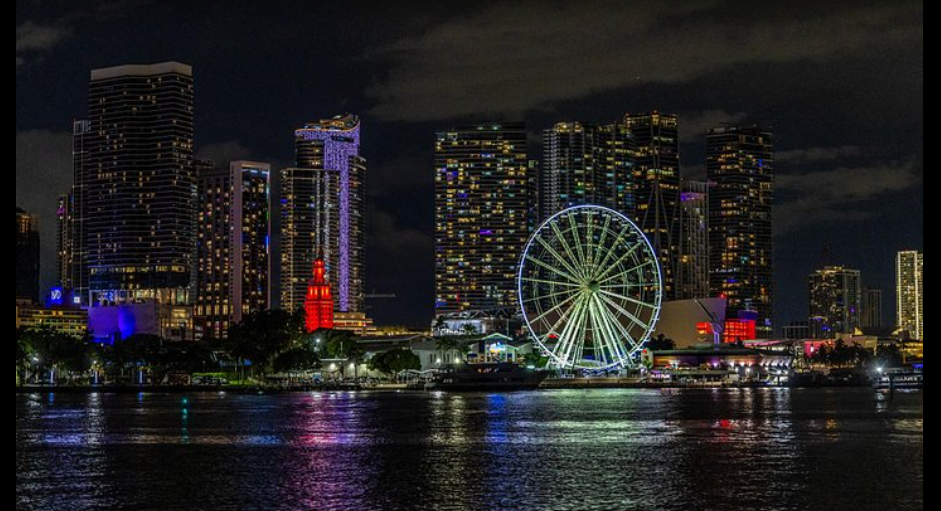
-
Occasional Thoughts on Climate Change
WolfStock1 replied to donsutherland1's topic in Climate Change
My thoughts are - that was a nasty weather event; I'm glad those coral species were saved, and I'd be willing to bet that a lot of fossil-fuel-burning boats were involved in the process of recovery. -
Occasional Thoughts on Climate Change
WolfStock1 replied to donsutherland1's topic in Climate Change
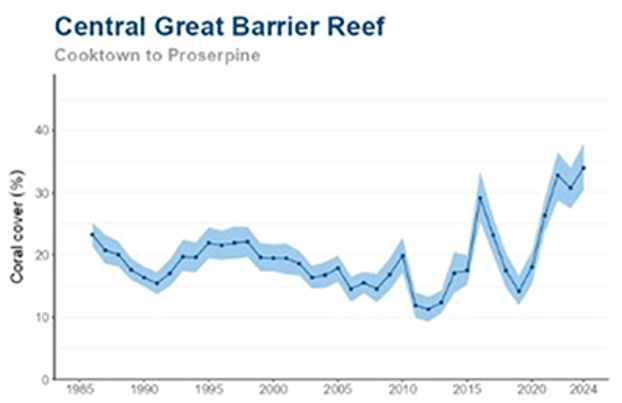
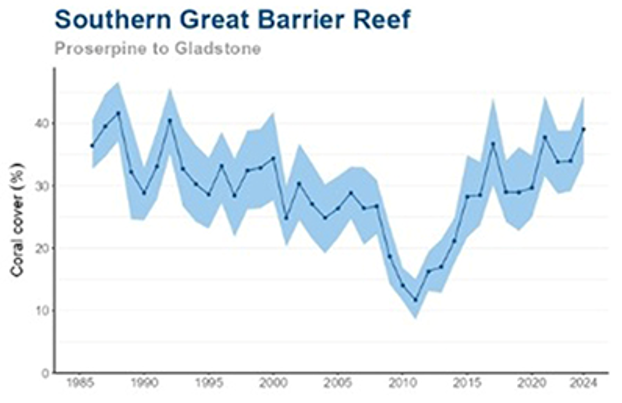
Re: reefs Generally hitting record levels these days, e.g.: https://www.aims.gov.au/monitoring-great-barrier-reef/gbr-condition-summary-2023-24 There's only been significant record-keeping since the 1980's, so we don't know what the trend is, or whether or not bleaching events that we've seen are normal vs CC-caused or not. Certainly not seeing any "death of the world" trending there. Re: Extinctions - let's look at that, shall we? Here's a database of recent extinctions: https://recentlyextinctspecies.com/database/most-recent-global-extinctions Starting from the top: Achatinella apexfulva - land snail; native to Hawaii; made extinct by introduction of predator by the rosy wolfsnail, deforestation, and the Jackson's chameleon. Not climate change. Ecnomiohyla rabborum - Rabb’s fringe-limbed treefrog; made extinct by chytrid fungus. Not climate change. Microcolpia parreyssii parreyssii - Parreys' thermal snail; existed in only one tiny locaion, made extinct by groundwater extraction. Not climate change. etc. etc. (not about to look up the details on the whole list) Wikipedia list of extinct species: https://en.wikipedia.org/wiki/Lists_of_extinct_species Cursory search - could not find a single one made extinct by climate change. There are thousands of them listed though, so maybe there are some I didn't see. The vast majority of extinctions happening, by far, are due to things *other* than climate change. Hunting, fishing, habitat loss due to deforestation, introduction of new predators, etc etc. Most of these are human-caused, yes, but not climate change. Bottom line: Fearmongering. There is no "world death" looming, of any sort. At least not due to climate change.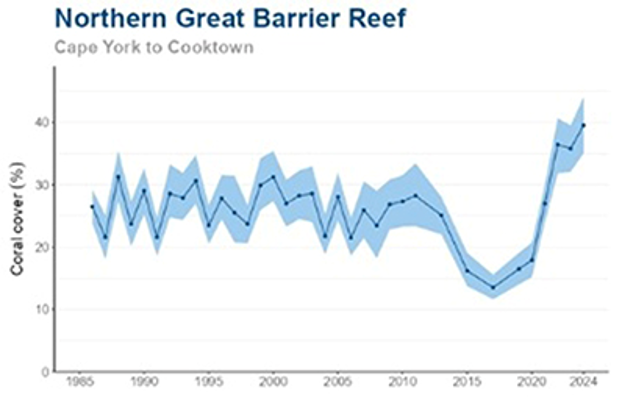
-
Occasional Thoughts on Climate Change
WolfStock1 replied to donsutherland1's topic in Climate Change
Going to put this out there. I've always been a bit of a weather nerd (thus generally enjoying this site) - many in my family are (though just casual). I've generally had a big respect for the meteorology profession, and my son is in fact now starting college in meteorology. But I have to say - some of this is starting to make me lose a lot of respect for the profession; the disregard for solid scientific principles in favor of bending to the winds of societal fearmongering. I'm sure it's not true of a lot of people in the profession; hopefully not most. It's just dismaying to see how prevalent it is. </soapbox> -
Occasional Thoughts on Climate Change
WolfStock1 replied to donsutherland1's topic in Climate Change
You keep shifting around the goalposts, even in your own posts. What kind of "death" are you talking about here? Because each type is hugely different. When you're talking about "world destiny" (your original) words, are you talking about: Death of humanity? Death of a bunch of non-human species? Death of "the world" - encompassing all of the above (a literal wasteland)? Each of these is *massively* different in their proposed causes, timeframes, scales, etc. Your term "world destiny" certainly sounds like the first or the latter, not just the death of a few species. While there are certainly a lot of species dying off in recent years - it has very much *not* been due to global warming; it's generally been due to habitat removal; in particular things like overfishing and overhunting (generally under control now), and forest clearing due to harvesting, farming, and development (still ongoing; though improving somewhat). On the latter - it's worth noting the massive acreage of forests that will be need to be cleared (or not allowed to regrow) to meet solar farm proposals; e.g. the 277,000-acre proposal in VA. If you're talking death of humanity - I refer to my previous chart, among other hopefully obvious things. The use of fossil fuels very much *lessens* the level of human deaths, in many, many ways. If things like king tides in Miami are such a big danger - wouldn't one expect the number of annual deaths from natural disasters to be steadily rising - not falling? Why aren't we seeing news reports of all these deaths being caused by these king tides? That seems... mysterious. -
Occasional Thoughts on Climate Change
WolfStock1 replied to donsutherland1's topic in Climate Change
Nothing that I posted there is misaligned with any of my previous posts, at least that I'm aware of. That's another disturbing trend I see. Anyone who tries to be pragmatic (e.g. playing devil's advocate with some assertions, as I am wont to do) is labeled "DENIER!!!". It's why a lot of people see religious / cultish aspects in the movement.- regular attempts to label those who don't agree whole cloth with the most extreme positions as heretics. -
Occasional Thoughts on Climate Change
WolfStock1 replied to donsutherland1's topic in Climate Change
Look - I am *not* attempting to assert that CO2, vis a vis fossil fuel burning, is not a long term problem. It is. My assertions are the following: That it is not an existential crisis, or anything close to it That our policy efforts to solve the problem have been and continue to be misguided; specifically in that they a) have less positive impact in fixing the problem than most people think, and b) have more negative impact than most people think - both economically and environmentally -
Occasional Thoughts on Climate Change
WolfStock1 replied to donsutherland1's topic in Climate Change
Wow.... just.... wow. Listen to your yourself. I'll just put this here, and let you struggle with your existential crisis. Let me know when that trend starts upward due to our fossil fuel burning, so I can... run somewhere or something.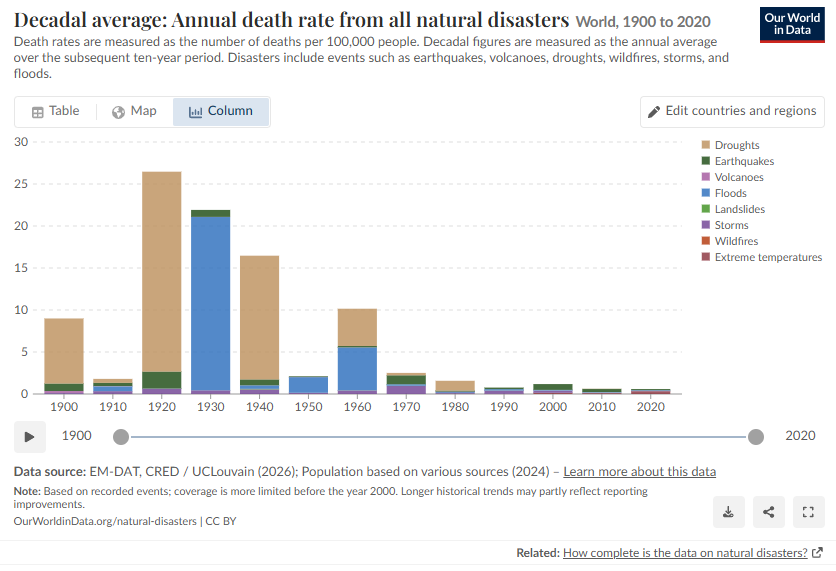
-
Occasional Thoughts on Climate Change
WolfStock1 replied to donsutherland1's topic in Climate Change
So your rebuttal is to latch onto one tiny bit in what I say, and misrepresent it? I did not say a windmill can kill a whale. That's the kind of mis-reading that causes people to misunderstand things, like the actual effects of climate change. -
Occasional Thoughts on Climate Change
WolfStock1 replied to donsutherland1's topic in Climate Change
Yes perhaps, but one would also need to include the costs for lower lifespan of solar and wind, the costs for recycling the very hard-to-recycle materials, the environmental costs of the things that can't be recycled (e.g. carbon-fiber blades), the costs for acquiring the land (including the huge amount of community-by-community fights that inevitably happens), the environmental costs of dead and disturbed wildlife - birds, whales, etc. (how to quantify?), and of cleared balsa forests, the cost for additional land and steel required for additional transmission lines, etc. etc. Also keeping in mind that this does not scale linearly. As the scale of projects get larger and larger (e.g. Spanberger's proposal for 277,000 acres of solar in Virginia), it drives the costs of material - e.g. silver for solar panels - up, due to their relative scarcity. These things are not nearly as simple as people make them out to be, due to the immense amount of factors, which is why you have to look at the bigger picture, such as what's been happening in Europe (and to a smaller extent the US). I mean - just step back and think about it. Electricity prices (especially in Europe) have been rising - faster than inflation. Is it because of rising oil prices? No - it can't be, because we don't use oil for generating electricity. Is it because of the price of coal? No - that's generally been flat (save for a big spike in 2022) since 2008 https://ourworldindata.org/grapher/coal-prices. Is it because of the price of Natural gas? No - that's been *down* the last couple of decades: https://www.eia.gov/dnav/ng/hist/rngwhhdm.htm. Why then? Why have electricity prices been going up so much? Is it just coincidence that it happens to be happening at the same time as we've pushing for replacement of fossil plants with renewable? No. Keep in mind that this is *despite* the money that's been flowing into the renewable energy industry, vis a vis our taxes. Without that electricity prices would be even higher. (and lest one be tempted to blame the price increase on increased demand from AI and data centers - keep in mind that the electricity prices started getting higher long before that recent demand spike) P.S. that Fresh Energy link is from what is essentially a renewable energy lobbying organization - extremely biased. The EIA link doesn't really provide any useful information for the conversation. -
Occasional Thoughts on Climate Change
WolfStock1 replied to donsutherland1's topic in Climate Change
Look at the data. Europe in general has had a heavier push for renewables, and has seen higher rises in electricity prices than has the US as a result. It's clear. https://www.wsj.com/opinion/climate-policy-reality-europe-energy-costs-gas-coal-11632754849 https://www.wsj.com/business/energy-oil/europes-green-energy-rush-slashed-emissionsand-crippled-the-economy-e65a1a07 etc. etc. Don't just look at the costs of individual projects and "peak output" which is what's often widely touted. Peak output is meaningless by itself. The problem is that renewables can't exist in a vacuum - they are too unreliable. Thus *even* if renewables could be less expensive than fossil on a per-KW basis (it generally isn't) - the overall *solution* is more expensive, because the fossil cannot be removed - it has to also stay in place to pick up the slack when unreliable wind and solar aren't present. Taking a specific case near where I live. There's an 800-acre 100 MW solar plant being installed right here (northern VA). Cost is $200 million. Since the capacity factor of solar here is about 20%, that makes it roughly $10M per MW. Compare that with a natural gas plant just down the road - 774 MW (about 540 MW w/capacity factor of 70%), and a cost of $778M. Thus it cost about 4x as much to build - but will be producing about 28x the electricity, and much more reliably so. Then compare with Kemmerer SMR being built in Wyoming. Cost is estimated to be $4B; will be putting out about 345 MW. Thus will be about $11.5M per MW - about the same cost as solar. And that's the *first* SMR being built - costs of future ones will come down a lot. Look at the numbers. Look at the *actual* numbers, not the theoretical ones. Look at the constant stream of renewable projects that have to be canceled to high costs - either during construction or during maintenance. Look at the interplay between sources of energy. Look at geography. Look at weather. Look at where people live, and what it takes to get electricity from there to here. Look at infrastructure. Look at land space usage. Look at materials usage (rare earths, silver, etc. etc.). Look at life spans, cycles, and recycling of materials used for generation. Etc. etc. -
Occasional Thoughts on Climate Change
WolfStock1 replied to donsutherland1's topic in Climate Change
There are many reasons for our energy cost increases, but the vast majority has been renewables. There is reams of data and articles on the subject, going back to before the current supply disruptions. Posting data from ERCOT is cherry picking. Texas is the one state that has the best blend of geographical conditions for wind and solar. As I say - low hanging fruit. Now do the same PJM (largest grid) and others. It's kind of like when people point out how Norway is so green with their renewables - well duh; they live in a population-sparse country with tons of mountains - perfect conditions for hydro. Most of the rest of the world doesn't have that geographical luxury. -
Occasional Thoughts on Climate Change
WolfStock1 replied to donsutherland1's topic in Climate Change
I think you're generally reinforcing my point, which is that this thing is much harder than most people thought it would be, and we're making less progress than people thought we would even given the increase in the use of renewables that we've seen. You say "Renewables only began to move the needle in this decade.", but there is no "this decade" in that chart - there is only "this year", which happens to be an extreme outlier w/El Nino, showing anything other than the same trend upward. I think that's likely the main factor, and not primarily due to energy policy. Only time will tell though, in the years ahead. If it's truly due to energy policy then we should see a continued bending-down of the curve. My additional assertion would be - this is also turning out to be more economically disruptive than anticipated; vis a vis the increases we've seen in electricity prices, and the resulting economic headwinds that have been experienced, in particular by countries that have had more aggressive renewable policies. -
Occasional Thoughts on Climate Change
WolfStock1 replied to donsutherland1's topic in Climate Change
I'm not seeing any slowing in the growth rate: (black line is a straight line) There *might* be a down year this year, but that's clearly just noise if so. Trends like this don't change that rapidly. Even the early 90's apparent flattening was clearly just a noise fluke.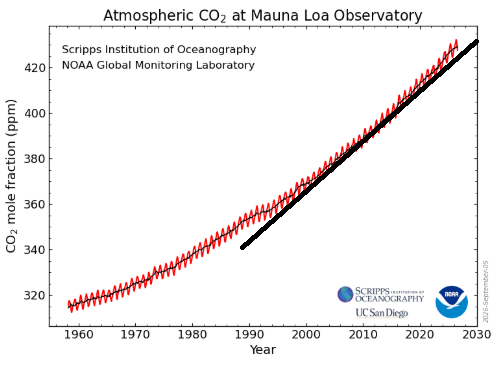
-
Occasional Thoughts on Climate Change
WolfStock1 replied to donsutherland1's topic in Climate Change
I'm sensing a cognitive disconnect here. We keep hearing about supposedly-good shifts in CC trends, for years now, and yet this most-important trend - the end result - seems to be unaffected by these shifts: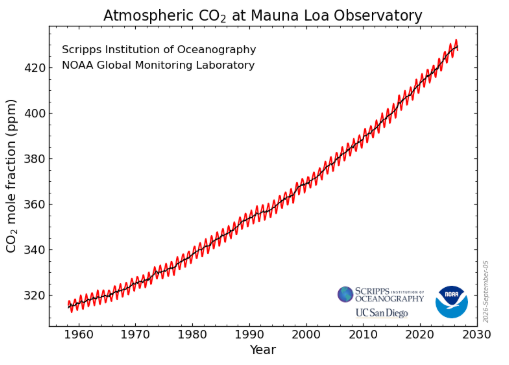
-
Occasional Thoughts on Climate Change
WolfStock1 replied to donsutherland1's topic in Climate Change
You're wrong on pretty much all that. - China's labor costs are roughly 1/3 that of the US. And there is no such thing as "unskilled labor" any more - any thing that used to be unskilled is done by machines now. - China's environmental policies have generally been way worse than the US. They're doing things that in no way would be feasible on the US - displacing cities and filling valleys to build dams, thousands of square miles of solar panels in wetlands and lakes, transmission lines that run all over without community pushback, etc. etc. - Renewables have gotten vastly more subsidies on a per-unit-of-energy basis than fossil fuels, which is what counts. - While wind farms *can* be built near the coast - they provide tiny amounts of energy and at huge environmental and economic costs, which is why so many projects have been canceled lately, and why you see numbers like 2.3% for the PJM region, even though it abuts the coast. The only region that's gotten any kind of bang-for-the-buck on offshore wind is places Denmark and the North Sea, because they've got the perfect geographical conditions for it there. The rest of the world not so much. - Can't speak to your house situation, since there are a host of untold factors (e.g. your location etc). But I suspect if you took at honest look at all the factors, including things maintenance and replacement costs (not just your system but the whole roof), and subsidies - you'd find it's not as cost-advantageous as you think. Also you're talking one tiny part of overall energy consumption - a house. That doesn't help things like factories, aviation, commercial transportation, etc. that use lots of fossil fuels. And it doesn't help the 95% or so of people who have living conditions that aren't amenable to rooftop solar, like non-south-facing houses, and multi-story apartments - virtually anything with a city. You've bought into all the green lobby talking points. You need to look under the hood more at the whole story. -
Occasional Thoughts on Climate Change
WolfStock1 replied to donsutherland1's topic in Climate Change
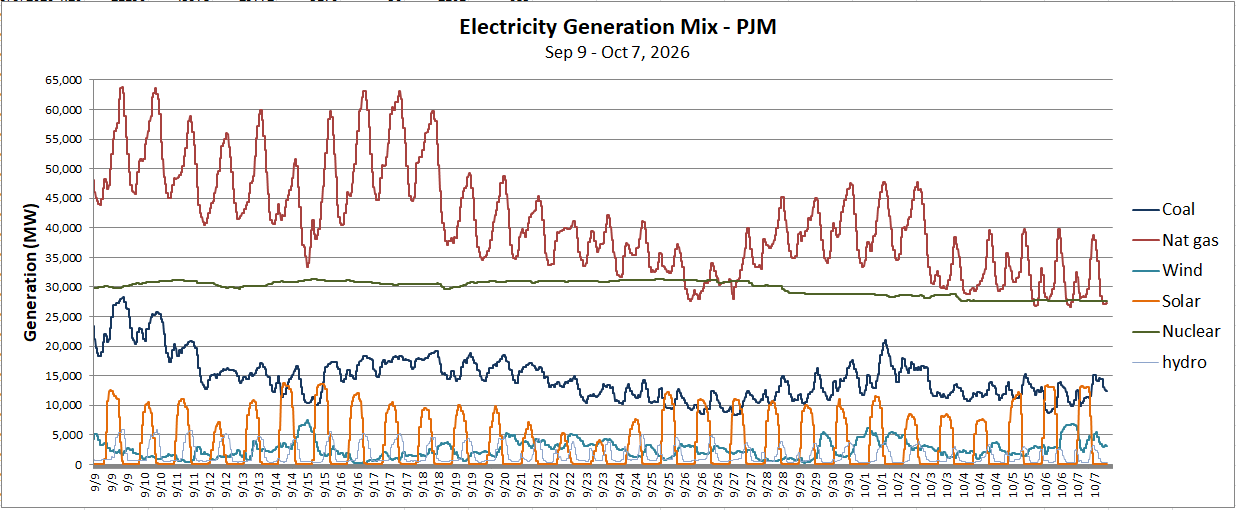
Yes and the vast majority of that was low-hanging fruit - in rural areas of a tyrannical country - China, where they have cheap labor and little regard for the environment or human rights. Here in the rest of world though things aren't so easy. As an example - here's the mix for the past month for PJM interconnect - the largest electrical grid in the US: https://www.gridstatus.io/live/pjm Only 2.6% was wind, and 3.7% solar. The vast majority is natural gas, nuclear, and coal. This is after several decades of big subsidies for renewables - still only 6% of the mix, in the largest grid in the country. Why, may you ask? Because a lot of people live here. It's just really hard to put solar and wind where people live. Because as I say - it take a lot of room, and a lot of resources. And people don't like it when your replace their local forests and farmlands with fields full of man made industrial stuff.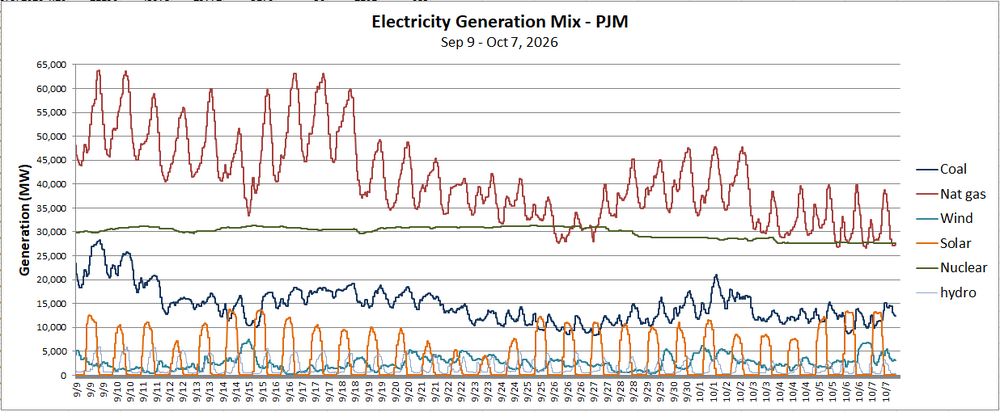
-
Occasional Thoughts on Climate Change
WolfStock1 replied to donsutherland1's topic in Climate Change
Hate to be the bearer of bad news then - coal's of course not the only fossil fuel in play: Net zero by 2050's not looking so likely. IMO the *only* thing that really has real potential to bend that curve down is nuclear - not solar, not wind, not hydro. Those can make dents, but only small ones. Physics - specifically energy density - really, really matters. If you don't have density you have to make up for it with size - but you can only go so big before you start running into problems.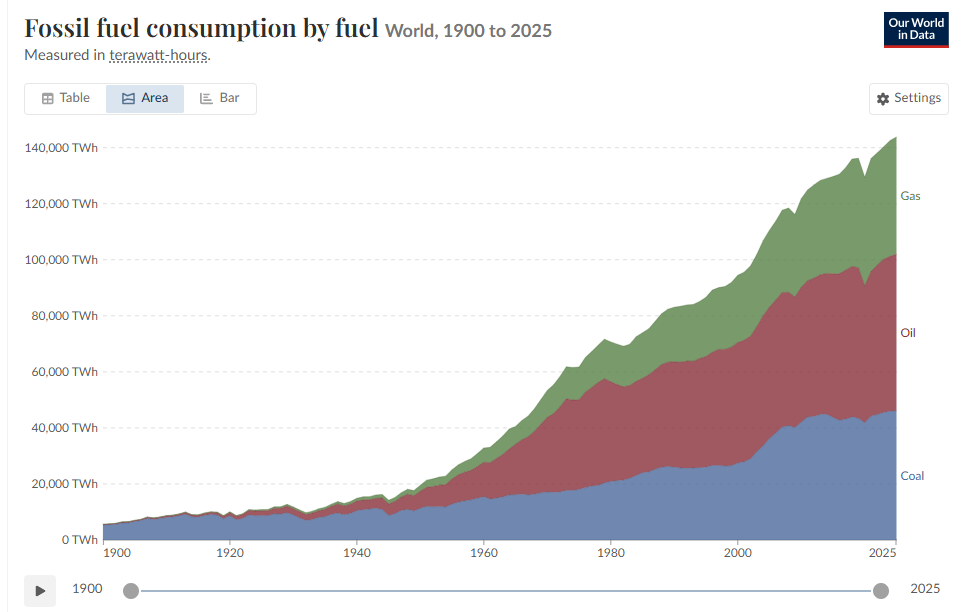
-
Occasional Thoughts on Climate Change
WolfStock1 replied to donsutherland1's topic in Climate Change
Without hope of what? Re: the chart - that's only for electricity production. Now do *all* energy, and in nominal not percentage terms, which is what really matters. I'll start with coal, the use of which isn't actually going down: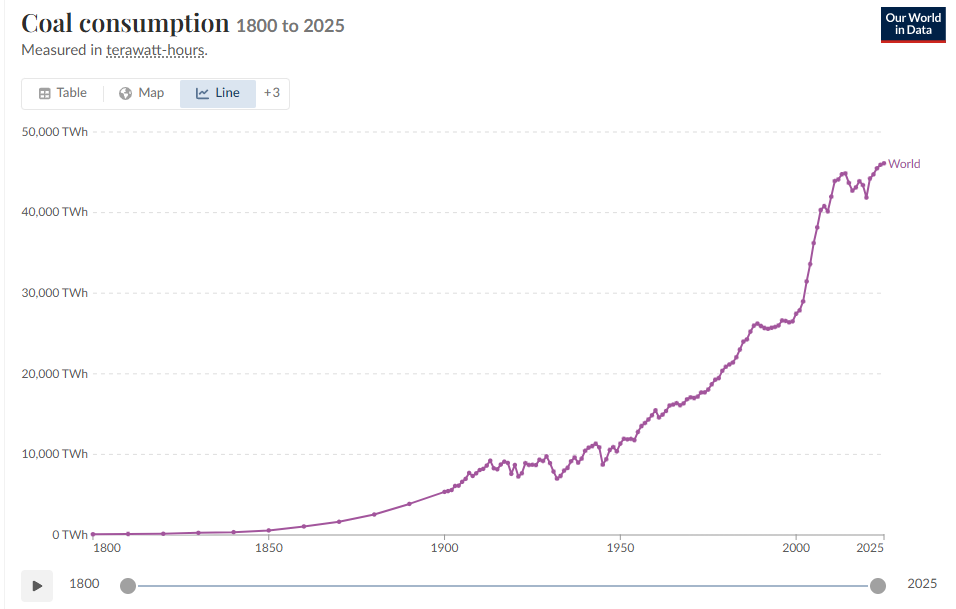
-
Occasional Thoughts on Climate Change
WolfStock1 replied to donsutherland1's topic in Climate Change
Yeah good point / info about the earthquakes. This kind of thing (glacier collapse) seems pretty similar to earthquakes in that there's just no way to know why or when a given one happened at a given time and place - the variables (essentially infinite number of land connection points / stresses) are just too numerous, and basically just not measurable. With meteorology at least the inputs - while still numerous - are actually *measurable*.