Jns2183
-
Posts
5,869 -
Joined
-
Last visited
Content Type
Profiles
Blogs
Forums
American Weather
Media Demo
Store
Gallery
Everything posted by Jns2183
-
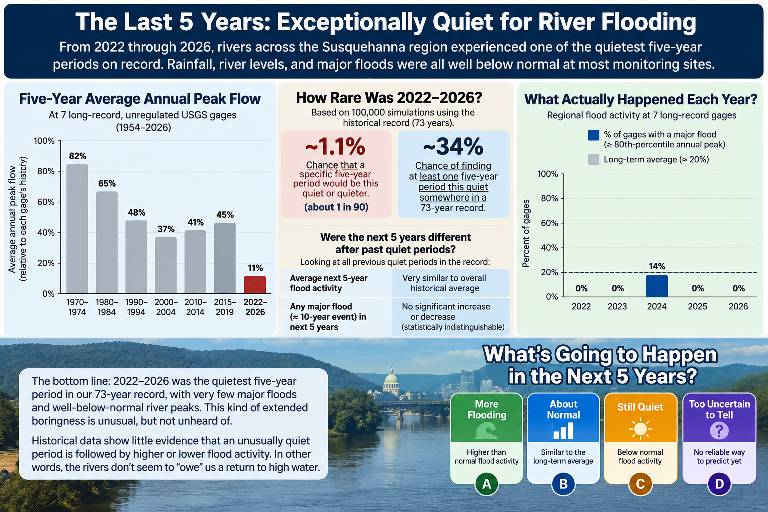
we have had an absolutely unbelievably boring past 5 years and I mean just earth-shatteringly boring weatherwise compared to any semblance of normal. the single most consequential weather thing to happen to me unfortunately was this summer being without power for 4 days it sucked it also was the only exciting weather event in The last 5 years. Five Years of Hydrological Boredom in South-Central Pennsylvania From water years 2022 through 2026, the Harrisburg region has experienced a remarkable absence of major river flooding. Not that it never rained, or that individual storms didn't cause problems. But the annual flood peaks across our rivers and creeks have been astonishingly subdued. In a consistent seven-gage network covering 1954–2026, the past five years rank as the quietest five-year stretch in the entire 73-year record. Even the Susquehanna at Harrisburg recorded an exceptionally low annual peak in 2026. How unusual is that? In simulations that preserve regional flood relationships, a particular five-year period this quiet occurred roughly 0.6%–1.1% of the time, depending on how consecutive years were resampled. And here's an interesting historical observation: among 13 unusually quiet five-year windows with follow-up data, nine were followed by five years of above-median flood activity. However, those windows overlap and represent only six distinct episodes, so this is not proof that a flood-rich period is coming. Rivers do not accumulate unpaid flood debt. So here's the question: After five extraordinarily boring years, what will 2027–2031 bring to south-central Pennsylvania? A. More of the same: another unusually quiet five years. B. Back to ordinary: a fairly typical mix of wet and dry years. C. A flood-active stretch: above-normal river flooding returns. D. The pendulum swings hard: one or more major, memorable regional floods. What's your prediction? Sent from my SM-S731U using Tapatalk
-
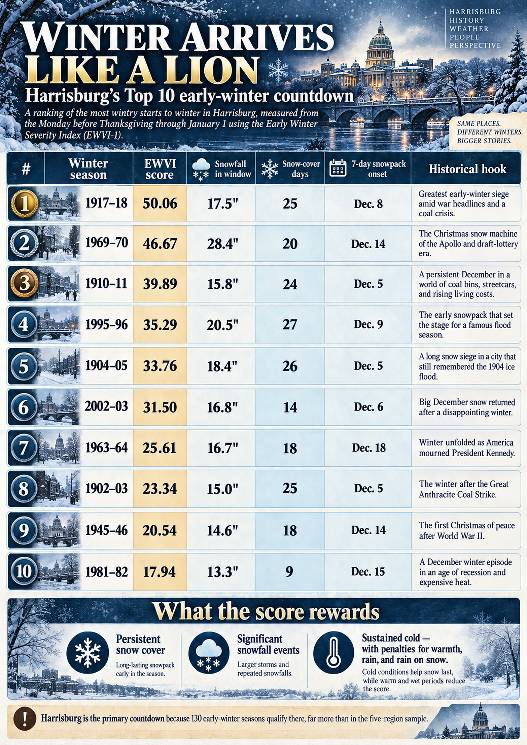
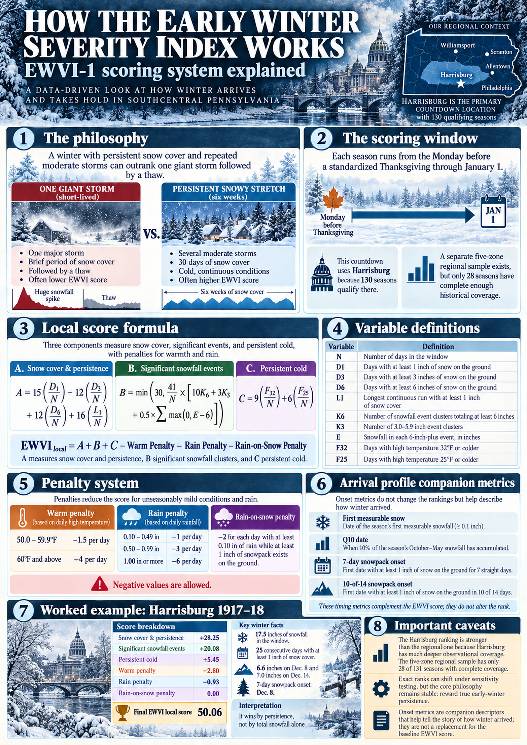
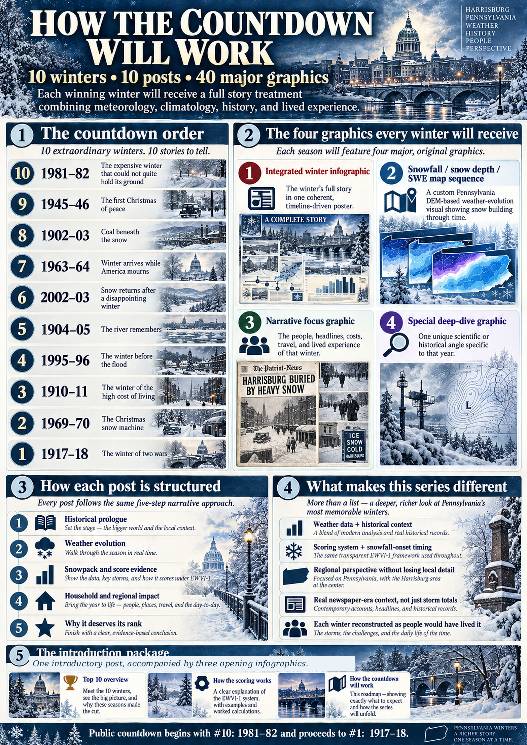
WINTER ARRIVES LIKE A LION Ten of Harrisburg's Most Wintry Starts to Winter, 1895–2026 TWO DECEMBERS. TWO VERY DIFFERENT WAYS TO REMEMBER WINTER. Imagine it is December 1917, and Christmas is approaching in Harrisburg, Pennsylvania. The United States is at war. Headlines speak of battles overseas, troop mobilization, and a newly declared war against Austria-Hungary. At home, people have a much more immediate concern: COAL. For many families, coal is not a quaint old-fashioned detail or a decorative fireplace accessory. It is what keeps the house warm. The warnings have been building for weeks. On November 26, the Harrisburg Telegraph reports that city officials are considering coal cards to manage an anthracite shortage. On December 4, it announces a 35-cent-per-ton increase in domestic anthracite prices. By December 18, the paper is reporting promised coal-car shipments for Harrisburg and Steelton, while ice on the Susquehanna interferes with river coal deliveries. Now think about what that means in a household with a coal-burning furnace. It is not even Christmas. The question is no longer whether the holiday will be white. It is whether the next coal delivery will come before the bin runs too low, and whether the household can afford it when it does. And the weather is not cooperating. Harrisburg records 6.6 inches of snow on December 8, followed by 7.0 inches on December 14. Snow cover establishes itself on December 8 and survives 25 consecutive days through New Year's Day, every one of those days maintaining at least three inches on the ground. There is a kind of winter that delivers a beautiful holiday scene. And then there is a winter that takes possession of the landscape while the people living in it are wondering how they're going to keep warm. Keep that December in mind for a moment. Now jump forward almost a century, to December 19, 2009. For many weather enthusiasts around central and southeastern Pennsylvania, the great pre-Christmas snowstorm is still a treasured memory. The Harrisburg station in our study measured 8.8 inches from that storm, with far greater totals farther southeast. For a little while, winter seemed to have arrived in spectacular fashion. But our full Thanksgiving-to-New-Year's analysis tells a surprising second story. Harrisburg accumulated 14.1 inches of snowfall during that 2009–10 scoring window, yet had only 11 days with at least an inch of snow on the ground, and its longest uninterrupted snow-covered stretch was seven days. Warmth, rain, and rain falling on snow outweighed much of the snowfall's positive contribution. Its final score was −4.88, placing it 44th among 130 eligible early winters. The December 2009 storm was memorable. The entire early-winter period was something else altogether. THAT IS THE CONTRAST AT THE HEART OF THIS PROJECT. One tremendous storm can make memories for a generation, while an older winter with less total snowfall can establish itself so thoroughly that the snow, the cold, the transportation problems, and even the fear of running short of heating fuel become part of everyday life. We're not ranking which storm was the most spectacular. We're asking something different: WHICH YEARS DID WINTER TRULY ARRIVE LIKE A LION, TAKE HOLD BEFORE THE NEW YEAR, AND REFUSE TO LET GO? HOW WE INVESTIGATED IT We examined 131 Thanksgiving-to-New-Year's periods, from 1895–96 through 2025–26, and found 130 with sufficient Harrisburg-area observations for our primary ranking. For consistency, each scoring window begins on the Monday before a standardized fourth-Thursday Thanksgiving and continues through January 1, inclusive. We use that calendar rule even in historical years when Thanksgiving was observed on a different day. We developed the Early Winter Severity Index (EWVI-1). Rather than simply adding up snowfall, it rewards three things. SNOW COVER AND STAYING POWER (UP TO 55 POSITIVE POINTS) Days with at least 1, 3, or 6 inches on the ground, plus the longest uninterrupted snow-covered run. SIGNIFICANT SNOWFALL EVENTS (UP TO 30 POSITIVE POINTS) Especially accumulating clusters of six inches or more. These clusters are defined from daily observations and are not automatically the same thing as individual meteorological storms. PERSISTENT COLD (UP TO 15 POSITIVE POINTS) Days when the high temperature remains at or below freezing, with additional credit for highs of 25°F or colder. Then the index subtracts points for strong warm-ups, confidently classified rainfall, and rain falling on existing snow cover. An otherwise impressive storm can belong to a disappointing overall early winter. Scores can even be negative, as our 2009 example shows. We also developed a separate winter-arrival profile. This examines the first measurable snow, the date by which 10% of the eventual October–May snowfall has accumulated, and the first confirmed seven-consecutive-day snowpack. Those are different clocks. A winter can deliver snow early without establishing lasting cover, and it can establish lasting cover before the bulk of the season's snow has arrived. These timing measurements add insight without changing the original EWVI rankings. This is a specific Harrisburg-area index, not a declaration about the ten greatest full winters in Pennsylvania history. A wider five-region investigation exists, but only 28 of 131 seasons currently meet its full overlapping data requirements. We'll use trustworthy regional observations to enhance the stories, without allowing missing early historical records to erase well-observed Harrisburg winters. WHAT THE THREE OPENING INFOGRAPHICS SHOW INFOGRAPHIC 1: THE HARRISBURG TOP 10 All ten ranked seasons, their EWVI scores, snowfall within the scoring window, number of snow-covered days, verified snowpack onset, and a glimpse of each year's historical setting. The rankings are revealed upfront. The countdown articles will explain how each winter earned its place. INFOGRAPHIC 2: HOW THE SCORING WORKS The actual equations, event definitions, snow-cover thresholds, cold points, warmth and rain deductions, and a worked example for our highest-scoring winter. It also shows how the separate onset measurements complement the main index. INFOGRAPHIC 3: THE COUNTDOWN ROADMAP Our plan is to travel from #10 to #1, one winter at a time, with four substantial high-resolution graphics for each year. Every winter will receive: 1) AN INTEGRATED MASTER INFOGRAPHIC Weather, historical setting, the exact score, and a coherent dated timeline woven together into one visually unified story. 2) A PENNSYLVANIA SNOWFALL, SNOW DEPTH, AND SWE PROGRESSION Using a custom Pennsylvania digital elevation model, we'll show the evolution of snowfall and snow cover through dated observations. Snow-water equivalent will be included where measurements or a defensible, clearly labeled model support it. Scattered station values will not be disguised as a fully observed statewide snowpack. 3) A HISTORICAL NARRATIVE GRAPHIC We'll explore contemporary headlines, transportation, heating, prices, and the human experience of that particular winter. 4) A SPECIAL DEEP DIVE UNIQUE TO THAT YEAR Whether it's a coal emergency, an extraordinary snow-cover streak, a succession of Christmas storms, or the flood risks lurking beyond the New Year, each winter will have its own distinctive story. WEATHER DOESN'T HAPPEN OUTSIDE HISTORY We will enter each year as though we do not already know what happens next. We'll examine the previous winter, summer, and fall, then follow the weather one day at a time through the contemporary world people actually inhabited. A family in 1902 had different heating problems, wages, travel options, and forecast information from a family in 1981 or a weather enthusiast online in 2002. That matters. So do the details. What did a ton of coal cost? What could a dollar buy? Were streets and railroads passable? What were families reading at breakfast? What could they reasonably have expected from tomorrow's weather? Original newspaper reporting and historical photographs will be distinguished from illustrations and narrative reconstruction. Weather station readings will be distinguished from estimates. Where the surviving records cannot support a claim, we'll say so. AND NOW, THE COUNTDOWN We begin with #10: 1981–82, a winter that gave Harrisburg nine consecutive snow-covered days in December before the snowpack retreated. Eventually we will arrive at #1: 1917–18, where those wartime coal headlines and the extraordinary December snowpack await us again, in their full historical setting. TEN WINTERS. TEN JOURNEYS INTO THE PAST. FORTY MAJOR GRAPHICS. Some winters give you one great storm to remember. Others take over your roads, your calendar, your landscape, and, in an era of fuel shortages, your thoughts about whether there's enough coal left to get through the next cold night. Let's find out which winters really arrived like a lion. RESEARCH AND SOURCE NOTES The 1917 coal-shortage context comes from contemporary Harrisburg Telegraph reporting on November 26, December 4, and December 18, 1917. These reports document rationing discussions, price increases, shipment efforts, and ice-related delivery difficulties. They do not establish that all or most Harrisburg households had exhausted their entire heating-fuel supply by Christmas. Historical newspaper sources: November 26, 1917: https://newspaperarchive.com/harrisburg-telegraph-nov-26-1917-p-1/ December 4, 1917: https://newspaperarchive.com/harrisburg-telegraph-dec-04-1917-p-1/ December 18, 1917: https://newspaperarchive.com/harrisburg-telegraph-dec-18-1917-p-1/ Snowfall totals, snow-cover runs, EWVI scores, and the 2009–10 rank come from the project's Harrisburg station analysis and EWVI-1 scoring tables. The three introductory posters contain interpretive winter and historical imagery. They are not archival photographs or measured statewide historical snow fields. Dated observations, reconstructions, and source methods will be documented throughout the series. Sent from my SM-S731U using Tapatalk
-
So now we get the RRFS, which is a hell of a lot more than just replacing the NAM with a newer model. NOAA is basically cleaning house, retiring the NAM, its 3km nests, SREF, HREF, and most of the HiResW models in favor of one massive 3km system covering most of North America, updating every hour and forecasting out to 84 hours. Along with it comes the REFS ensemble with 14 members, although there's a catch. Twelve of those members come from the same RRFS model family, with six being older runs, and the other two come from the HRRR. So while we're gaining resolution and coverage, we're also losing some of the diversity between completely different models. There's a difference between 14 models independently agreeing on something and 14 relatives all being confidently wrong at the same family reunion. I'm pretty excited about what this thing could do, especially with mesoscale snowbands, convection, and heavy rainfall. But I'm also skeptical about how well it will handle those sharp thermal gradients that can turn 15 inches of snow into 3 inches of sleet over the distance of a few exits on I-81. The early verification has been encouraging, but we haven't seen it survive a full Pennsylvania winter yet. Hopefully we're getting a significant upgrade and not just replacing our one drunk uncle with an entire family of them. I highly doubt it can go anywhere near the entertainment value of the nam when it was wrong and that was the only redeeming part of being wrong Either way, November 3rd begins a pretty interesting new chapter in weather forecasting. Sent from my SM-S731U using Tapatalk
.thumb.jpg.7f1488f41cca854b9d6addceca08d605.jpg)
-
Twenty years of the NAM was like having a crazy uncle in the room every time a storm threatened Harrisburg. Half the time it was off in its own universe NAMMING the LSV with a 30-inch fantasy, or drawing a snow/sleet gradient through Cumberland County so tight you could practically cross it walking down the street. March 2015 was vintage NAM: a run trying to dump 2–3 inches of sleet over parts of the LSV while taking snowfall from 12 inches to 2 inches in roughly 10 miles. Then came January 2016. While the Euro and GFS wandered around, the NAM kept hammering away at the same outrageous solution, the SREF had a camp increasingly interested in the bigger totals, and the 700–500 mb frontogenesis actually provided a physical reason to take it seriously. KMDT finished with 30.2 inches, with 36.9 inches reported at either Carlisle Mechanicsburg. That doesn't mean every crazy NAM map verified, but that storm is why you could never completely dismiss the damn thing. although it was great here in 2016 it's greatest coup in history had to be New York City Central Park same storm where 12 hours before you had the euro and the GFS adamant that Central Park would see no more than 12 in and the man was there drunk giving them the finger saying eat this with his 26". 24 hours later Central Park with register 27.5 in breaking their all-time record and forever cementing NAM in lore and more than making up for being burned by it the year prior. although I do feel bad for the Mid-Atlantic people maybe it's fitting poetry that it saves is absolute most let yourself on fire bad calls for that area the most. who forgets who could forget the famous March 6th 2013 10-in call with borderline crappy thermals. yes everyone knows not to trust in them but it was so adamant that so when you got their hopes up as I continue to print out 6 in of snow when it was nothing but sleet and rain. the name did everything and it's power to put some life and craziness into this hobby and a certain as it was it'd be too far north with the precipitation shield you knew that it was either going to have the one of the greatest groups ever or one of the greatest bust ever it was never not entertaining. That is why even though it might spend months going down in flames we still paid attention because at heart it was the biggest weather weenie model of them all. Cheers to your retirement you big doofaus. maybe just maybe it's 3 weeks until able to give it just enough time to have one last crazy ending by November 3rd, as it just 15 years ago on October 29th we had Jim cantore thunder snow whiteouts and 5.5 in on 1.4 in of precipitation with a high of 42. About as much as his nam storm as you're going to ever get. That was the only the second time we ever exceeded 3 in of snow by November 3rd. the first time was during the absolute most freakish 4 years of snow this area has ever seen November 3rd 1962. Sent from my SM-S731U using Tapatalk
-
so apparently it paid off someone to hang around till November 3rd Sent from my SM-S731U using Tapatalk
-
in a little over 27 hours the Nam will be officially retired. Since June 13th, 2006 it's been our crazy uncle who was never afraid to swing for the fences. I figured the last day of its existences we should give it a little tribute as it did get the blizzard right. what are your best and worst memories of the nam? Sent from my SM-S731U using Tapatalk
-
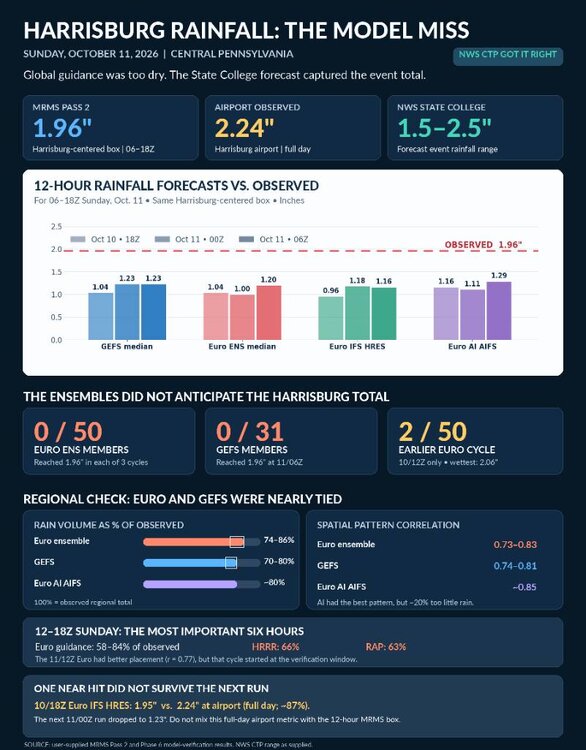
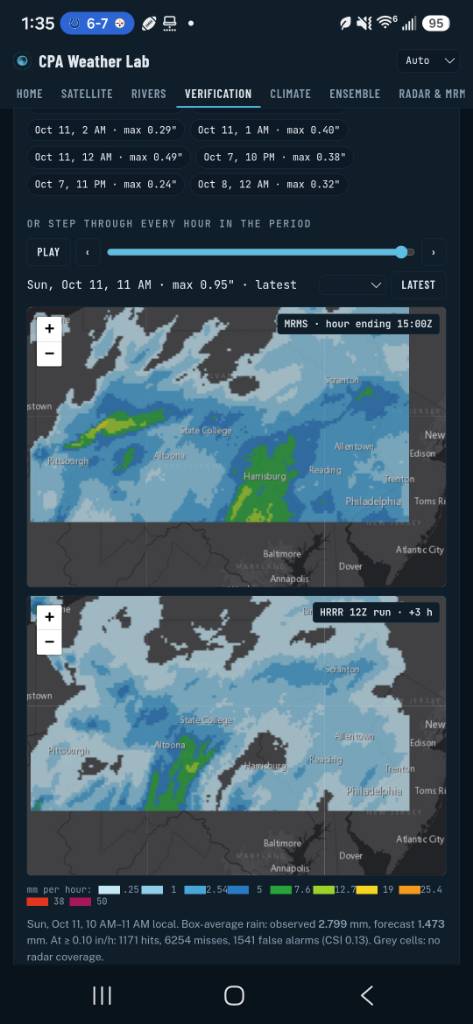
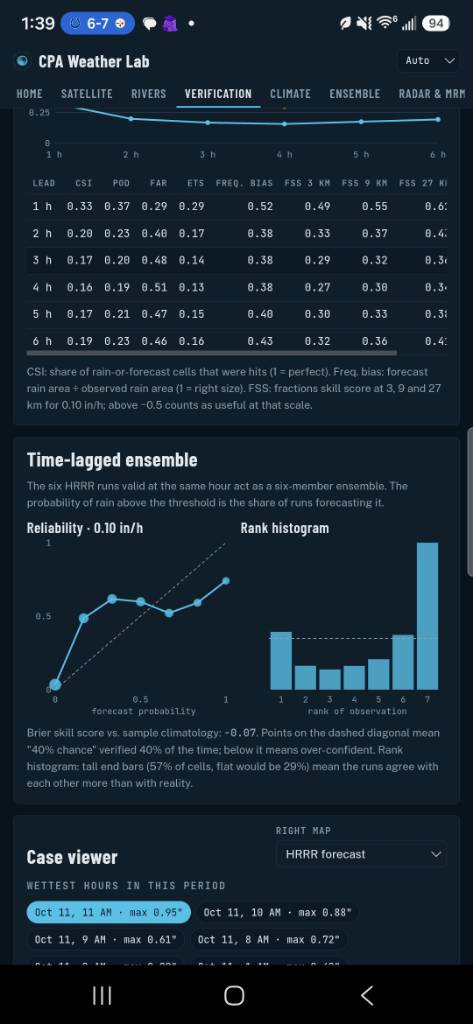
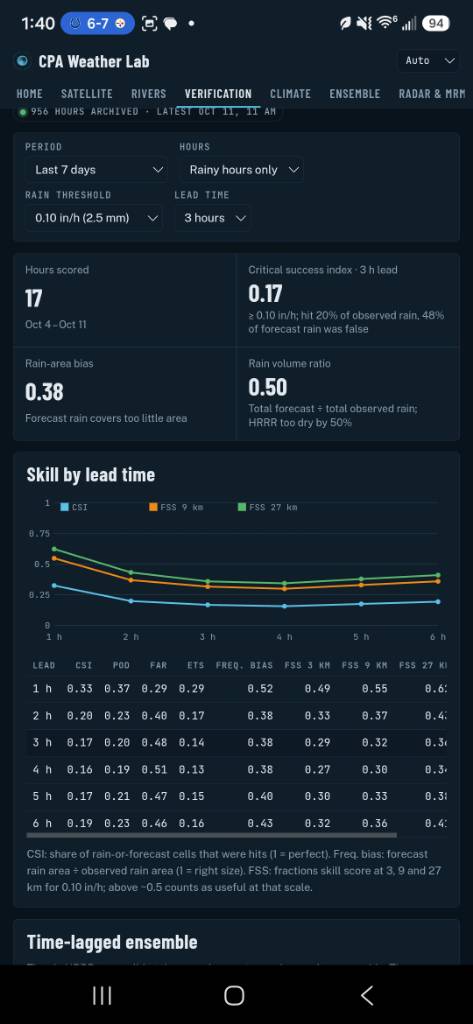
shall we discuss the total and complete collapse of every single model and ensemble model for this past system. The HRRR literally had a negative skill score at 3 hours that's how bad it was. and it wasn't just the American the euro is just as bad I don't know what that hints for this winter time but that was the most epic and total failure I have seen by models in a long long time Sent from my SM-S731U using Tapatalk
-
the hrrr is getting absolutely wrecked Sent from my SM-S731U using Tapatalk
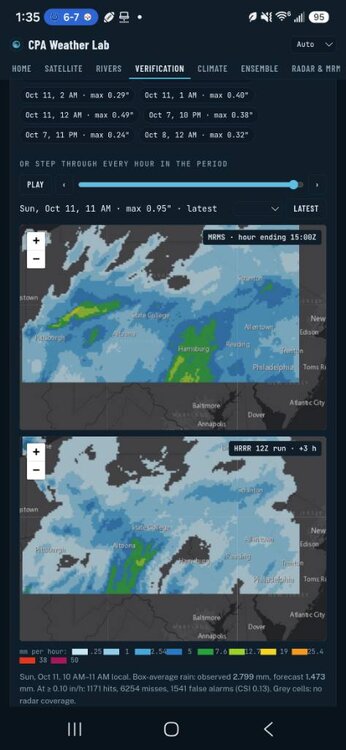
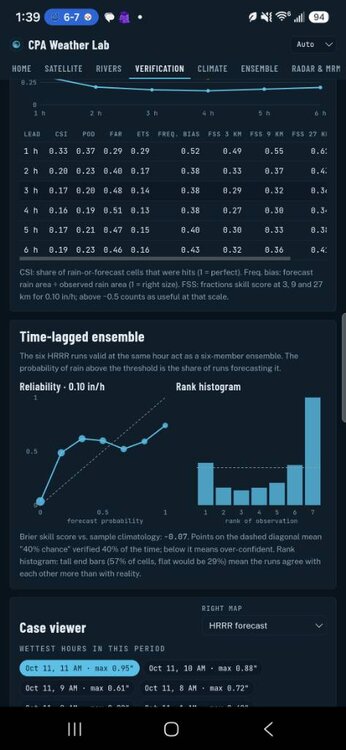
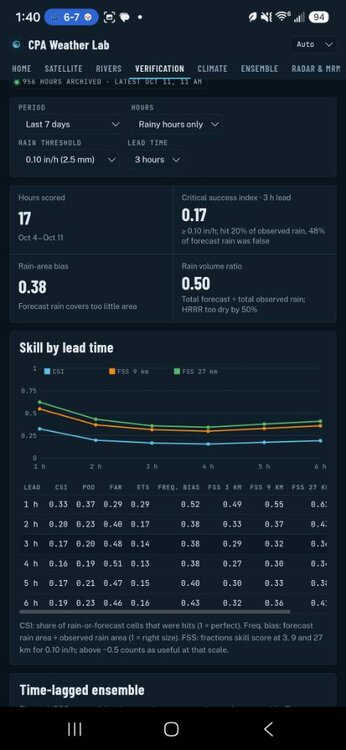
-
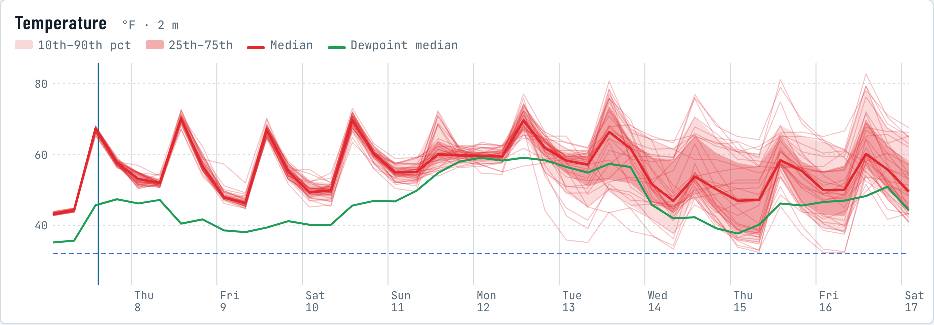
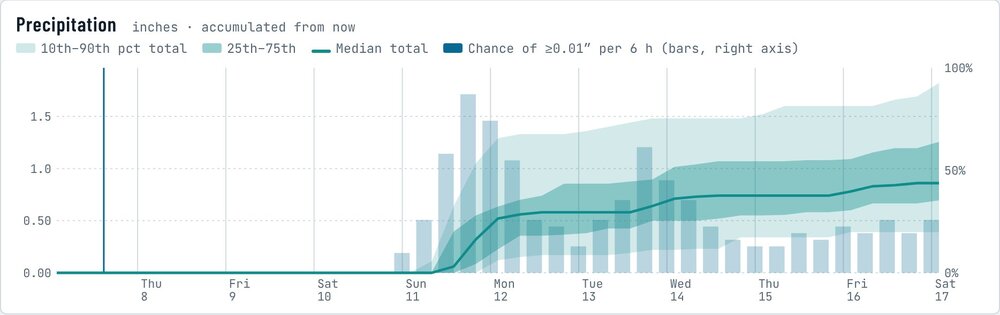
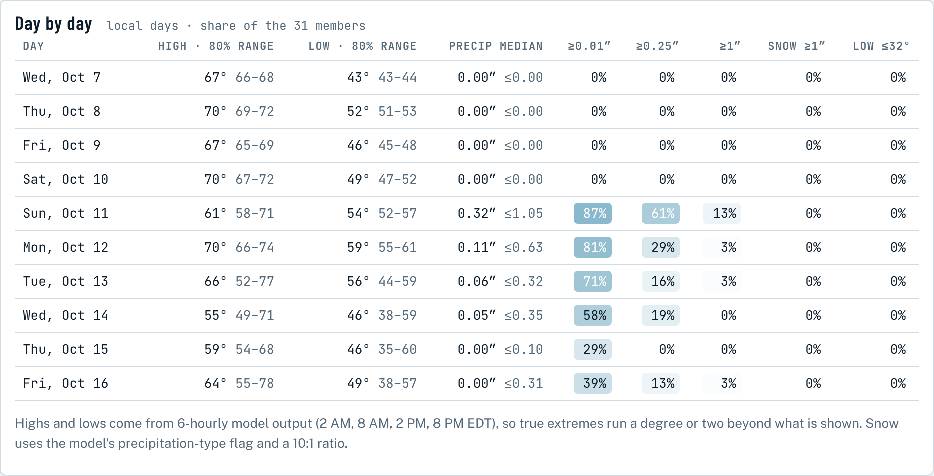
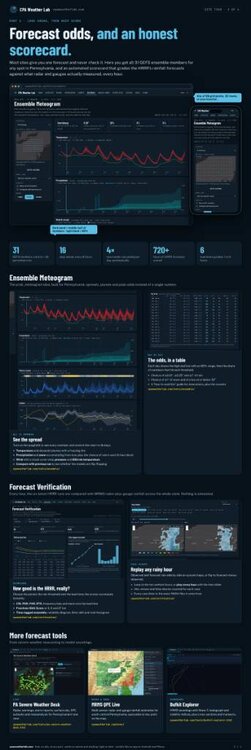
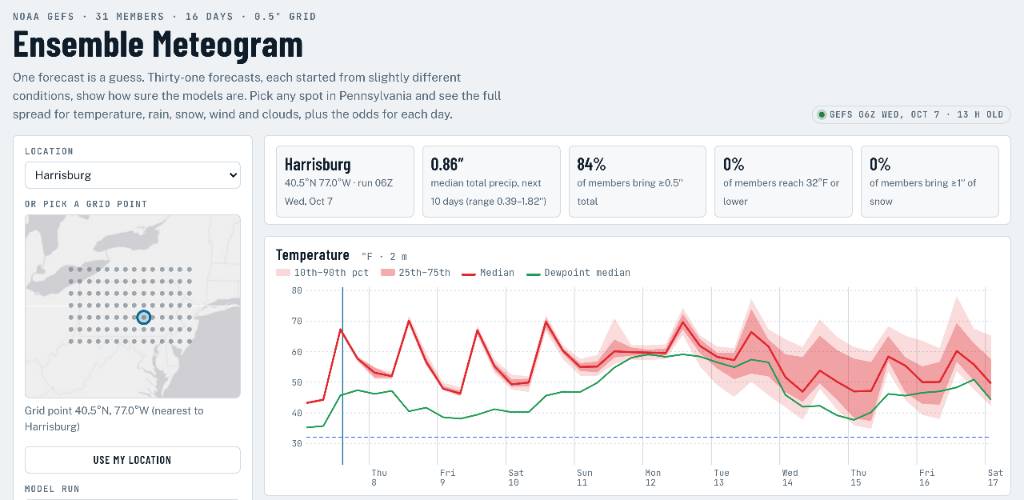
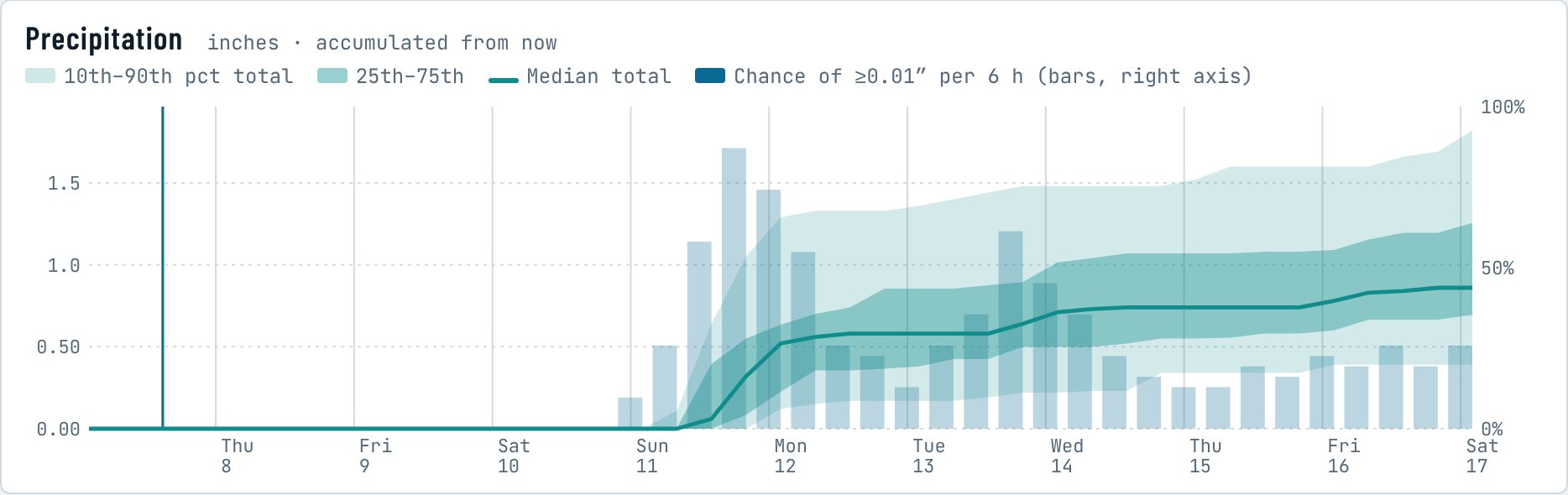
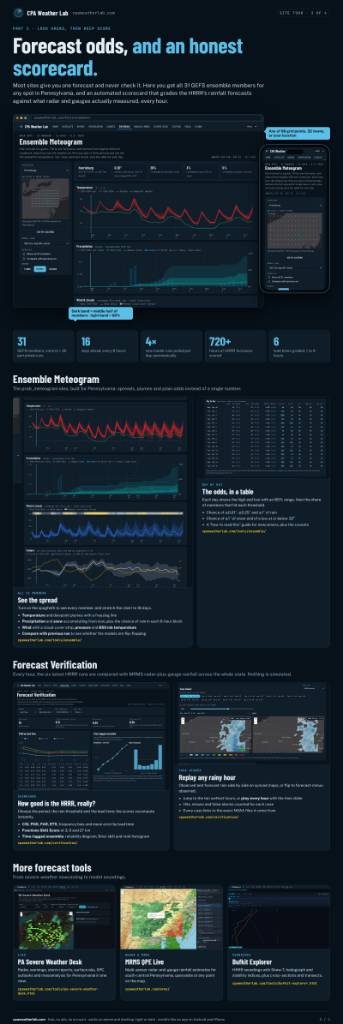
Tool Spotlight #1: The Ensemble Meteogram https://cpaweatherlab.com/tools/ensemble/ What it is. Most forecasts you see are a single answer: 68 and sunny, half an inch of rain. But that answer comes from one run of one model, and the atmosphere is chaotic enough that tiny errors in the starting conditions grow into big differences a few days out. NOAA handles this by running its Global Ensemble Forecast System (GEFS) 31 times, four times a day, each run starting from slightly different conditions. The Ensemble Meteogram takes all 31 of those forecasts for any spot in Pennsylvania and lays them side by side out to 16 days: temperature, rain, snow, wind, clouds and the overall pressure pattern, plus a day-by-day table of the odds. Instead of one guess, you see the whole range of what the models think could happen. How to use it. Pick a city from the Location menu, tap a dot on the little map, or hit "Use my location." The tiles across the top give you the headline numbers for that spot: the median rain total for the period, the chance of at least half an inch, the chance of a freeze and the chance of an inch of snow. Below that, each chart works the same way. The solid line is the median (the middle member), the darker band holds the middle half of the 31 members, and the lighter band holds 80 percent of them. Use the 7 / 10 / 16 day buttons to zoom in or out, and the Model Run menu if you want to look at an earlier run. The spread is the forecast. Check the "Show all 31 members" box and you'll see every individual forecast drawn as its own thin line. Look at this week for Harrisburg: through Saturday the lines are practically stacked on top of each other, which means the models agree and you can trust the numbers. Starting around Tuesday they fan out, with highs anywhere from the low 50s to the upper 70s on the same day. That isn't the tool being broken; that's the honest answer. When the lines fan out, any single-number forecast for that day is basically a coin flip. "Compare with previous run" helps here too: if the median keeps jumping from one run to the next, confidence should stay low even if the latest run looks tight. Rain odds you can actually read. The precipitation chart shows rain piling up over time, with blue bars for the chance of at least a hundredth of an inch in each 6-hour block. Right now it shows nothing through Saturday, then the bars jump on Sunday as the members agree rain is coming. The Day by Day table turns all of that into plain percentages, and they're simple member counts: Sunday's 87% chance of measurable rain means about 27 of the 31 members produce it, and the 61% for a quarter inch or more means about 19 of them do. Shaded cells make the wet days jump out, and the "80% range" next to each high and low tells you how wide the uncertainty is. Why it's worth your time, and a few caveats. Knowing the odds is more useful than a single number when you're planning anything outdoors, deciding whether to cover the garden, or watching for a storm a week out. It also teaches you to spot a shaky forecast before it busts. A few honest limits: each grid point is about 35 by 25 miles, so it won't capture your valley or ridge, and the NWS point forecast is still better for local detail. The GEFS also tends to be a bit overconfident, so real-world odds for extremes are a little wider than it shows. Highs and lows come from 6-hourly output and can miss the true extremes by a degree or two. Use it for timing and odds, and let it tell you how much to trust everything else you're reading. Give it a try and post what you find. Data: NOAA/NCEP GEFS v12, processed on the CPA Weather Lab server. Not an official forecast. Sent from my SM-S731U using Tapatalk
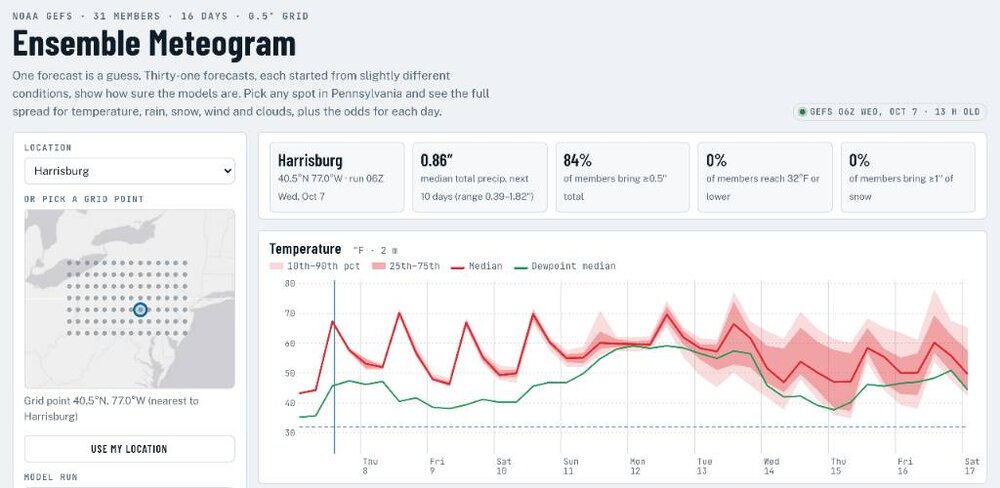
-
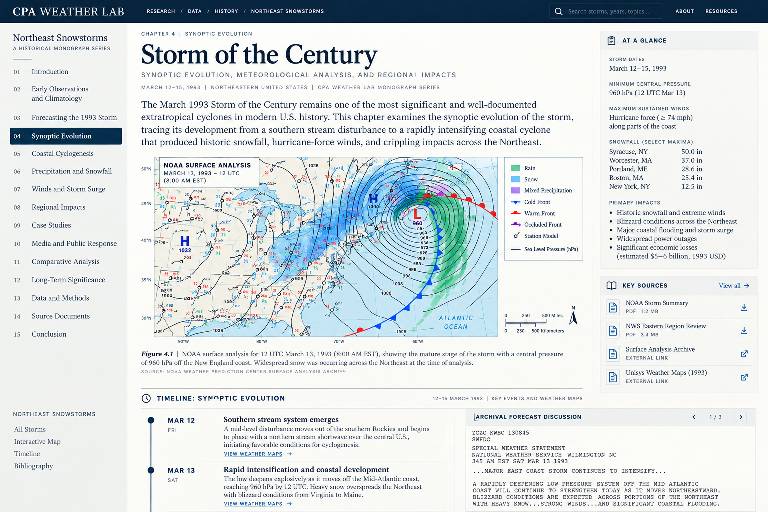
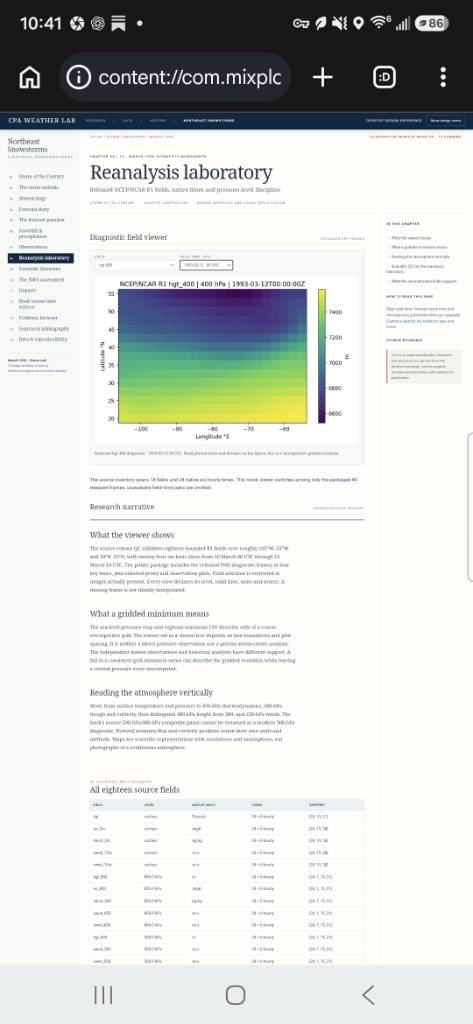
So I'm almost done with 1993 and about 30%-40% finished overall with my NORTHEAST SNOWSTORMS VOL I & II PROJECT There are whispers volume 3 might be out this winter. When finished every snowstorm highlighted in Vol I & II book will have its on Special Portal. I pull in the narrative and analysis from Paul Kocin, Louis Uccellini, various other Scientist who have analyzed each of the storms I provide interactive reanalysis viewer, and laboratory. I try to hone in especially on what feature or part was meterologly interesting as well as local in depth narrative if at all possible, from those inside and around the storm. Mix in GIS NESIS sciring and snowfall maps, detailed co-op, cochras, spotter reports. If recent am trying to do a full 3D imaging and analysis of CCB band and hopefully a proper montage of its highlights. Hopefully by the end you'll be able to close your eyes and taste the storm. Sent from my SM-S731U using Tapatalk
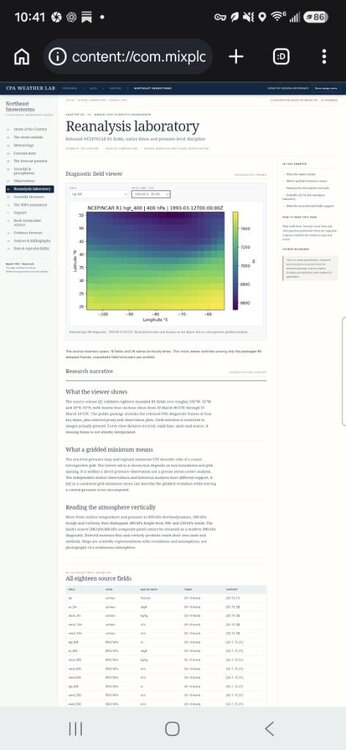
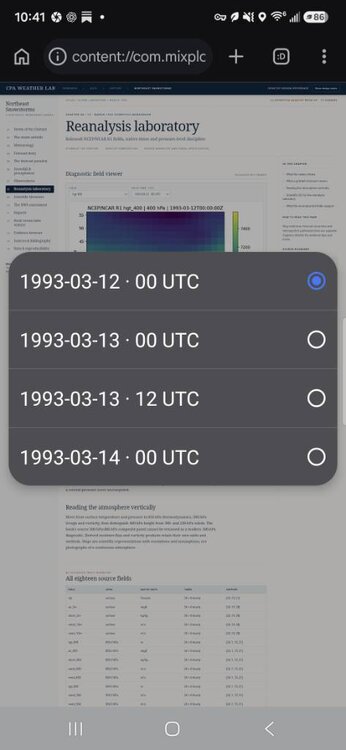
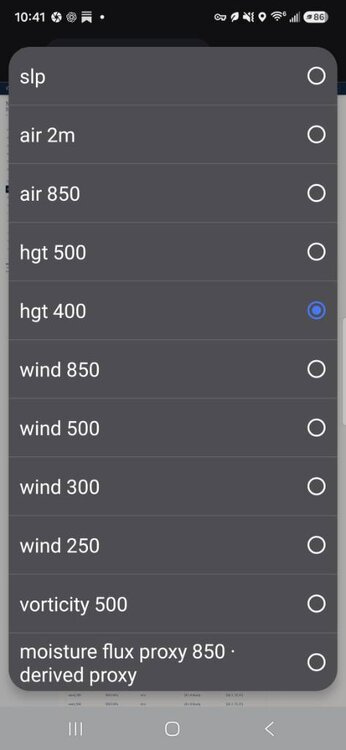
-
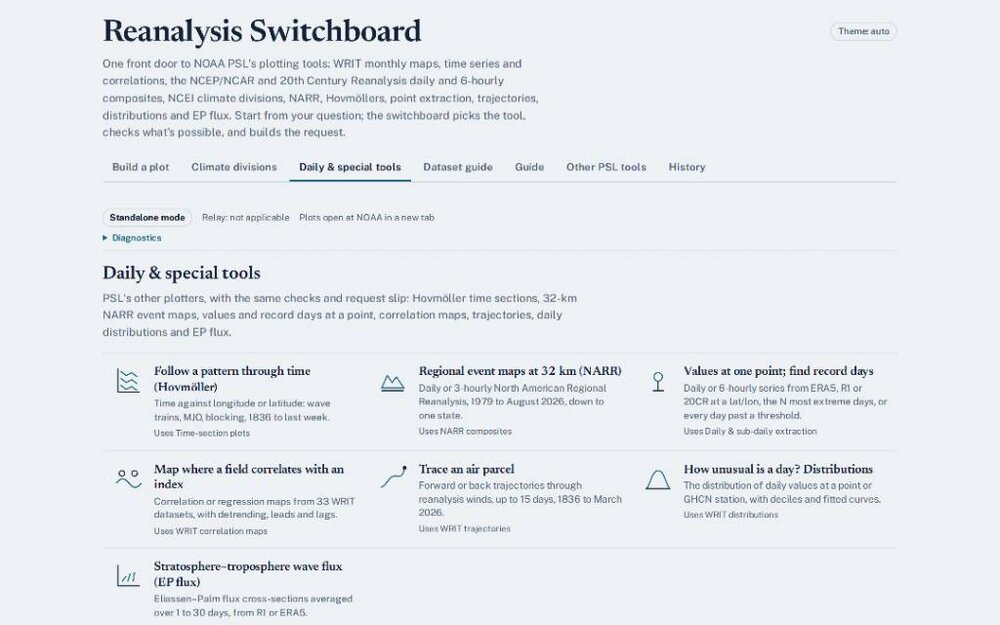
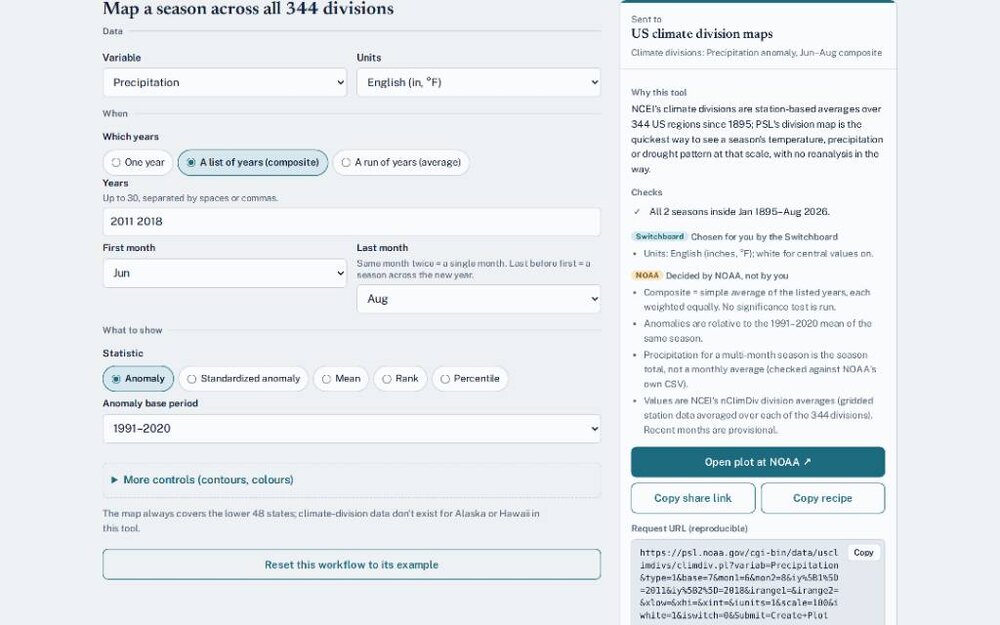
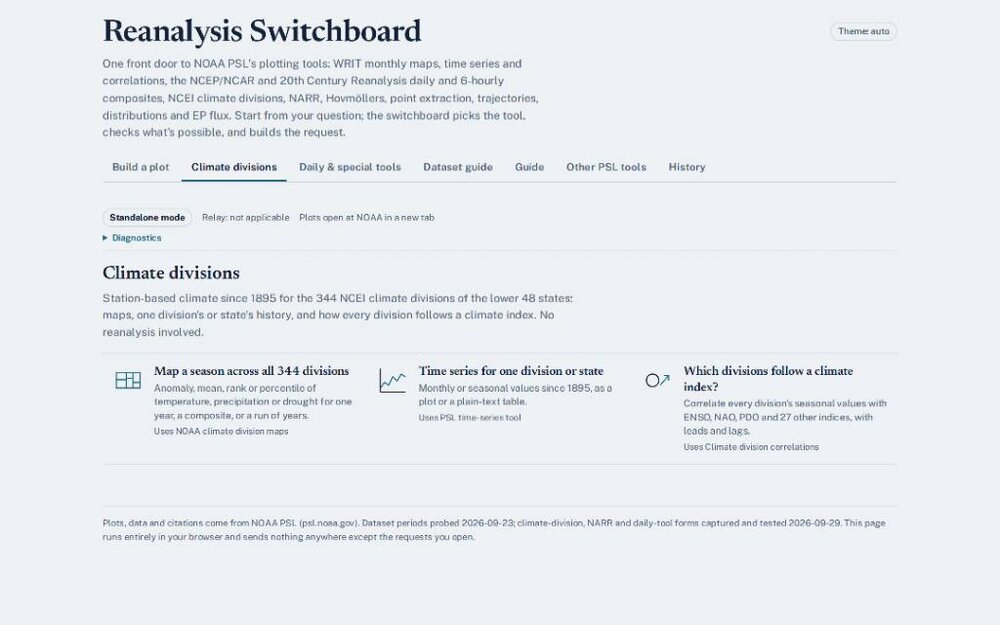
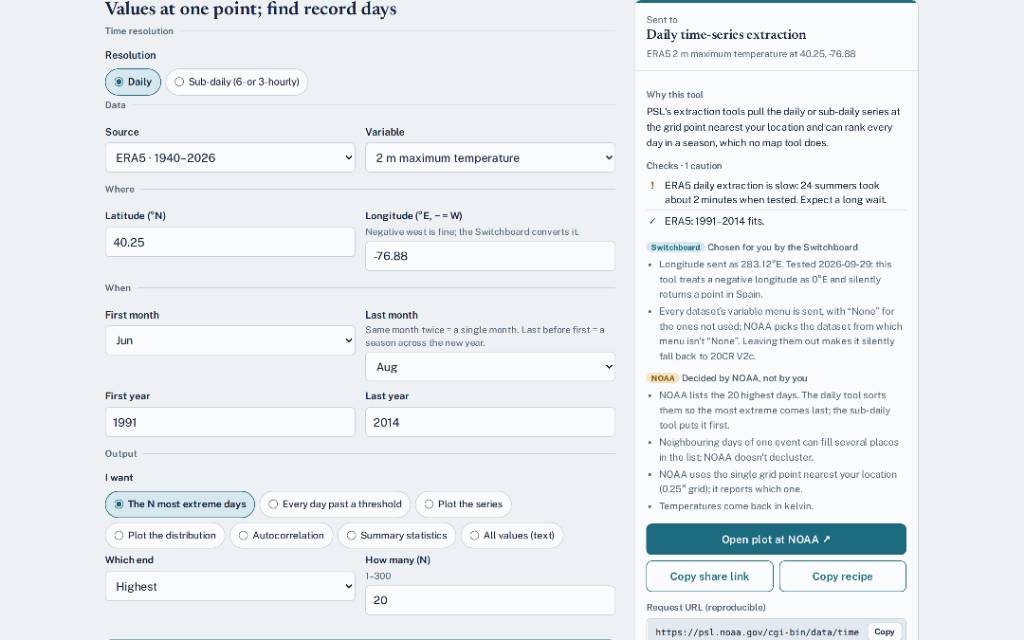
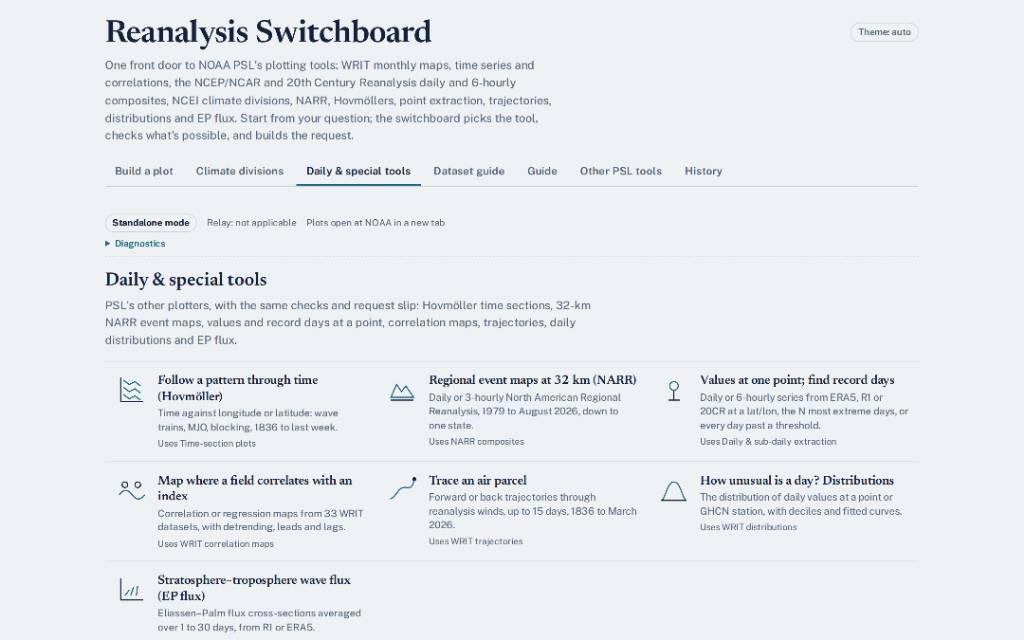
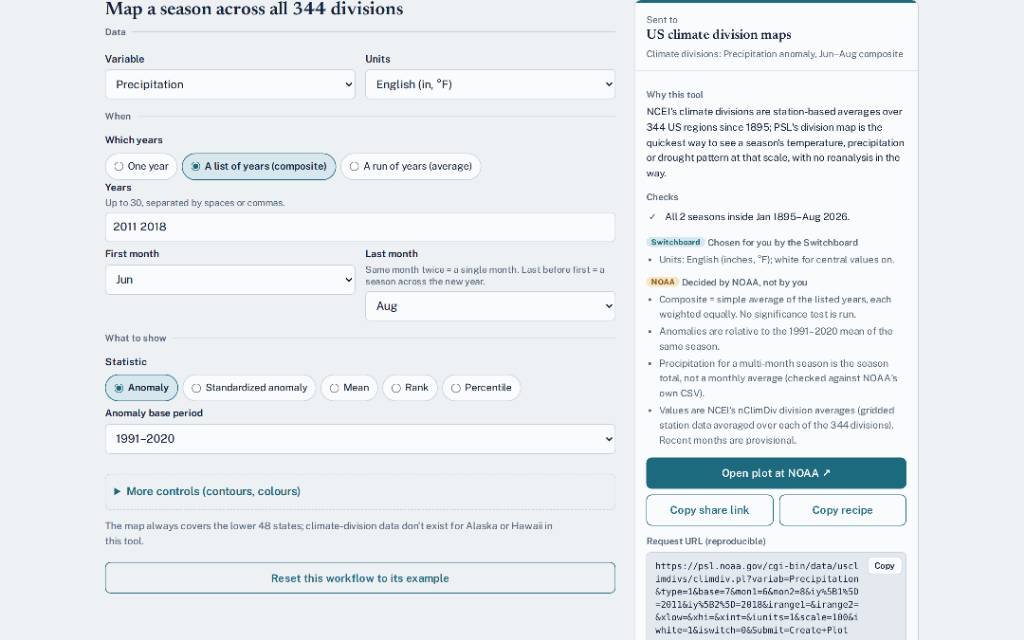
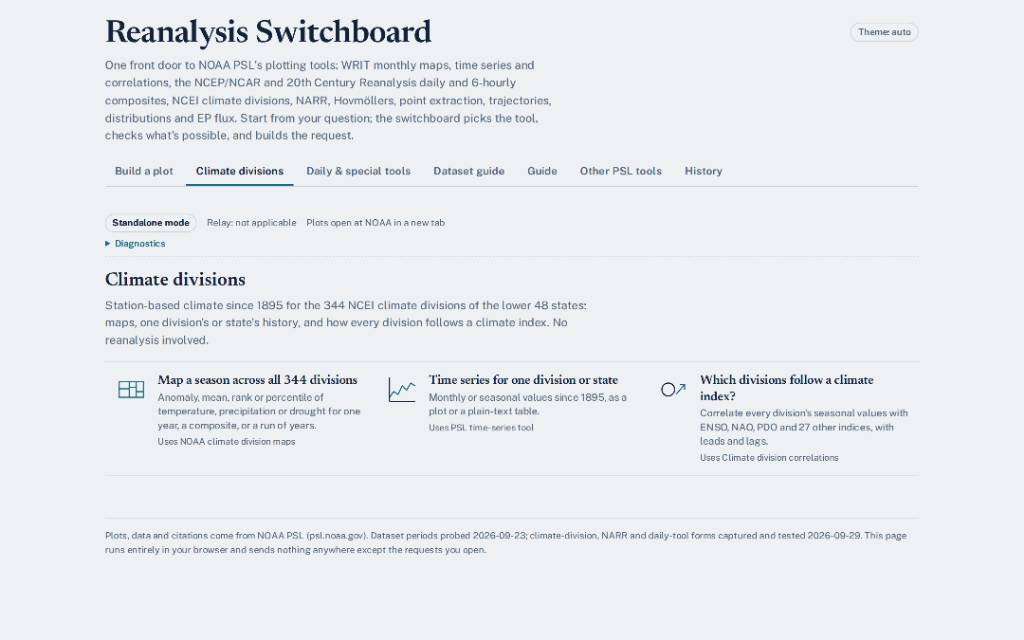
http://CPAWEATHERLAB.COM/SWITCHBOARD.COM UPDATED UPDATED UPDATED **Climate divisions tab** This tab uses NCEI climate-division data: averages built from station observations for 344 regions of the lower 48, from 1895 to August 2026. No reanalysis is involved. - **Map a season across all 344 divisions.** Maps temperature, max/min temperature, precipitation, degree days or any Palmer index. You can map one month or season for one year, a list of up to 30 years averaged together, or a run of years. Show it as an anomaly, standardized anomaly, mean, rank or percentile, against a base period you choose. For precipitation and degree days, a season's value is the total, not the monthly average. For a season that crosses the new year, you enter the year of its last month; the page converts it to NOAA's first-month labelling for you. - **Time series for one division or state.** Gives one division's or one state's history from 1895, as monthly values or one value per year for a season. You get a plot or a plain-text table you can save. Anomalies are switched off for single divisions because NOAA's are wrong there; they work for state averages. - **Which divisions follow a climate index?** Maps how closely every division's seasonal values track one of 30 indices, such as ENSO, NAO, PNA, PDO, AMO or a plain trend. The index can lead or lag by up to 12 months or seasons. The slip tells you roughly how large a correlation has to be to stand out from zero with your number of years. **Daily & special tools tab** - **Follow a pattern through time (Hovmöller).** Plots time against longitude or latitude, averaged across a band you choose. It shows wave trains, blocking and the MJO moving. Data runs from 20CRv3 in 1836 through R1 to NCEP's operational analysis, which is current to within a few days. - **Regional event maps at 32 km (NARR).** Makes daily or 3-hourly maps from the North American Regional Reanalysis, 1979 to August 2026. You can frame the map on one state, like Pennsylvania, or a custom box. This is PSL's best source for recent events now that R1 has ended. The page asks for a 0.3° plot so the 32-km detail isn't smoothed away. - **Values at one point; find record days.** Pulls daily or 6-hourly values from ERA5, R1 or 20CR at a latitude and longitude, or from a daily climate index. It can plot the series or its distribution, or list the N most extreme days in a season (up to 300), or every day past a threshold. The page catches NOAA's bug where a western longitude silently becomes a point in Spain. - **Map where a field correlates with an index.** Makes a correlation or regression map of a seasonal field against an index, using any of 33 WRIT datasets. You can detrend both series and have the index lead or lag. It shows where a climate mode's influence reaches. - **Trace an air parcel.** Runs forward or back trajectories up to 15 days through reanalysis winds at one pressure level. You can add a box of neighbouring starting points to see how much the path depends on where it starts. Use it to see where a moisture plume or air mass came from. - **How unusual is a day? Distributions.** Gathers every day of a season at one point (from R1, 20CR V2c or PRISM precipitation) or at one GHCN station, and shows the distribution with its deciles and a fitted curve. It can also give the probability of a value you enter. - **Stratosphere–troposphere wave flux (EP flux).** Draws Eliassen–Palm flux arrows, with divergence or the implied acceleration, from R1 or ERA5, averaged over 1 to 30 days. It's the standard picture of waves driving the stratosphere, useful around sudden warmings. Sent from my SM-S731U using Tapatalk
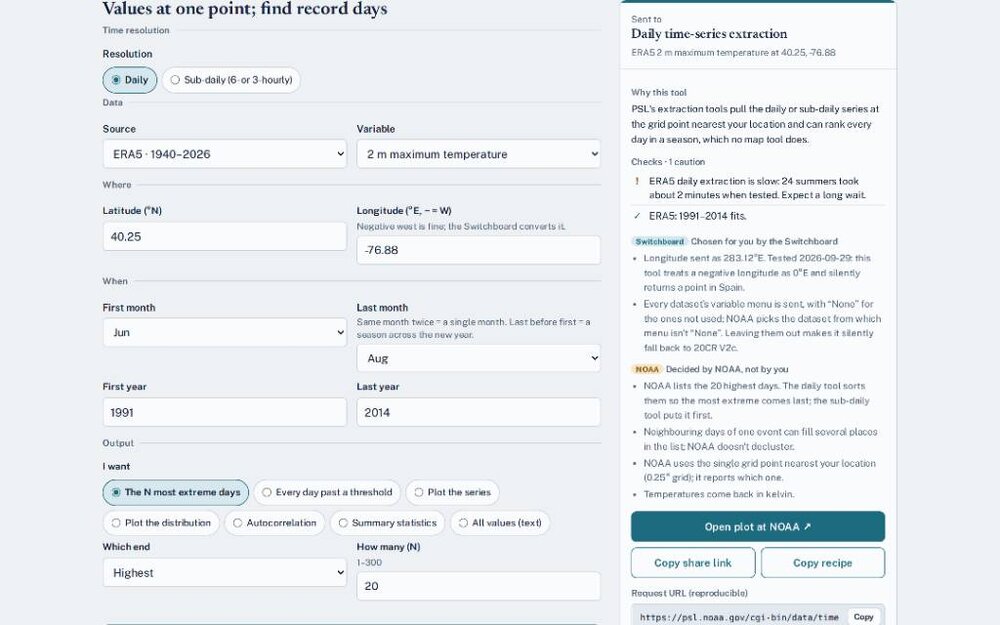
-
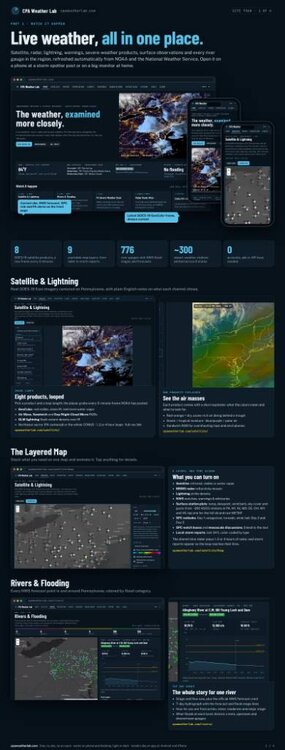
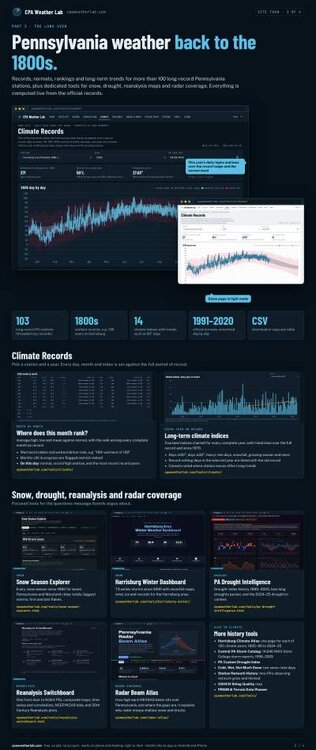
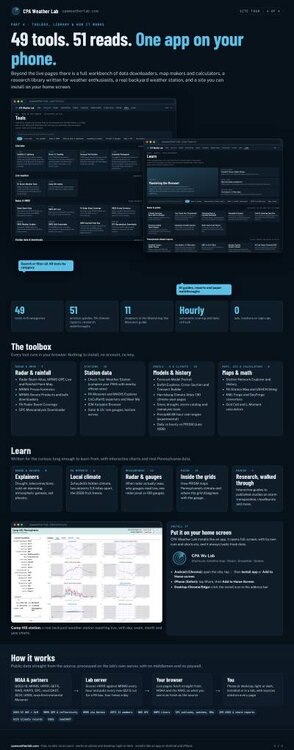
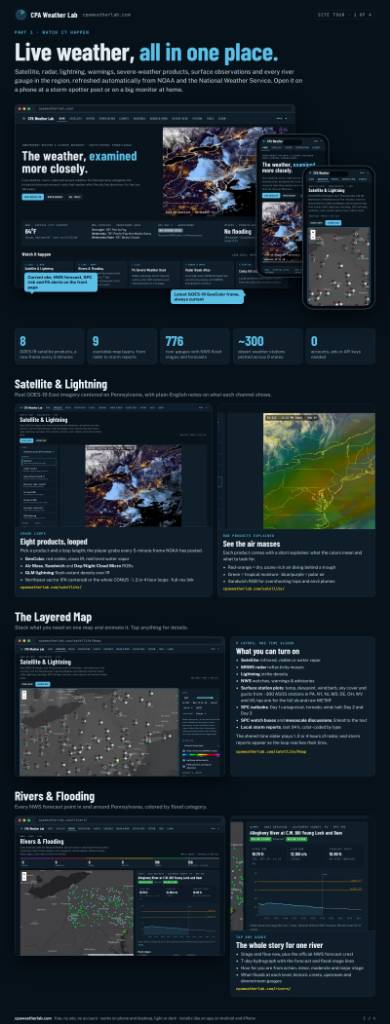
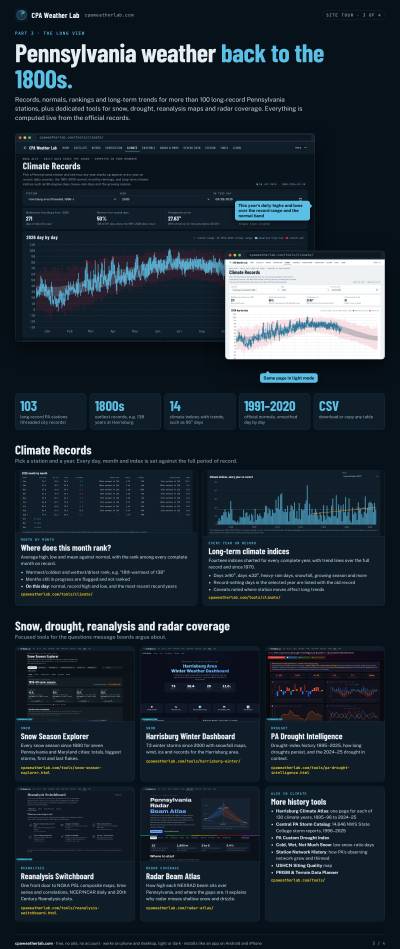
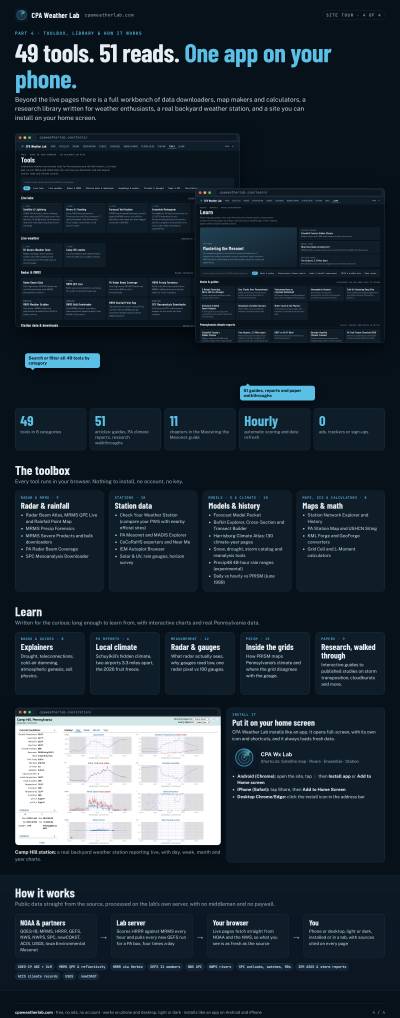
CPA Weather Lab https://cpaweatherlab.com TAKE A TOUR!!!! https://claude.ai/artifact/3hPJ2tTBfYqULiavQzXZ7U#cf7995a2-237f Most people check the weather, see “60% chance of rain,” and continue living productive lives. I apparently took that as a personal challenge and built an entire weather laboratory to determine exactly where the other 40% went. CPA Weather Lab has live radar, satellite, river gauges, severe weather, surface observations, ensembles, climate records, storm archives, and enough historical data to turn a perfectly healthy interest in weather into something your family quietly refers to as “the website.” The forecast section is particularly useful if you enjoy watching certainty die in real time. Thirty-one GEFS ensemble members begin with roughly the same atmosphere and gradually wander off in different directions like relatives trying to agree on where to eat. You can watch the spread grow, compare consecutive model runs, examine precipitation and snow probabilities, yell at models that have personally offended you, and cackle at yesterday's model run once observational data arrives and exposes its lies. This is meteorology, where screaming “THAT IS NOT WHERE THE LOW IS GOING” at a computer screen remains technically unpaid peer review. And because merely yelling at numerical weather prediction models seemed far too emotionally healthy, there is forecast verification. The HRRR makes a prediction, MRMS observes what actually happened, and CPA Weather Lab keeps the receipts. Hits, misses, false alarms, bias, CSI, probability reliability, lead-time degradation. The model can confidently paint two inches of rain across half of Pennsylvania, reality can put it somewhere else entirely, and the next day we can gather around the statistics and quietly cackle over the evidence like deeply maladjusted meteorological raccoon goblins. Today's beautiful model solution is tomorrow's row in a verification table. Then there is the historical side, because sometimes today's weather is disappointing and you need to investigate whether people in 1914 were also disappointed. Harrisburg records stretch back into the 1800s, alongside snowfall histories, drought analysis, storm catalogs, climate rankings, station records, radar tools, and enough obscure meteorological rabbit holes to make “I'll just check one thing” a statement with absolutely no credibility. Nothing restores perspective quite like spending an evening researching a 117-year-old precipitation event because something about Tuesday's rainfall seemed suspicious. At some point I realized I had essentially become a weather raccoon: awake at unreasonable hours, digging through NOAA's enormous data dumpster with both paws, dragging home anything shiny labeled radar, reanalysis, snowfall, or precipitation, and then becoming strangely territorial when somebody suggests I probably don't need another dataset. The difference is that a normal raccoon eventually gets tired and leaves the trash can. I built search tools for mine. There are tools for examining radar coverage because apparently knowing that it is snowing is insufficient when you can instead calculate how many thousands of feet above your head the lowest radar beam is passing. There are river gauges because rain eventually becomes somebody else's problem downstream. There are weather-station tools because spending hundreds of dollars measuring rainfall naturally leads to wondering whether the rain gauge is lying to you. And there are climate tools for those special evenings when you would rather rank 130 winters than interact with another human being. CPA Weather Lab is also a web app, so if merely visiting this thing occasionally isn't enough commitment, you can install it directly from your browser on your phone, tablet, or computer and give it its own icon like a normal app. On Android you can install it through Chrome, on iPhone through Safari's Add to Home Screen, and desktop browsers such as Chrome and Edge can install it too. Then it opens full-screen, because apparently what your phone was missing was immediate access to river hydrographs, ensemble spaghetti, radar beam heights, and more than a century of evidence that Pennsylvania weather has been doing this nonsense far longer than any of us have been alive. This whole thing exists because weather refuses to behave like the tidy numbers in a forecast table. Models disagree. Gauges disagree. Radar misses things. Snowfall measurements become arguments. Rivers ignore county boundaries. Ensembles abruptly discover seventeen different futures. A model that looked brilliant at 00Z can become an object of ridicule by breakfast. And somewhere in central Pennsylvania, I will be staring at the screen yelling at it, then returning twelve hours later to cackle when the observations confirm that, yes, the lying bastard really did move the storm 150 miles. Instead of accepting any of this like a well-adjusted person, I kept adding datasets. So CPA Weather Lab is basically what happens when “I wonder what the weather is doing” goes untreated for long enough and the local weather raccoon gains server access. Now you can install the condition on your phone. https://cpaweatherlab.com Sent from my SM-S731U using Tapatalk
-
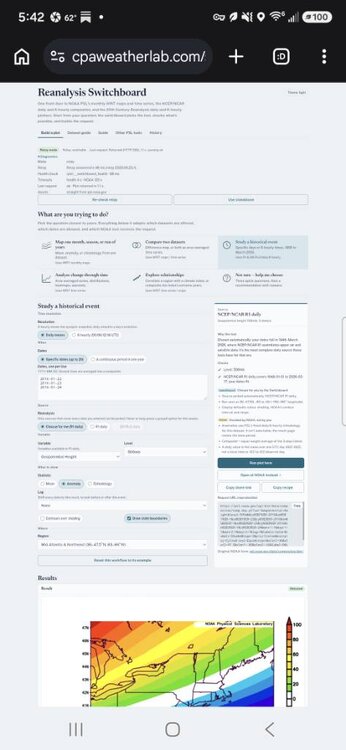
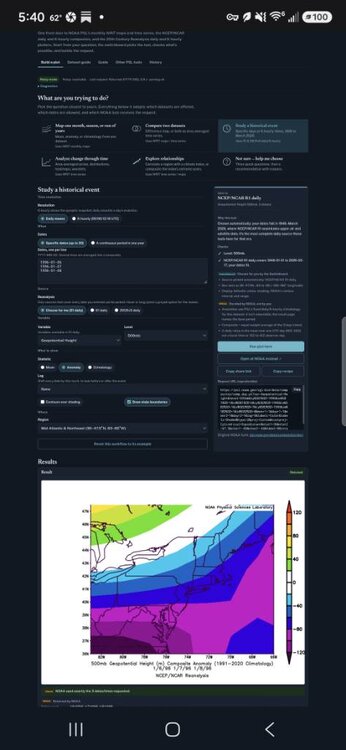
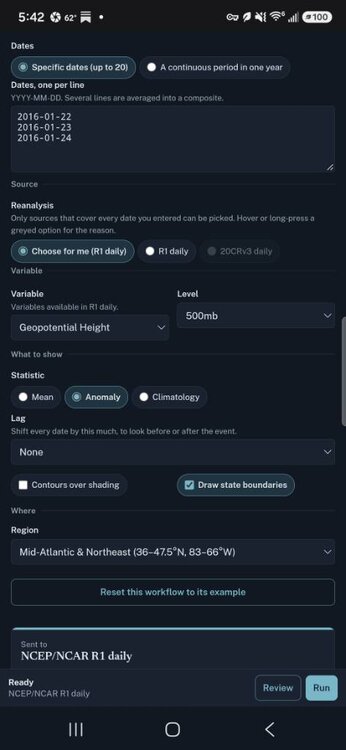
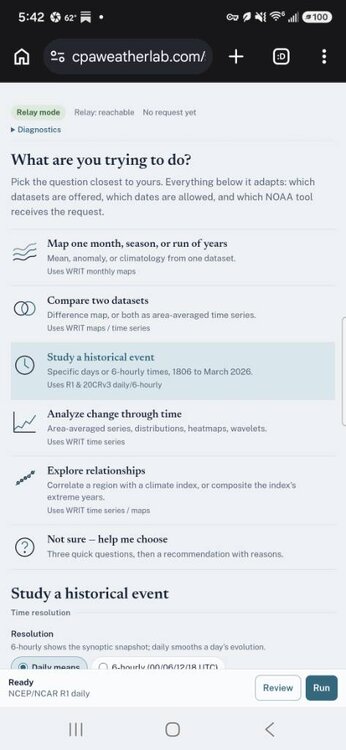
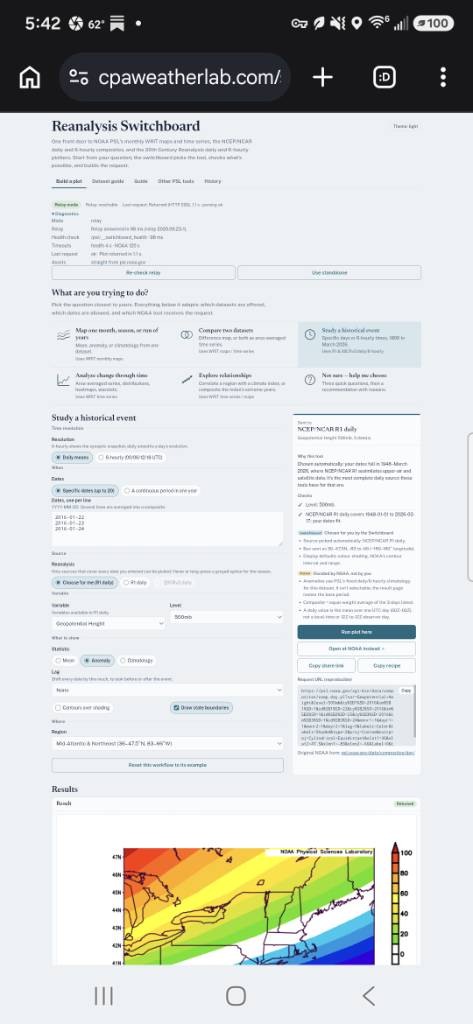
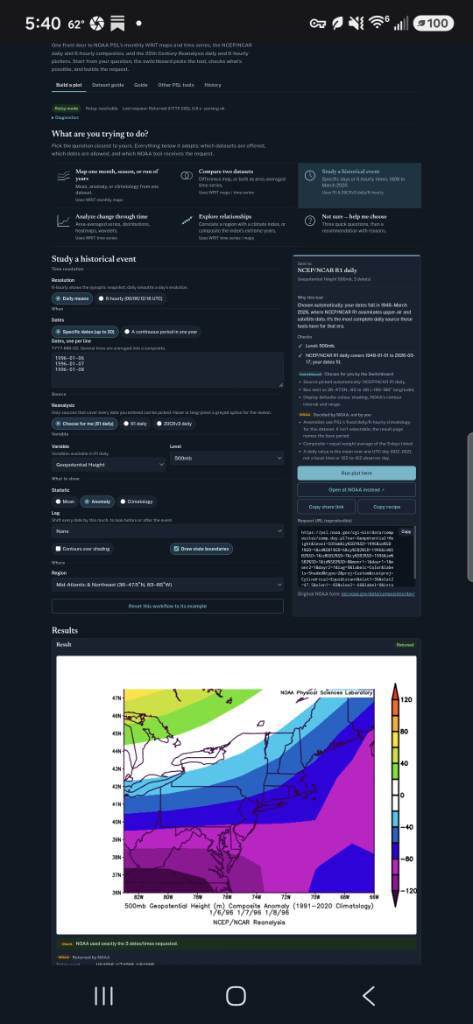
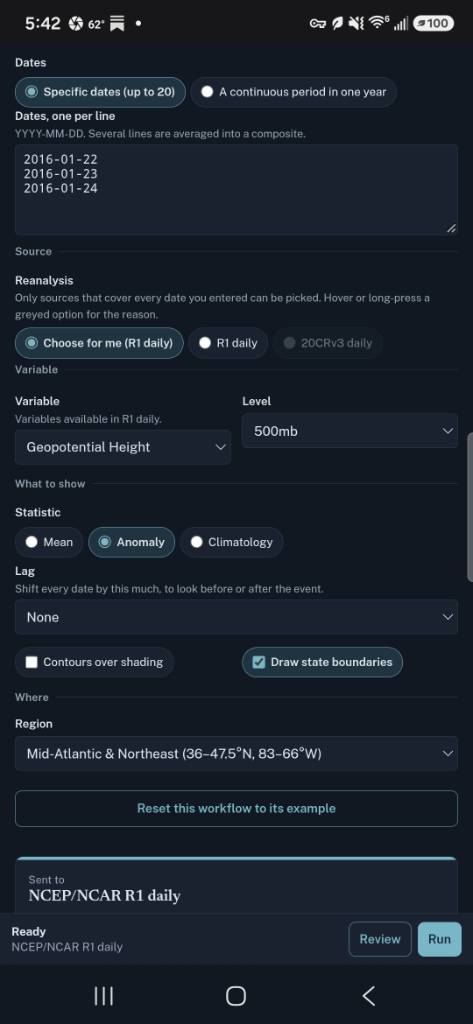
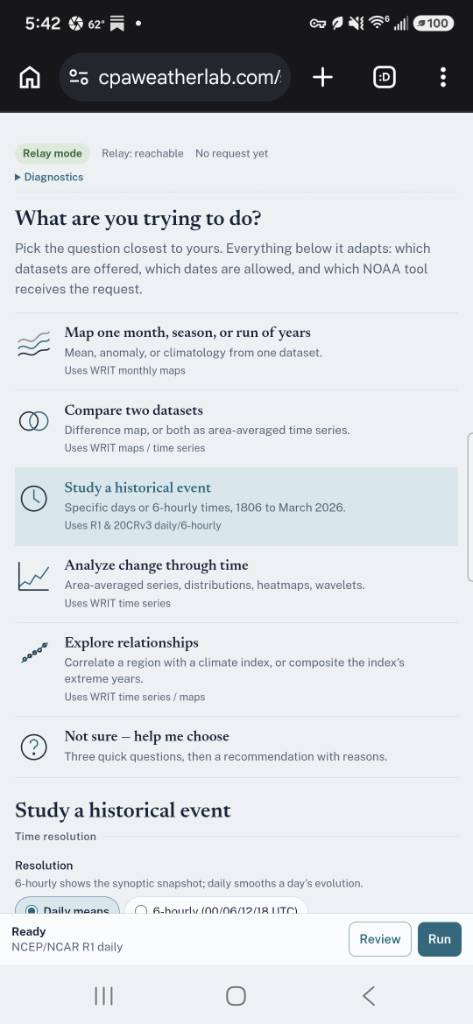
Tis the season where this will come in handy. A gift to the board, with plenty more to follow. Reanalysis Switchboard I put together the Reanalysis Switchboard as a friendlier front door to NOAA Physical Sciences Laboratory’s historical weather and climate tools. NOAA has an enormous amount of reanalysis data and some genuinely powerful plotting tools, but there has always been a slight assumption that the person using them already has a PhD in atmospheric science, knows what every dataset acronym means, and remembers which web form was designed sometime around the Clinton administration. I wanted something where a weather enthusiast could start with the actual question instead. The Switchboard lets you map a month or season, compare two datasets, examine individual historical storms at daily or 6-hourly resolution, analyze changes through time, make distributions and month-by-year heatmaps, run wavelet and autocorrelation analyses, and explore relationships with climate indices such as the NAO, PNA, ENSO, PDO and others. Instead of making you figure out which NOAA tool to use, the Switchboard asks what you are trying to do, determines which NOAA plotting system can handle it, checks whether the dates and variables are actually available, explains important limitations, and builds the request for you. The plots and underlying data still come from NOAA PSL. The Switchboard is basically the traffic controller. I also added a simple Dataset Guide because the alphabet soup gets ridiculous very quickly. It gives basic information about ERA5, JRA-3Q, JRA-55, MERRA-2, NCEP/NCAR R1, 20th Century Reanalysis V3, CORe and the other datasets, including their approximate spatial resolution, period of record, time resolution available through the site, what each dataset actually is, and why you might choose one over another. One example is comparing two famous East Coast snowstorms. I used the Switchboard to compare the Blizzard of 1996 (January 6–8, 1996) with the January 2016 blizzard (January 22–24, 2016). Both storms were analyzed using the same NCEP/NCAR Reanalysis 1 dataset, the same Mid-Atlantic/Northeast geographic area, the same three-day averaging method and the same anomaly climatology. That makes it possible to directly compare things such as the 500-mb upper-air pattern and precipitable water between the two storms without first downloading a reanalysis archive and writing a bunch of code. That is really the point of the project: give people access to some very powerful historical-weather tools without requiring them to earn another degree just to figure out which button NOAA wanted them to press. Reanalysis Switchboard: https://cpaweatherlab.com/switchboard/ Sent from my SM-S731U using Tapatalk
-
Central PA Summer 2026 Discussion/Obs Thread
Jns2183 replied to Voyager's topic in Upstate New York/Pennsylvania
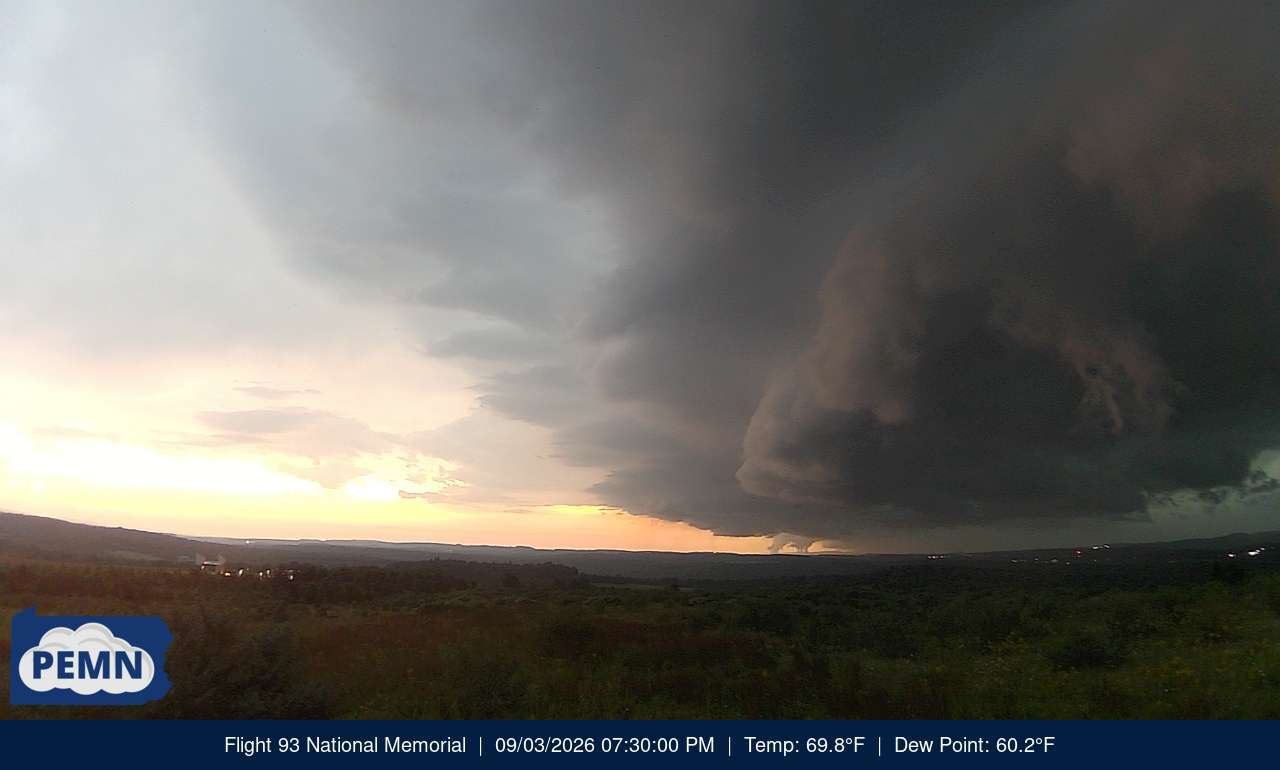
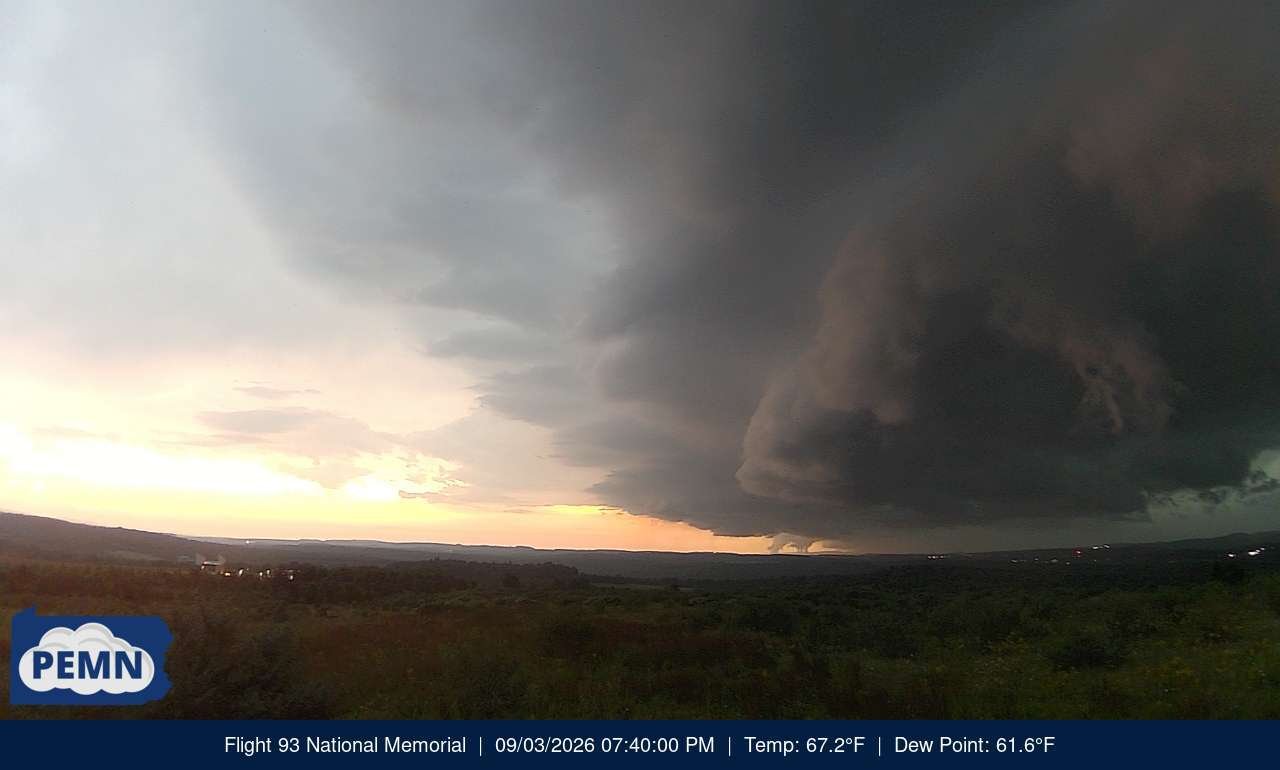
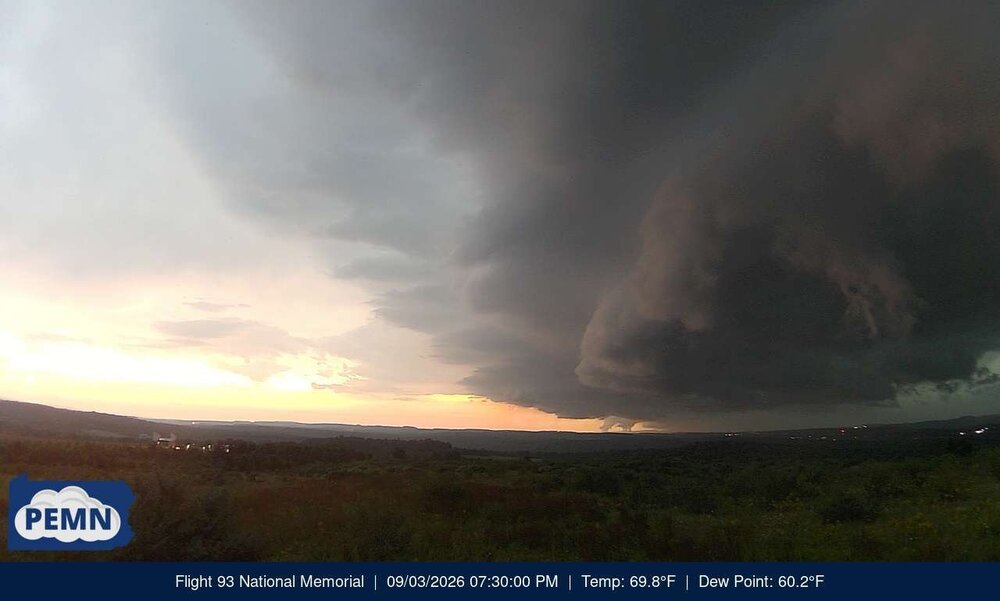
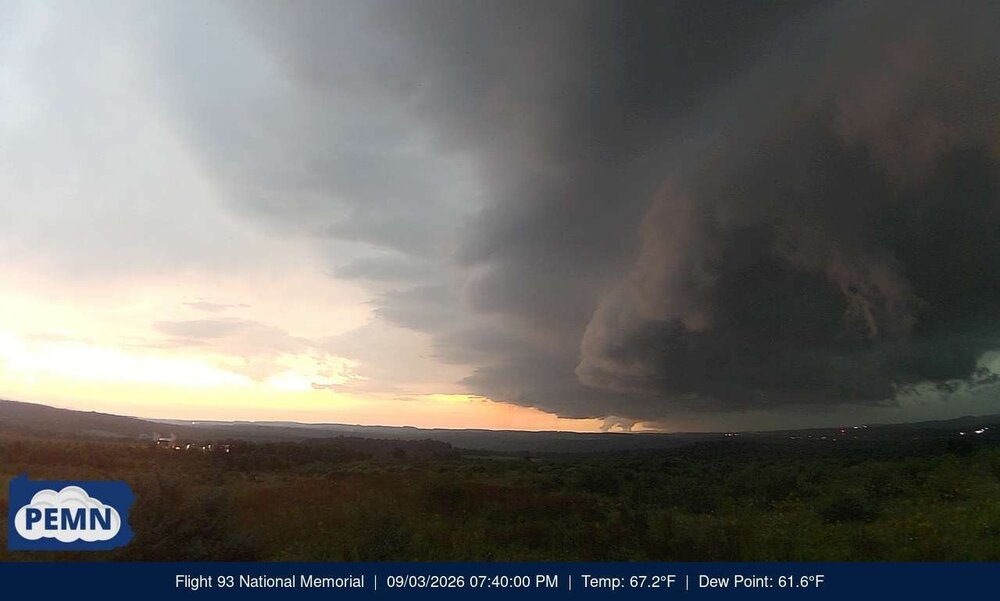
from the flight 93 memorial PEMN weather station cameras appointed right after that tornado warned storm that is coming towards. first picture is 7:10 717-20 thirds 7:30 this last one 7:40 station itself has one minute resolution so if you want to enjoy watching the live webcam I'll see one minute resolution weather station data have at it https://climate.met.psu.edu/data/pemn/?site=SMRS02&numObs=1440 Sent from my SM-S731U using Tapatalk.thumb.jpg.4d606dd9631d85f1fa6db5056aa35ff6.jpg)
-
Central PA Summer 2026 Discussion/Obs Thread
Jns2183 replied to Voyager's topic in Upstate New York/Pennsylvania
best ring of fire action I've seen in years and it's quite delayed from normal Sent from my SM-S731U using Tapatalk -
Central PA Summer 2026 Discussion/Obs Thread
Jns2183 replied to Voyager's topic in Upstate New York/Pennsylvania
Sometimes the hardest part of reading about past disasters is having enough imagination to truly grasp the power of nature. if you ever were curious about the Johnstown flood than go watch the video coming out today about Glacial damn flood in Nepal and China. Especially the one at the border with giant building that gets engulfed. Sent from my SM-S731U using Tapatalk -
Central PA Summer 2026 Discussion/Obs Thread
Jns2183 replied to Voyager's topic in Upstate New York/Pennsylvania
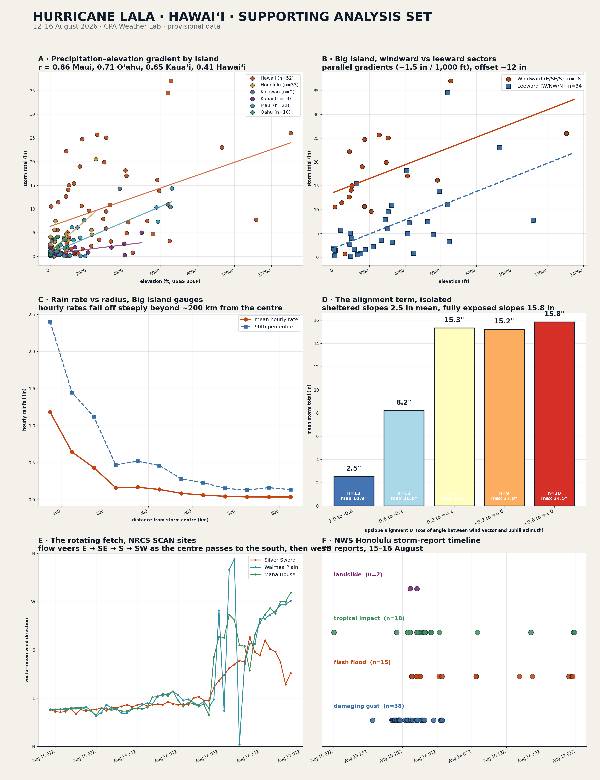
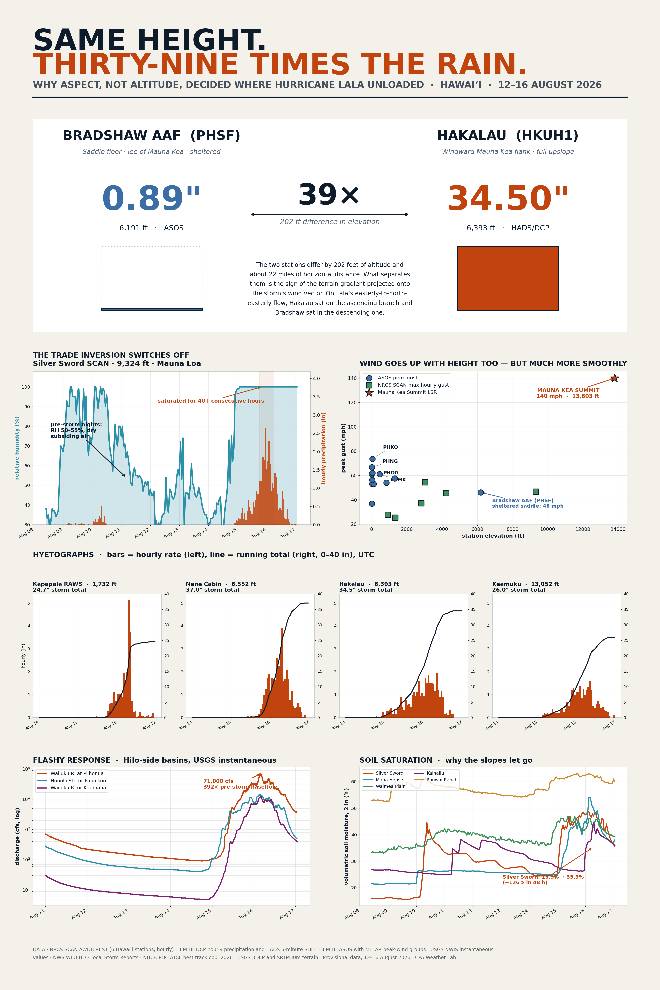
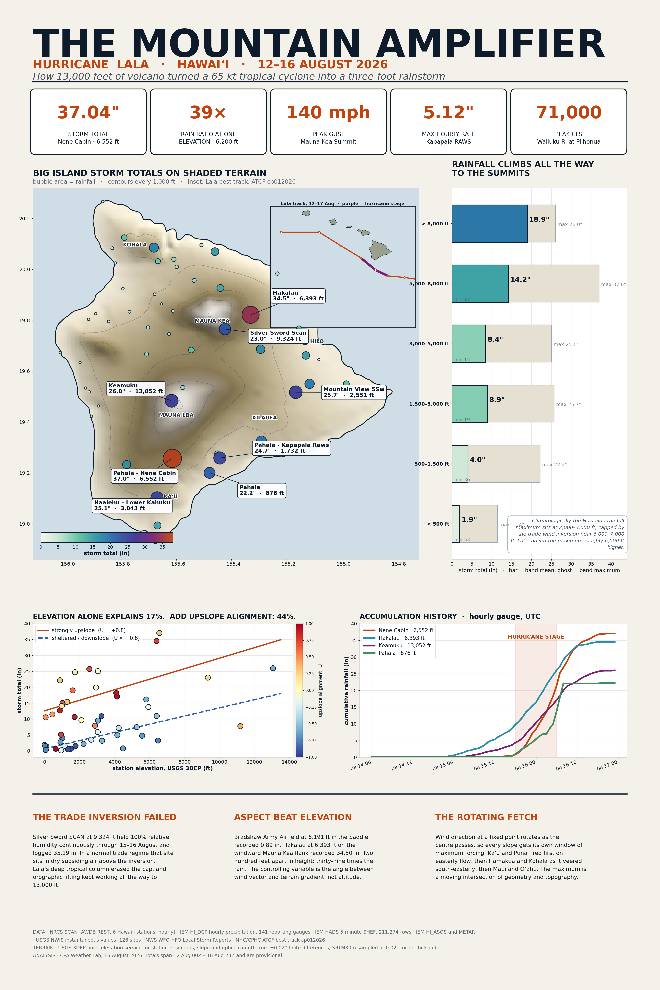
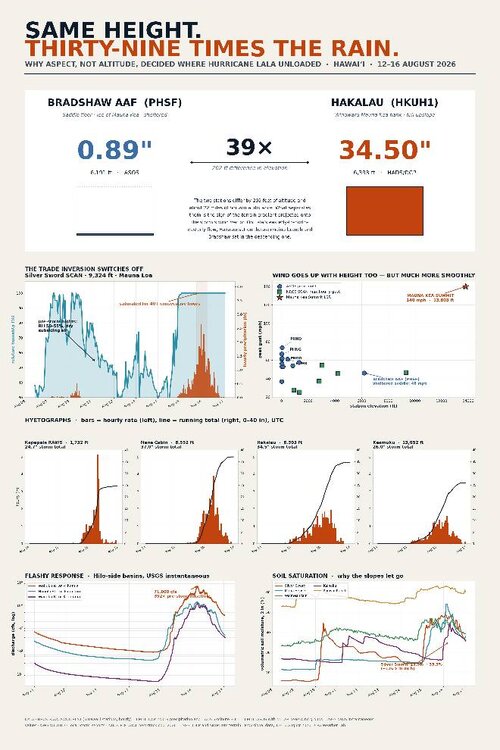
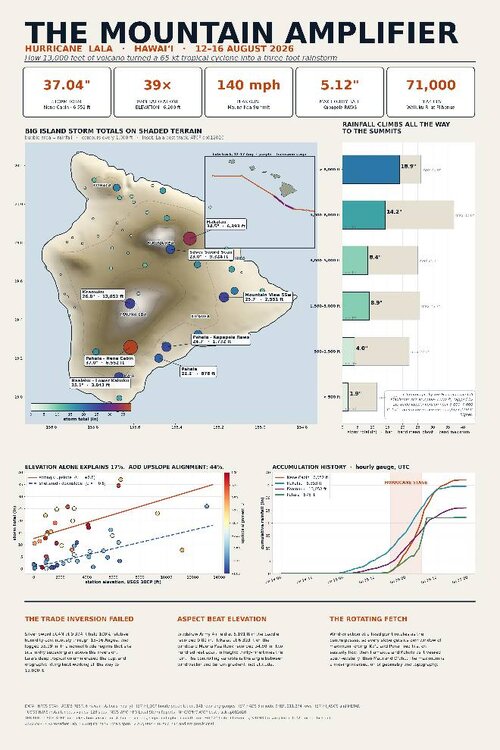
I love Hawaii for being at the same time a hydrologist nightmare and heaven. the duality of existence in 3 infographs Sent from my SM-S731U using Tapatalk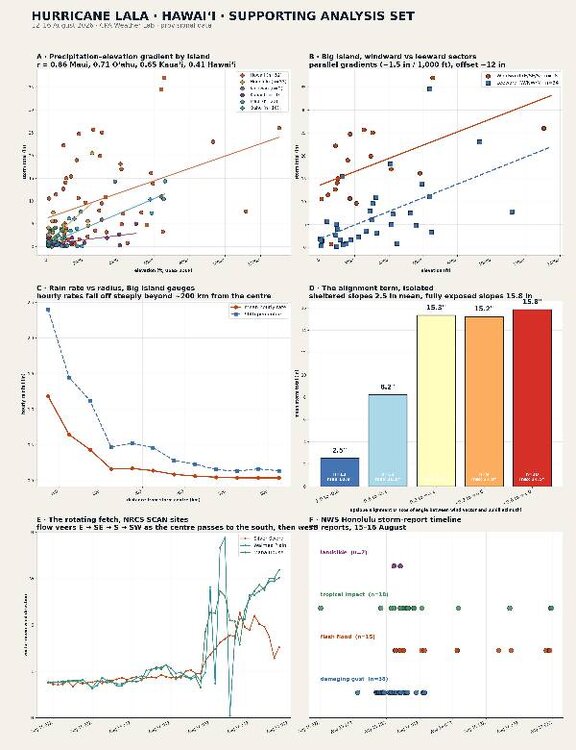
-
Central PA Summer 2026 Discussion/Obs Thread
Jns2183 replied to Voyager's topic in Upstate New York/Pennsylvania
did you see some of the rain totals?? I downloaded a bunch of the networks and saw many 20" to 40" totals. Multiple hours of 2"-5" per hour rates. what's nuts is unless those gauges are weighing gauges, which only a few are, those totals are definite underestimates due to the nature of tipping bucket rain gauges when you have heavy rain and wind Sent from my SM-S731U using Tapatalk -
Central PA Summer 2026 Discussion/Obs Thread
Jns2183 replied to Voyager's topic in Upstate New York/Pennsylvania
I plan to do a whole series of posts in the next week but if anyone wants a little preview I did a big study of Schuylkill County climate and I plan to do the same one for each of the counties around here here is a link to the PDF. https://drive.google.com/file/d/1MHxIs3rJgobWYai4cVpQR4d_XyRf-hFQ/view?usp=drivesdk Sent from my SM-S731U using Tapatalk -
Central PA Summer 2026 Discussion/Obs Thread
Jns2183 replied to Voyager's topic in Upstate New York/Pennsylvania
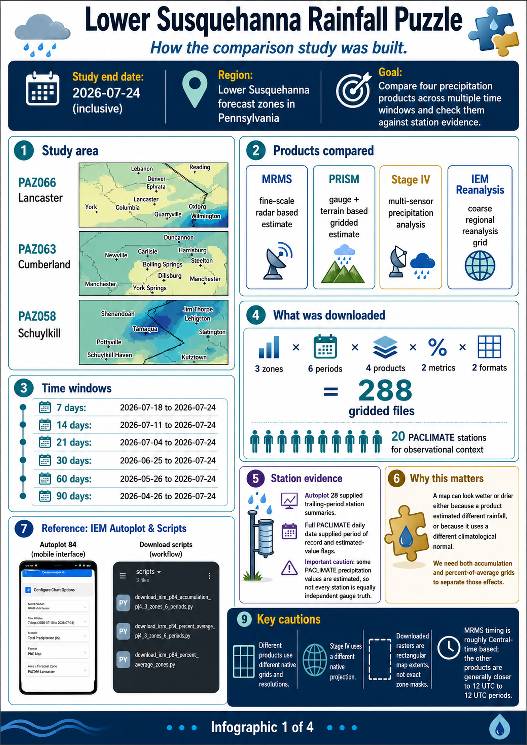
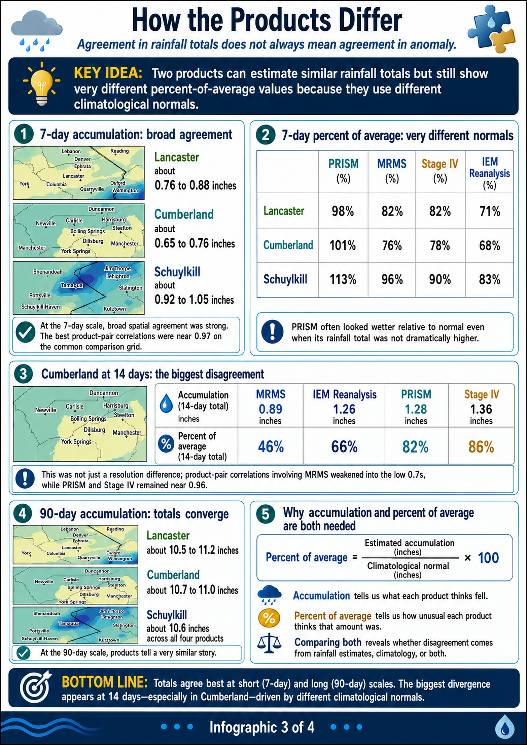
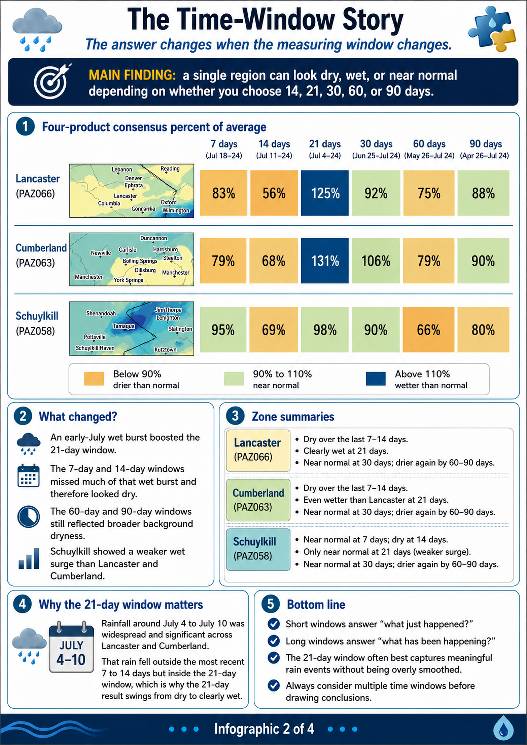
Six Windows, Four Products, One Rainfall Puzzle in the Lower Susquehanna The clearest finding is that the Lower Susquehanna’s apparent wetness depends heavily on the time window being examined. Lancaster and Cumberland looked dry during the most recent seven and fourteen days, but abruptly became wet when the period expanded to twenty-one days. That reversal occurred because the twenty-one-day window captured a substantial rainfall episode around July fourth through July tenth, while the shorter windows missed much of it. By thirty days, both areas were closer to normal, while the sixty- and ninety-day periods still reflected broader background dryness. Schuylkill experienced a weaker early-July wet surge and remained comparatively drier over the longer periods. There was therefore no single honest answer to whether the region was wet or dry without first stating the dates involved. MRMS, PRISM, Stage IV, and IEM Reanalysis generally agreed on the broad placement of wetter and drier areas, particularly over the seven-day period and again by ninety days. Their seven-day accumulation estimates were fairly close, and their ninety-day totals converged to roughly ten and a half to eleven inches across the three forecast-zone domains. The most conspicuous disagreement occurred in Cumberland during the fourteen-day period. MRMS estimated about zero point eight nine inches of precipitation, while IEM Reanalysis estimated about one point two six inches, PRISM about one point two eight inches, and Stage IV about one point three six inches. MRMS was therefore describing a materially drier two-week period, not merely displaying the same rainfall through a different map resolution. The products disagreed more strongly about percent of average than they did about actual rainfall accumulation. PRISM frequently appeared wetter relative to normal even when its estimated rainfall total was similar to the other products. Over seven days, for example, PRISM showed Lancaster near ninety-eight percent of average, Cumberland near one hundred one percent, and Schuylkill near one hundred thirteen percent. IEM Reanalysis showed those same areas near seventy-one, sixty-eight, and eighty-three percent. This demonstrates that some disagreement comes from the climatological normal used by each product rather than from the estimated rainfall itself. Accumulation describes how much precipitation a product believes fell, while percent of average combines that estimate with the product’s own definition of normal. Examining only the anomaly maps would therefore hide whether the argument concerns the rainfall numerator, the climatological denominator, or both. The PACLIMATE station archive provides the observational context needed to determine which product was most accurate, but the station records must also be treated carefully. Stations such as Middletown-Harrisburg, Reading, Harrisburg Airport, Reading Airport, Cashtown, Newport, Mahanoy City, Lebanon, and Harrisburg Eight South-Southwest had little or no estimated precipitation during the recent one-year period and are the strongest starting points for validation. Other series contained many estimated days, including Landisville and the Lower Susquehanna Climate Division, where all three hundred sixty-five recent days were estimated. Those records remain useful for understanding and reproducing PACLIMATE behavior, but they are not equally independent gauge truth. The next analytical step is to mask the grids to the exact forecast-zone boundaries, extract each product at the reliable station locations, and calculate bias, mean absolute error, and root-mean-square error for every time period. Sent from my SM-S731U using Tapatalk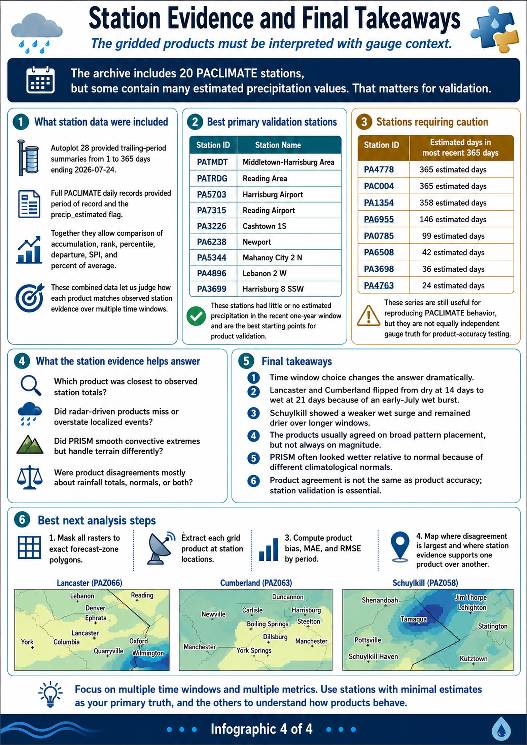
-
Central PA Summer 2026 Discussion/Obs Thread
Jns2183 replied to Voyager's topic in Upstate New York/Pennsylvania
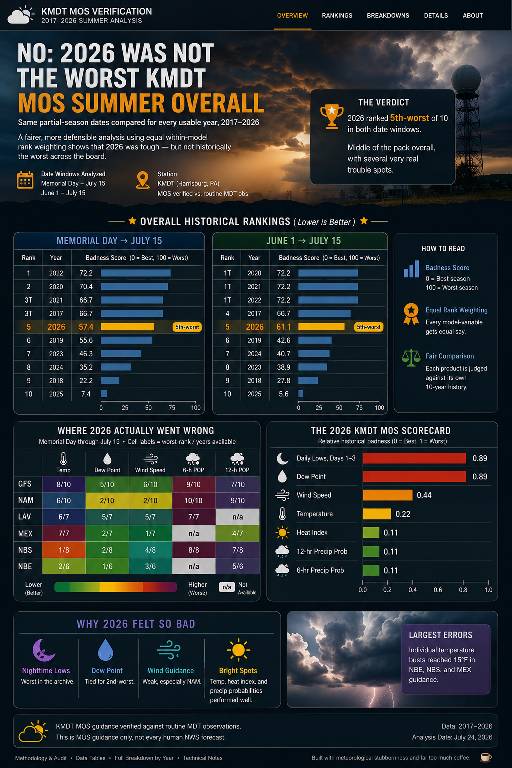
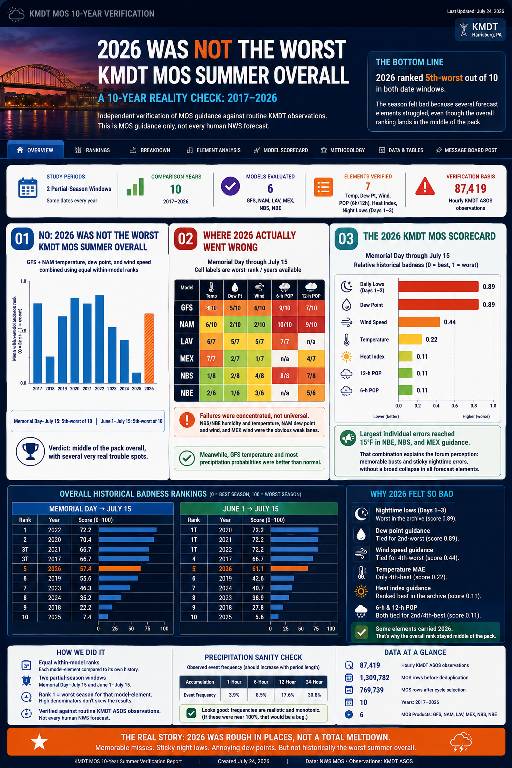
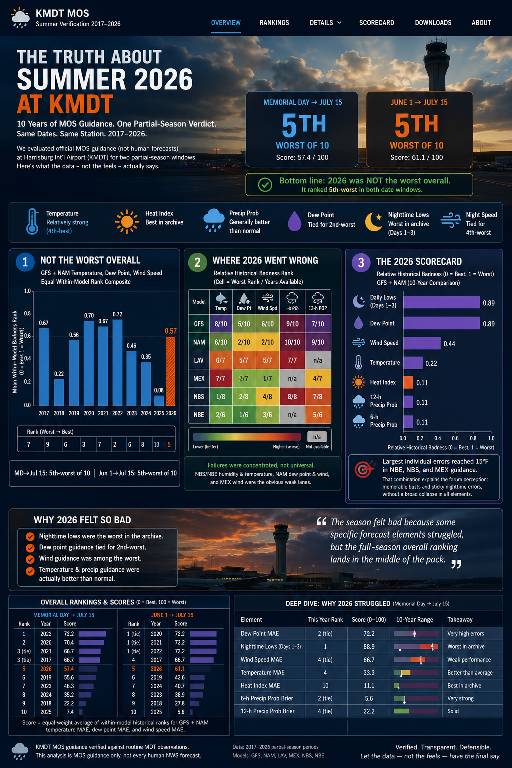
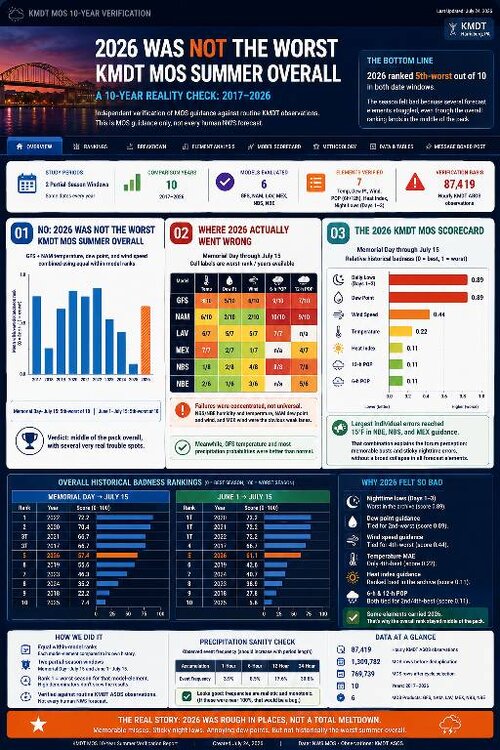
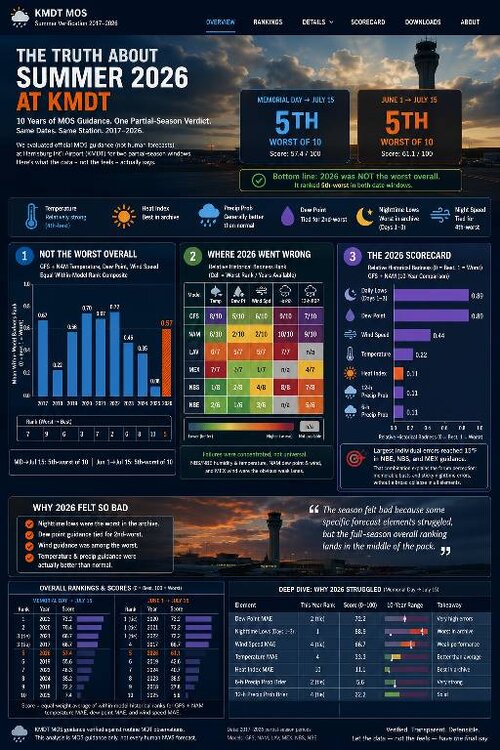
I need some feedback before a website page that's basically a report which is better a, b or c Sent from my SM-S731U using Tapatalk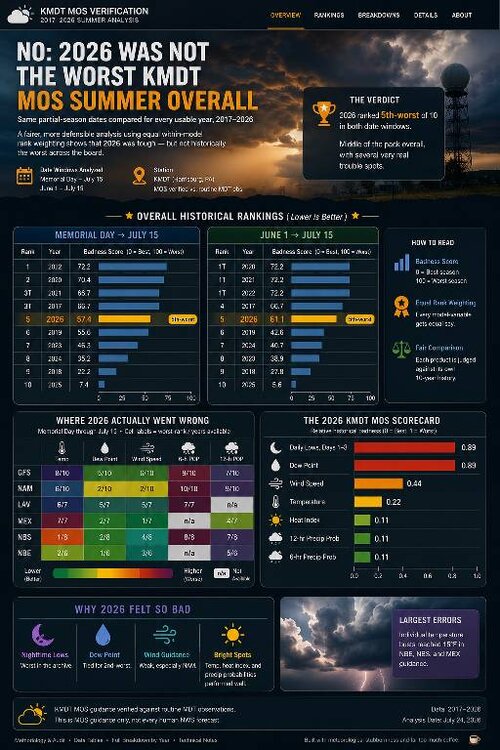
-
Central PA Summer 2026 Discussion/Obs Thread
Jns2183 replied to Voyager's topic in Upstate New York/Pennsylvania
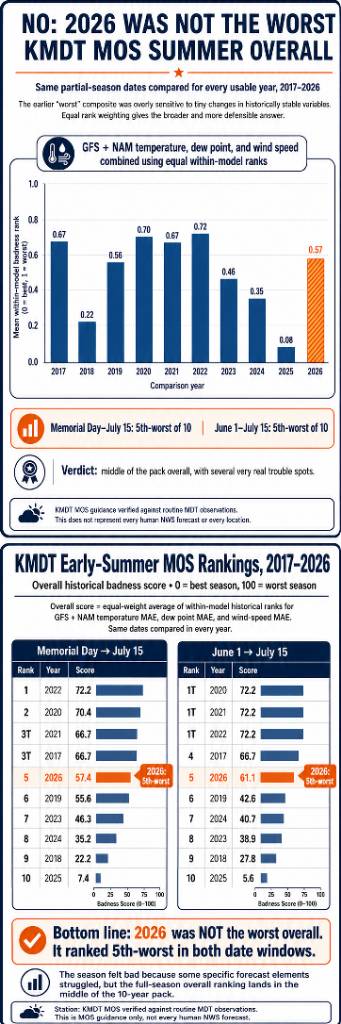
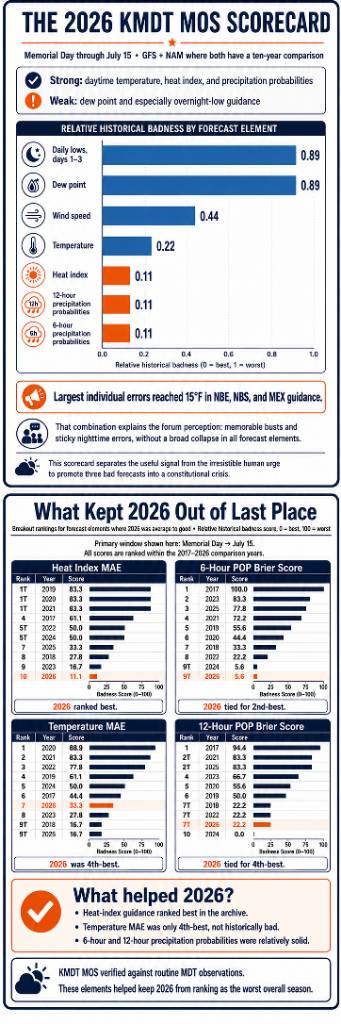
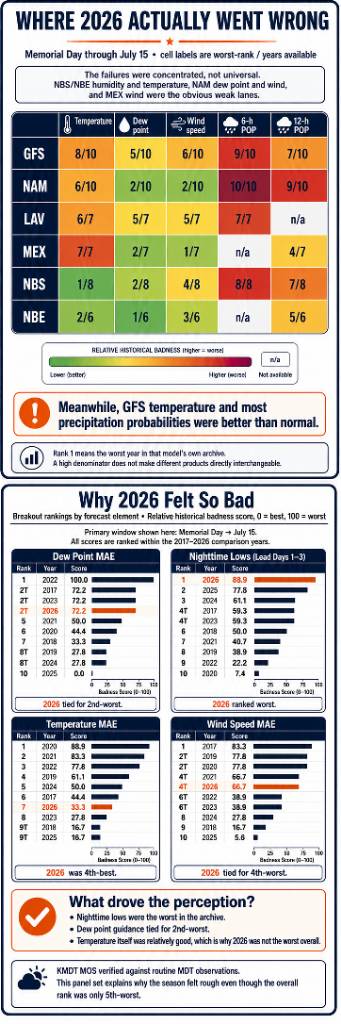
I tested the “worst forecast summer ever” claim by verifying KMDT MOS guidance against routine MDT observations and comparing the same partial-season dates in every usable year from 2017 through 2026. The broad claim does **not** hold up. Using equal within-model ranks for GFS and NAM temperature, dew point, and wind speed, 2026 ranks **5th-worst out of 10** for both Memorial Day–July 15 and June 1–July 15. In other words, this season lands in the middle of the pack overall, not at the bottom of the archive. That does **not** mean the complaints were imagined. Dew-point guidance was poor, overnight-low forecasts were the real train wreck, and several NBS, NBE, and MEX temperature busts reached **15°F**. NAM wind guidance also had some ugly stretches. Meanwhile, daytime temperature guidance, heat-index guidance, and precipitation probabilities were comparatively solid. So this was an **uneven** forecast season, not a universal collapse. Bottom line: **2026 was not the worst overall, but it absolutely had some loud, memorable failure modes**. I attached the infographic panels below Sent from my SM-S731U using Tapatalk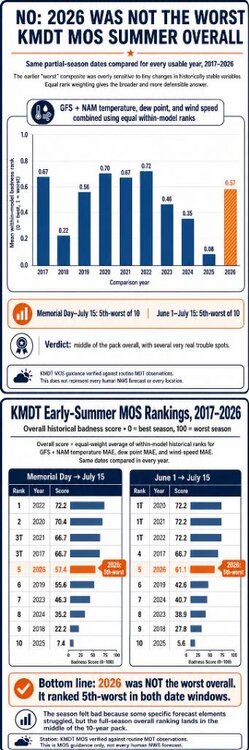
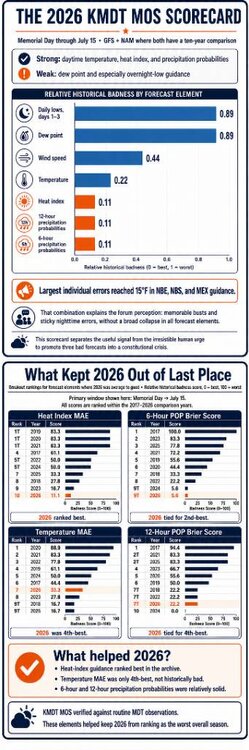
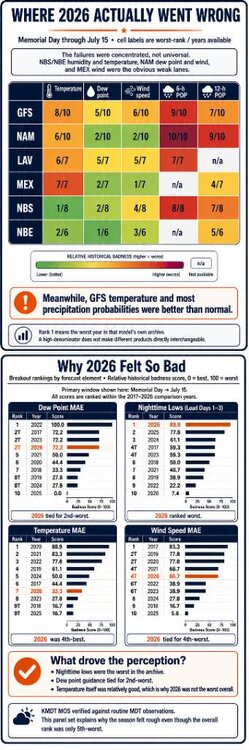
-
Central PA Summer 2026 Discussion/Obs Thread
Jns2183 replied to Voyager's topic in Upstate New York/Pennsylvania
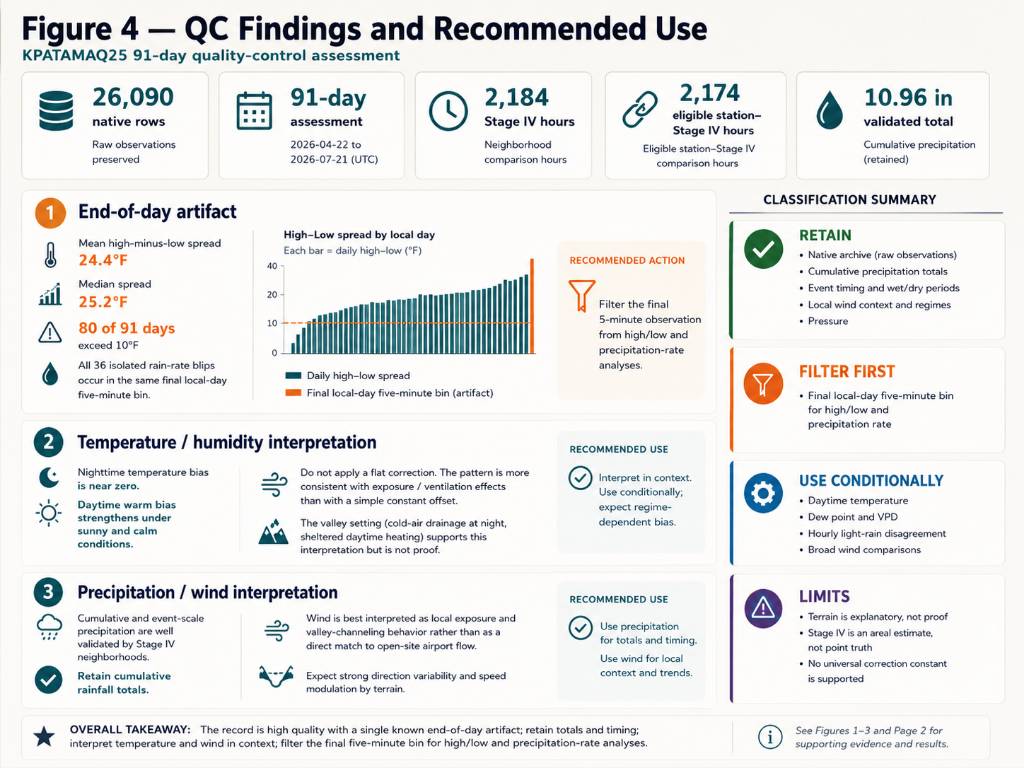
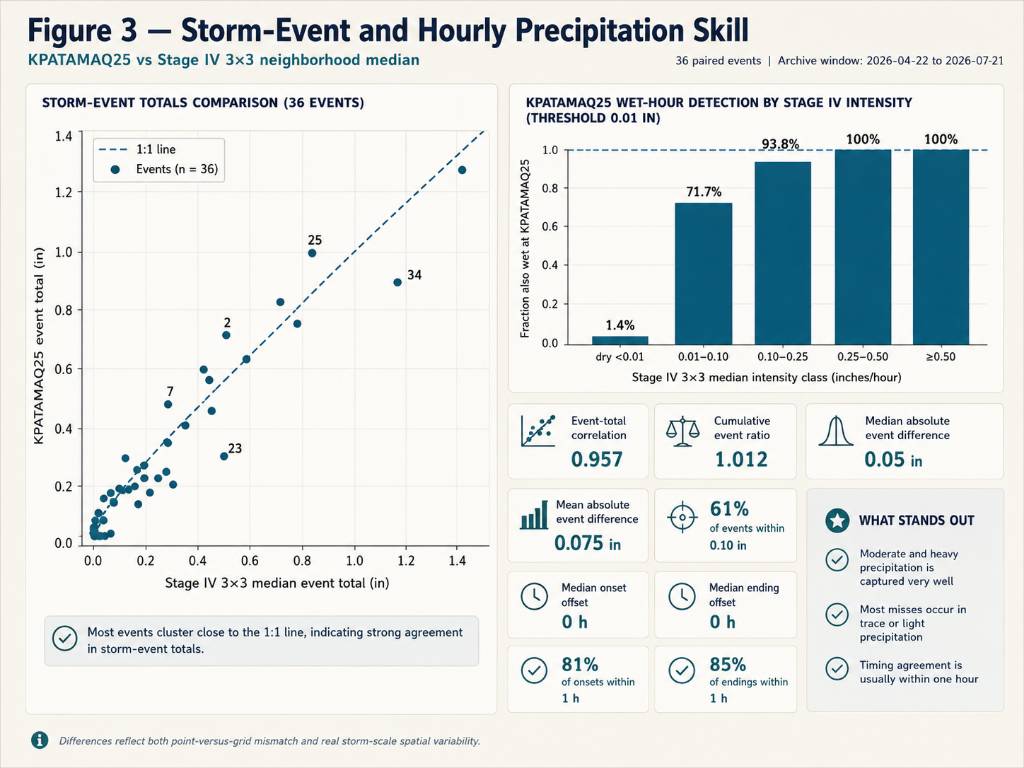
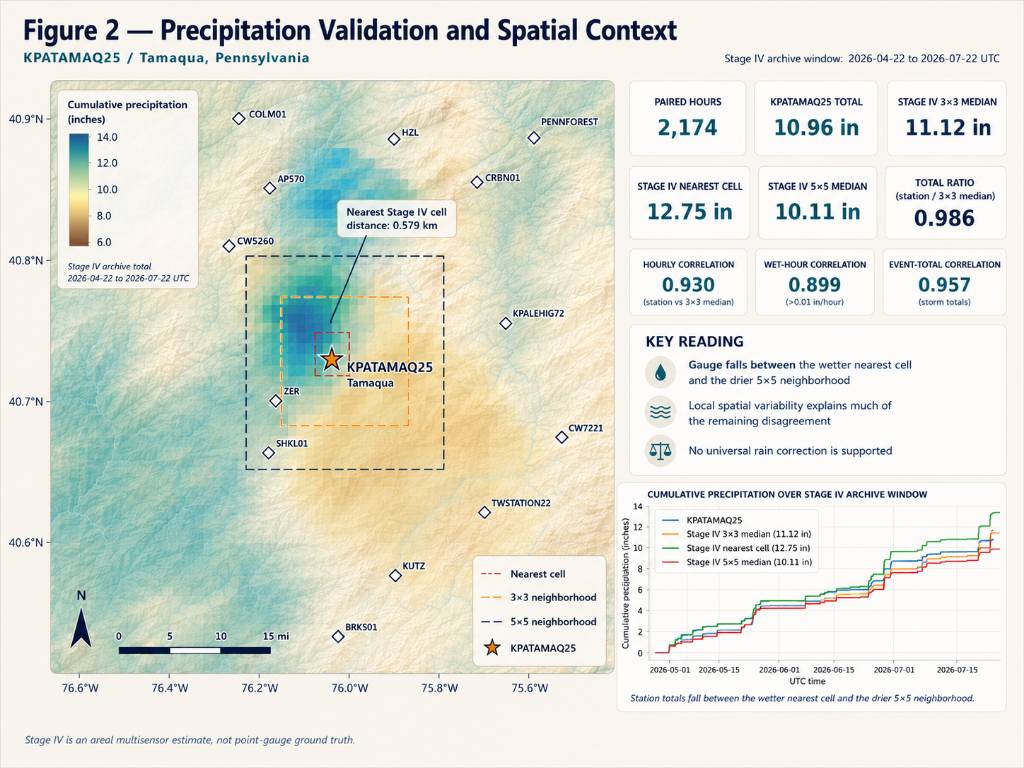
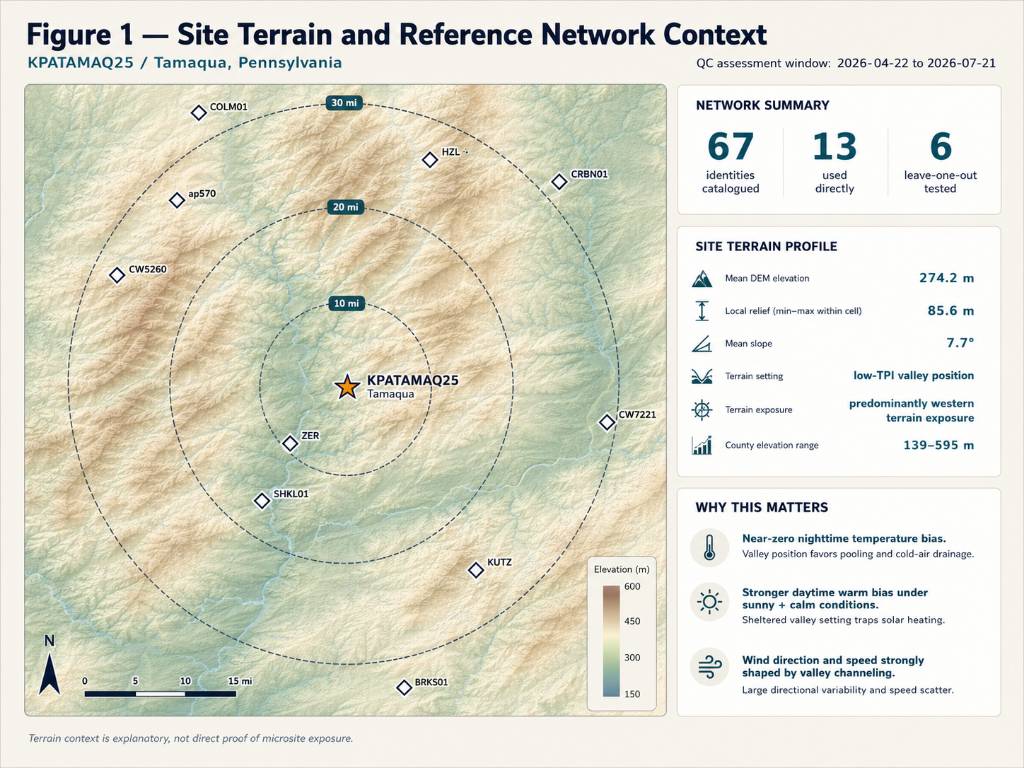
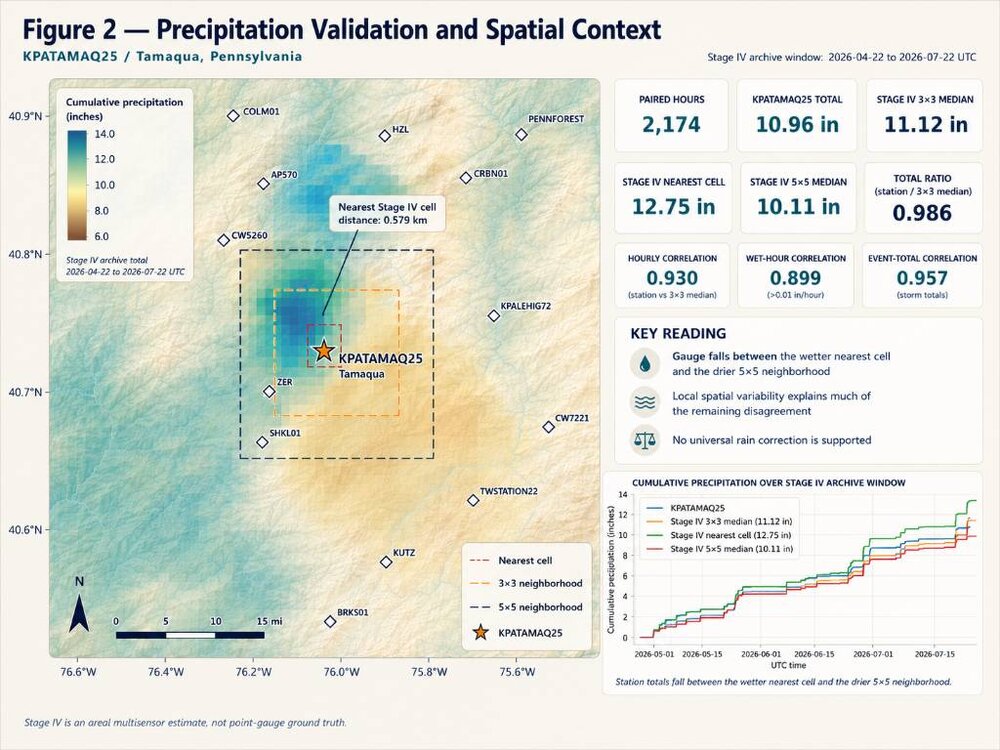
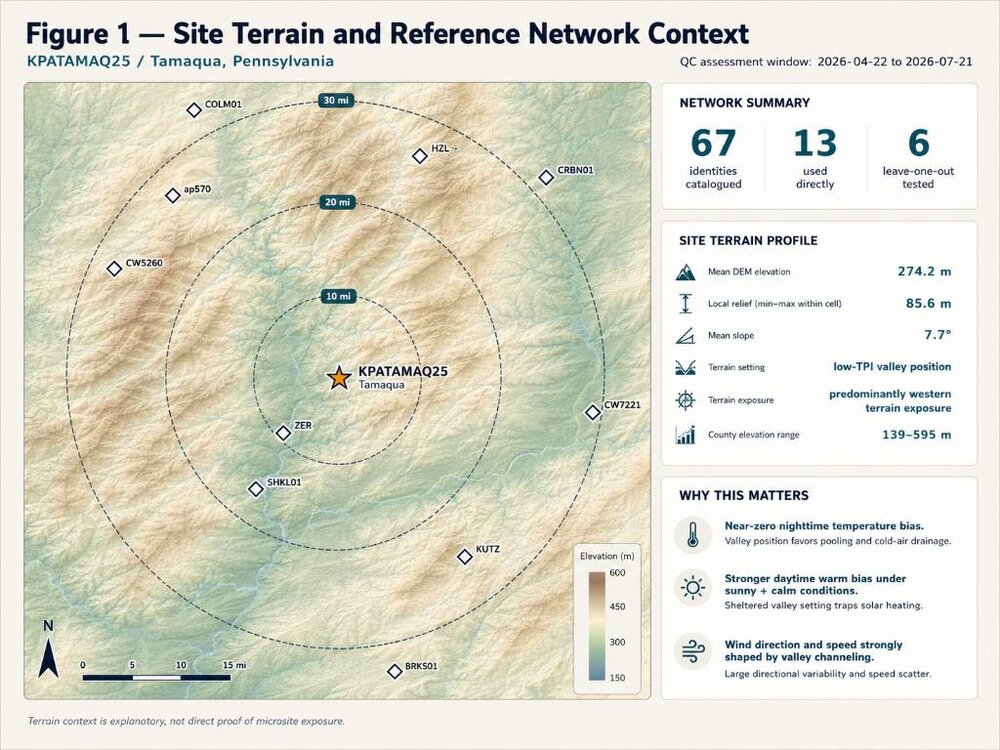
@Voyager Voyager’s Tamaqua Weather Station: A 91-Day QC Autopsy Voyager was kind enough to point me to his station in Tamaqua, so naturally I reacted in the most restrained and proportionate way possible. I downloaded 26,090 five-minute observations, catalogued 67 nearby station identities, untangled duplicate names and aliases, built several reference networks, pulled Pennsylvania Mesonet and ASOS data, aligned PRISM to its actual observation day, extracted 2,184 hourly Stage IV precipitation grids, separated rainfall into storm events, tested nearby personal stations one at a time, and dropped the whole thing onto a 30-meter terrain model. At some point this stopped being “Does Voyager’s thermometer read a little warm?” and became a minor federal research program, except it produced results and nobody had to attend a webinar. The analysis covers April 22 through July 21, 2026, a total of 91 days. The basic method, or how far down the rabbit hole went The core record was the station’s native five-minute archive. I preserved the raw observations and rebuilt hourly and daily values rather than relying entirely on precomputed summaries. For reference data, I used a professional-tier group consisting mainly of four Pennsylvania Mesonet stations, two airport ASOS sites, and one Pennsylvania DEP station. I also tested six nearby personal or CWOP stations against that professional group to see whether they were trustworthy enough to join the comparison. Then came PRISM. PRISM daily data does not use the normal local-calendar day. Its precipitation day ends at 12 UTC, which is 8 AM during daylight time. My first daily comparison used local midnight and briefly suggested that Voyager’s rainfall had almost no relationship to regional precipitation. This would have been a remarkable meteorological discovery. It was instead a timestamp problem. Once I rebuilt everything using the correct 12 UTC boundary, the relationship became extremely strong. The atmosphere was acquitted. The clocks were guilty. I then added NCEP Stage IV precipitation. That gave me 2,184 complete hourly multisensor precipitation fields covering the study period. Rather than comparing Voyager with one arbitrarily chosen grid cell, I extracted: the nearest Stage IV cell, the median of the surrounding 3×3 cells, and the median of the surrounding 5×5 cells. That matters because a rain gauge measures one point, while Stage IV estimates precipitation over an area. Thunderstorms remain stubbornly unwilling to distribute their rain evenly for the convenience of spreadsheets. Finally, I placed the station and reference network onto a real 30-meter digital elevation model of the Tamaqua area. This allowed me to compare the statistical behavior with the actual terrain rather than merely saying “mountains probably did something,” which is the traditional Pennsylvania forecasting method. Finding number one: the station record itself is structurally good The native archive is nearly continuous and passed the basic physical and internal-consistency checks. I did not find widespread impossible temperatures, broken timestamp ordering, random cumulative-rain resets, or the usual assortment of digital woodland creatures that live inside personal weather station archives. There is, however, one extremely clear processing artifact. The final five-minute observation of each local day contains corrupted daily high/low and precipitation-rate information. Across the 91 days: the mean high-minus-low spread in that final observation was 24.4°F, the median spread was 25.2°F, 80 of the 91 days showed a spread greater than 10°F, and all 36 isolated rain-rate blips in the entire record occurred in that same final local-day bin. Every one of them. Once I removed that final observation from precipitation-rate analysis, no isolated rain flickers remained. The genuine rainfall events had coherent multi-interval structure. This does not look like a thermometer or tipping-bucket failure. It looks like the daily summary fields are being folded into the final observation during the local-midnight rollover. The fix is wonderfully simple after all the detective work: Keep the raw archive, but exclude the final local-day five-minute observation from daily high/low and precipitation-rate analyses. Cumulative rainfall totals appear to remain usable. Temperature: good at night, warm under sunshine and weak wind Voyager’s overnight temperatures behaved quite well against the nearby reference network. The nighttime temperature bias was close to zero. The station and surrounding references generally agreed around the morning minimum. The daytime behavior was different. The station tended to run warmer during sunny conditions, and the warm bias increased when the wind was light. Under strong sun and calm conditions, the difference was roughly three degrees greater than during dark or overcast periods. Daily maximum temperatures also ran several degrees warmer than the PRISM estimate, while daily minima were close to unbiased. The timing helps tell the story. Voyager’s station typically reached its afternoon maximum about an hour earlier than the surrounding reference ensemble. That is what I would expect from a sensor environment responding too directly to solar heating or poor ventilation. A simple calibration error would shift the temperature almost equally at noon and at 5 AM. That is not what happened. Therefore, applying one flat temperature correction would be a bad idea. It would improve some sunny afternoons and make the nighttime values worse. My interpretation is: nighttime temperatures are generally reliable, daytime temperatures should be viewed with more caution during sunny and calm periods, and any future adjustment should depend on solar radiation and wind rather than being a fixed number. Humidity, dew point, and vapor-pressure deficit also showed systematic differences and should be used conditionally. They are mathematically tied to temperature, so a solar-heated temperature sensor can spread its mischief into several derived variables. One biased input variable, many exciting downstream consequences. Software engineers call this efficiency. Rainfall: the gauge did very well This was probably the strongest part of the entire station. Across 2,174 eligible station–Stage IV hourly comparisons: Voyager recorded 10.96 inches, the Stage IV 3×3 neighborhood median recorded 11.12 inches, the difference was only 0.16 inch, and the total ratio was 0.986. The hourly correlation with the 3×3 Stage IV median was 0.930. For wet hours only, the correlation was 0.899. When I grouped precipitation into 36 storm events, the event-total correlation rose to 0.957. The cumulative event ratio was 1.012, and the median absolute difference per event was only 0.05 inch. Timing was also good: the median storm-onset difference was zero hours, the median ending-time difference was zero hours, 81% of storm onsets were within one hour, and 85% of endings were within one hour. The station became more reliable as rainfall intensity increased: during Stage IV hours of 0.01–0.10 inch, Voyager also reported rain about 72% of the time, from 0.10–0.25 inch, detection rose to about 94%, and every Stage IV hour above 0.25 inch was detected. In other words, the disagreements were concentrated mainly in drizzle, traces, and highly localized light showers. Moderate and heavy rainfall was captured very well. That is exactly the pattern I would prefer to see. Trace precipitation is where point gauges, radar estimates, hour boundaries, virga, and the general perversity of Appalachian weather all begin arguing. The spatial comparison was especially revealing: nearest Stage IV cell: 12.75 inches, 3×3 median: 11.12 inches, Voyager: 10.96 inches, 5×5 median: 10.11 inches. The gauge falls between a wetter nearby grid cell and a drier broader neighborhood. That tells me the remaining differences are not simply “the gauge is low” or “the radar is high.” The local precipitation field genuinely varied across only a few grid cells. I found no evidence supporting a universal rain multiplier. My conclusion is that Voyager’s cumulative and storm-scale precipitation record is trustworthy, with normal uncertainty during light and highly localized precipitation. One caution: Stage IV is a multisensor areal estimate, not divine revelation descending from the radar dome. It should not be treated as exact point-gauge truth. Wind: local, messy, and behaving exactly like wind Wind was the least transferable variable, which is not the same as saying it was bad. Correlations with the Pennsylvania Mesonet sites were reasonable for stations separated by several miles, while correlations with the more openly exposed airport sites were weaker. Wind-direction differences were often large. That sounds alarming until one remembers where Tamaqua is located. Voyager’s site sits in a valley environment surrounded by complex ridges. Wind near the surface is blocked, redirected, accelerated through openings, and occasionally sent down the wrong hallway by terrain and nearby structures. An airport anemometer on an open field and a residential anemometer inside Appalachian terrain are not measuring quite the same atmosphere. Demanding identical values from them would be like comparing traffic speed on Interstate 81 with traffic speed on a Tamaqua side street and concluding that one speedometer is defective. Voyager’s wind data is useful for: local wind trends, frontal passages, gust timing, calm-versus-mixed regimes, and what the wind is actually doing at his property. It should not be expected to match an airport or ridge-top exposure exactly. Terrain provided the physical explanation The station’s terrain cell has: a mean elevation of about 274 meters, or 900 feet, roughly 86 meters of local relief, an average slope near 7.7 degrees, a low topographic-position value consistent with a valley setting, and predominantly western terrain exposure. That terrain context matches several findings: 1. Nighttime temperatures were close to the references. Valleys favor cold-air drainage and nighttime pooling. 2. The daytime warm bias increased when it was sunny and calm. A sheltered setting can retain locally heated air when ventilation is weak. 3. Wind direction and speed differed substantially from open reference sites. Valley channeling and terrain blocking are expected. This does not prove the exact sensor-level cause. A digital elevation model cannot see the station’s mounting pole, nearby roof, fence, tree, radiation shield, or neighbor who planted an ornamental shrub in precisely the wrong place. But the terrain provides a physically credible setting for the observed behavior. Pressure, solar, and the remaining odds and ends Relative pressure performed very well and was among the cleanest variables in the comparison. I found no reason to change the current pressure setting based on this study. Solar radiation was useful mainly for identifying the temperature bias regime. The station’s available solar field behaved well enough as a timing and peak-intensity indicator, but it was not a clean integrated-energy measurement. I would use it for relative solar conditions rather than treat it as laboratory-grade daily energy. I made no soil-moisture conclusions about Voyager’s station because it does not have a soil-moisture sensor. I studied nearby network soil sensors as context, but eventually resisted the temptation to grade equipment that does not exist. Scientific discipline occasionally survives. Final verdict Voyager does not have a failed station. He has a largely strong station record with: one sharply defined end-of-day processing artifact, a daytime temperature and humidity bias that depends on sunshine and ventilation, precipitation performance that is excellent at the event and seasonal-total scales, wind measurements that represent his immediate valley exposure rather than a regional open-air standard, and pressure data that performs very well. My practical recommendations are straightforward: preserve the native five-minute archive, filter the final local-day five-minute bin from high/low and precipitation-rate work, retain the cumulative rainfall totals, do not apply a flat temperature correction, interpret daytime temperature, humidity, and VPD in the context of sun and wind, and treat wind as a local microscale measurement. After 26,090 observations, 2,184 Stage IV grids, several reference networks, corrected day boundaries, storm-by-storm scoring, and one digital elevation model, my conclusion is reassuringly ordinary: Voyager’s station is good. It simply lives in Tamaqua...... tis was fun Sent from my SM-S731U using Tapatalk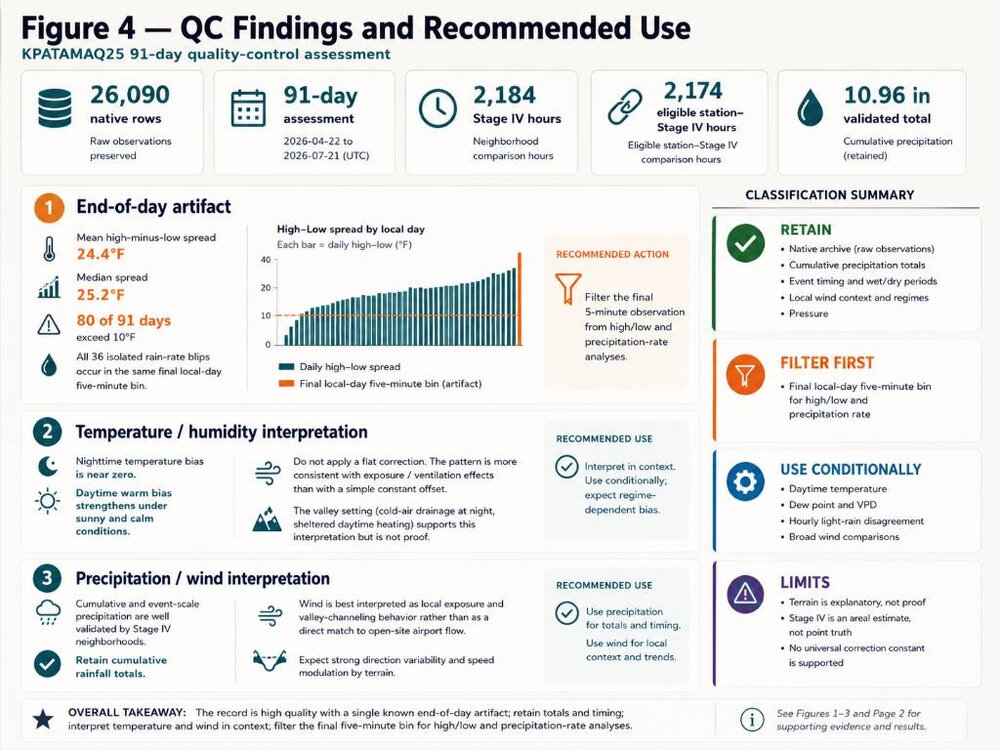
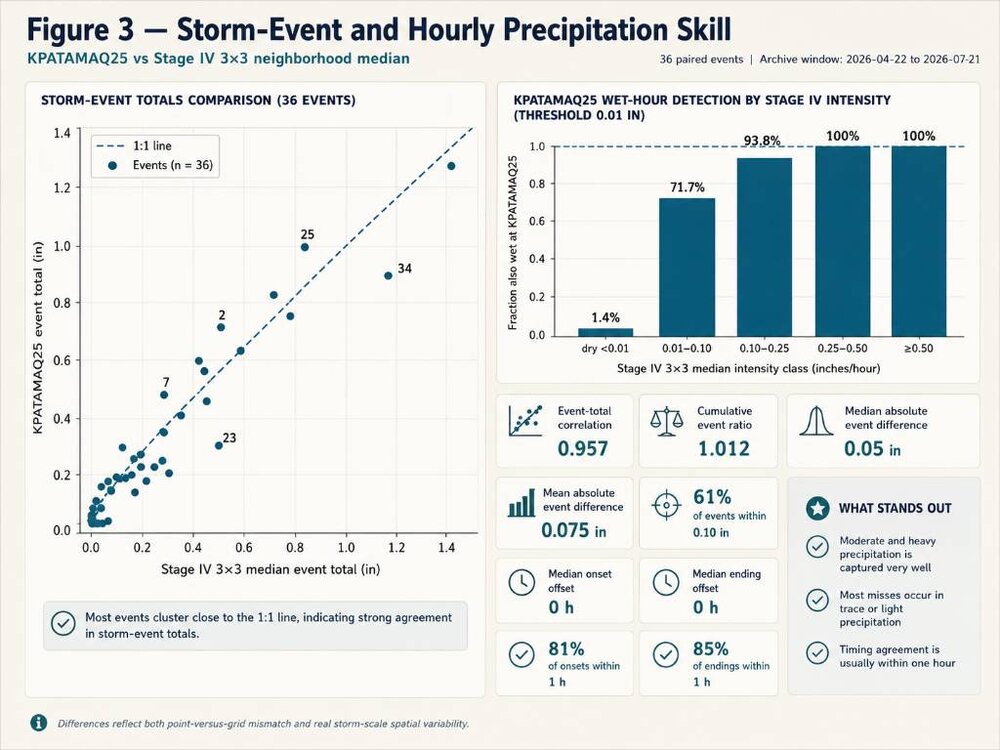
-
Central PA Summer 2026 Discussion/Obs Thread
Jns2183 replied to Voyager's topic in Upstate New York/Pennsylvania
at least it won't be hot these next 10 days because it looks really dry Sent from my SM-S731U using Tapatalk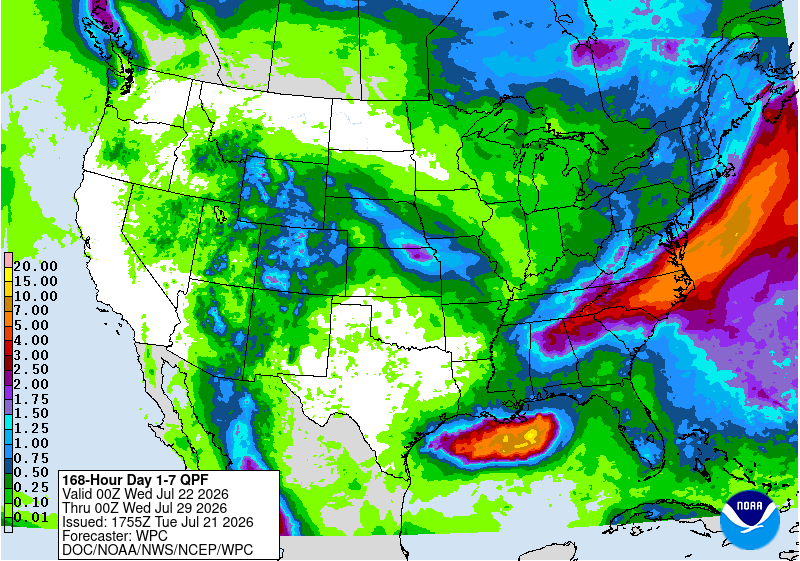
-
Central PA Summer 2026 Discussion/Obs Thread
Jns2183 replied to Voyager's topic in Upstate New York/Pennsylvania
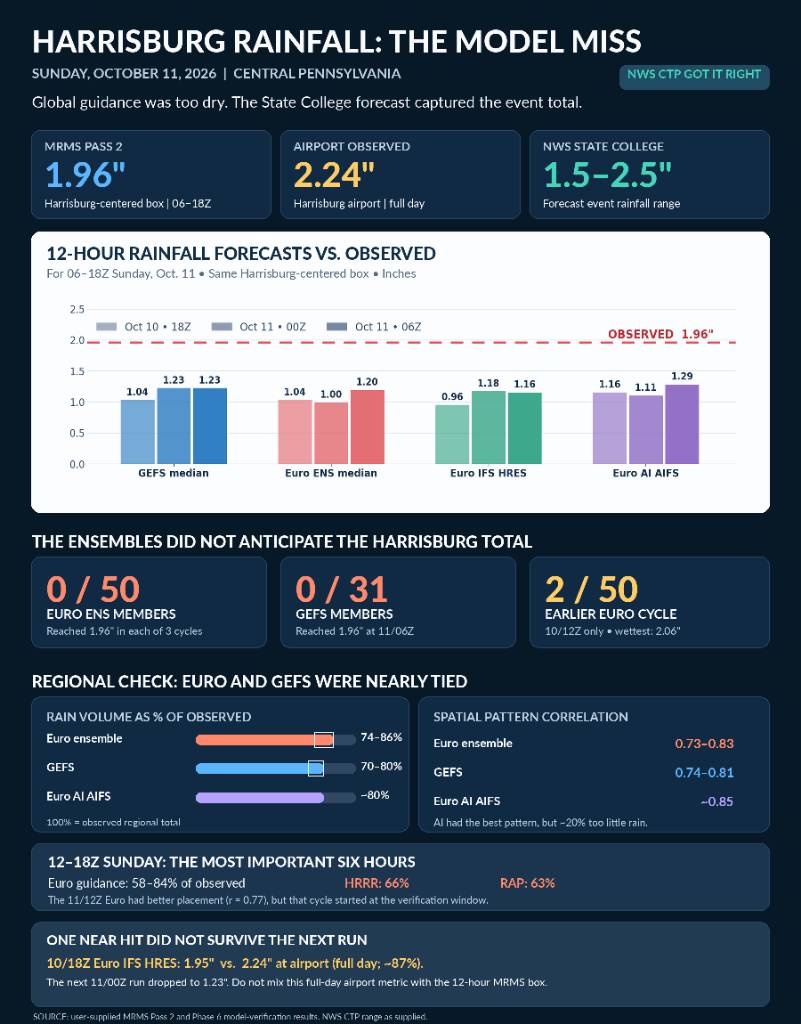
I don't see how we get any more than some light rain. Sent from my SM-S731U using Tapatalk

.jpg.eef30e5085f124b3162760b9ef3c230a.jpg)



.jpg.112d72f291640cfc9dec499b566e51f4.jpg)